

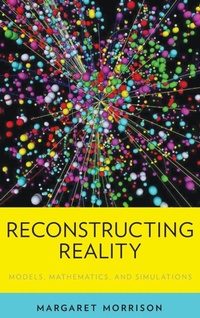
Reconstructing Reality
Models, Mathematics, and Simulations
Published on 29. January 2015
Book
Hardback
344 pages
978-0-19-938027-5 (ISBN)
Description
Attempts to understand various aspects of the empirical world often rely on modelling processes that involve a reconstruction of systems under investigation. Typically the reconstruction uses mathematical frameworks like gauge theory and renormalization group methods, but more recently simulations also have become an indispensable tool for investigation.
This book is a philosophical examination of techniques and assumptions related to modelling and simulation with the goal of showing how these abstract descriptions can contribute to our understanding of the physical world. Particular issues include the role of fictional models in science, how mathematical formalisms can yield physical information, and how we should approach the use of inconsistent models for specific types of systems. It also addresses the role of simulation, specifically the conditions under which simulation can be seen as a technique for measurement, replacing more traditional experimental approaches. Inherent worries about the legitimacy of simulation "knowledge " are also addressed, including an analysis of verification and validation and the role of simulation data in the search for the Higgs boson. In light of the significant role played by simulation in the Large Hadron Collider experiments, it is argued that the traditional distinction between simulation and experiment is no longer applicable in some contexts of modern science. Consequently, a re-evaluation of the way and extent to which simulation delivers empirical knowledge is required.
"This is a, lively, stimulating, and important book by one of the main scholars contributing to current topics and debates in our field. It will be a major resource for philosophers of science, their students, scientists interested in examining scientific practice, and the general scientifically literate public. "-Bas van Fraassen, Distinguished Professor of Philosophy, San Francisco State University
This book is a philosophical examination of techniques and assumptions related to modelling and simulation with the goal of showing how these abstract descriptions can contribute to our understanding of the physical world. Particular issues include the role of fictional models in science, how mathematical formalisms can yield physical information, and how we should approach the use of inconsistent models for specific types of systems. It also addresses the role of simulation, specifically the conditions under which simulation can be seen as a technique for measurement, replacing more traditional experimental approaches. Inherent worries about the legitimacy of simulation "knowledge " are also addressed, including an analysis of verification and validation and the role of simulation data in the search for the Higgs boson. In light of the significant role played by simulation in the Large Hadron Collider experiments, it is argued that the traditional distinction between simulation and experiment is no longer applicable in some contexts of modern science. Consequently, a re-evaluation of the way and extent to which simulation delivers empirical knowledge is required.
"This is a, lively, stimulating, and important book by one of the main scholars contributing to current topics and debates in our field. It will be a major resource for philosophers of science, their students, scientists interested in examining scientific practice, and the general scientifically literate public. "-Bas van Fraassen, Distinguished Professor of Philosophy, San Francisco State University
Reviews / Votes
each chapter can stand alone, contributing an argument or position to a specific question related to modeling, and offering insight into specific instances of modeling through the case studies ... The examples in the book can provide meaningful considerations then for those looking to understand modeling in context, which may be the best way to understand how contemporary science is engaged in the practice of reconstructing reality. * Melissa Jacquart, Science and Education * In sum, Morrison's new book is a rich and provocative contribution to several core debates in current philosophy of science such as explanations and understanding, idealizations, models, and computer simulations. Even if one is not convinced by all of the points that Morrison makes in (what we call) a 'particularist' and 'therapeutic' style, one thing is for sure: if one wants to defend a 'general philosophical account' of some of the discussed topics, then one has to respond to the criticisms forcefully presented in Reconstructing Reality. * Alexander Reutlinger and Stephan Hartmann, British Journal for the Philosophy of Science * Morrison's look at concrete and intricate cases of modeling raises a number of interesting issues, and at places, her piecemeal approach is as refreshing as her claims are thought-provoking. The book thus is a valuable reading for philosophers who work on modeling in physics. * Notre Dame Philosophical Reviews Online * Her limpid exposition and copious use of example in the interpretation of the function of models in different investigative contexts is an essential contribution to the current debate about the role of reconstructive methods in the practice of science ... Highly recommended. * L. C. Archie, CHOICE *More details
Series
Language
English
Place of publication
New York
United States
Target group
College/higher education
Illustrations
9
Dimensions
Height: 235 mm
Width: 157 mm
Thickness: 23 mm
Weight
652 gr
ISBN-13
978-0-19-938027-5 (9780199380275)
Copyright in bibliographic data and cover images is held by Nielsen Book Services Limited or by the publishers or by their respective licensors: all rights reserved.
Schweitzer Classification
Other editions
Additional editions
E-Book
12/2014
1st Edition
OUP eBook
€56.49
Available for download
Person
Margaret Morrison is Professor of Philosophy at the University of Toronto. Her publications span many fields including general philosophy of science, history and philosophy of physics, and the history of early modern philosophy (especially Kant). She has also published articles on methodological issues related to the development of population genetics.
Content
Preface ; Part One: Mathematics, Explanation and Understanding ; Chapter One: Abstraction and Idealisation: Understanding via Models ; Chapter Two: From the Pure to the Concrete: How Mathematics Yields Physical Information ; Part Two: Where Models Meet the World: Problems and Perspectives ; Chapter Three: More than Make-Believe: Fictions, Models and Reality ; Chapter Four: Mediated Knowledge: Representation and The Theory-Model Axis ; Chapter Five: Making the Best of It: Inconsistent vs. Complementary Models ; Part Three: Computer Simulation: The New Reality ; Chapter Six: Why Materiality is Not Enough: Models, Measurement and Computer Simulation ; Chapter Seven: Legitimating Simulation: Methodological Issues of Verification and Validation. ; Chapter Eight: Without it there's Nothing: The Necessity of Simulation in the Higgs Search ; Index