

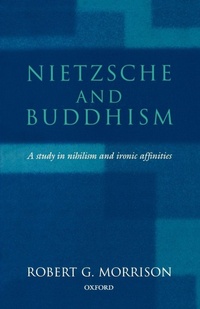
Nietzsche and Buddhism
A Study in Nihilism and Ironic Affinities
Published on 21. January 1999
Book
Paperback/Softback
260 pages
978-0-19-823865-2 (ISBN)
Description
Robert Morrison offers an illuminating comparative study of two linked and interacting traditions that have had great influence in twentieth-century thought: Buddhism and the philosophy of Nietzsche. Nietzsche saw a direct historical parallel between the cultural situation of his own time and of the India of the Buddhas age: the emergence of nihilism as a consequence of loss of traditional belief. Nietzsche's fear, still resonant today, was that Europe was about to enter a nihilistic era in which people, no longer able to believe in the old religious and moral values, would feel themselves adrift in a meaningless cosmos where life seems to have no particular purpose or end. Though he admired Buddhism as a noble and humane response to this situation, Nietzsche came to think that it was wrong in not seeking to overcome nihilism, and constituted a threat to the future of Europe. It was in reaction against nihilism that he forged his own affirmative philosophy, aiming at the transvaluation of all values.
Nietzsche's view of Buddhism has been very influential in the West; Dr Morrison gives a careful critical examination of this view, argues that in fact Buddhism is far from being a nihilistic religion, and offers a counterbalancing Buddhist view of the Nietzschean enterprise. He draws out the affinities and conceptual similarities between the two, and concludes that, ironically, Nietzsche's aim of self-overcoming is akin to the Buddhist notion of citta-bhavana (mind-cultivation). Had Nietzsche lived in an age where Buddhism was better understood, Morrison suggests, he might even have found in the Buddha a model of his hypothetical uebermensch.
'illuminating . . . Nietzsche was a genius, if a very odd one, and the Buddhist practitioner with an interest in philosophy should not neglect him. Morrison's explanatory work can be recommended . . . A paperback edition must be hoped for.' The Middle Way
Nietzsche's view of Buddhism has been very influential in the West; Dr Morrison gives a careful critical examination of this view, argues that in fact Buddhism is far from being a nihilistic religion, and offers a counterbalancing Buddhist view of the Nietzschean enterprise. He draws out the affinities and conceptual similarities between the two, and concludes that, ironically, Nietzsche's aim of self-overcoming is akin to the Buddhist notion of citta-bhavana (mind-cultivation). Had Nietzsche lived in an age where Buddhism was better understood, Morrison suggests, he might even have found in the Buddha a model of his hypothetical uebermensch.
'illuminating . . . Nietzsche was a genius, if a very odd one, and the Buddhist practitioner with an interest in philosophy should not neglect him. Morrison's explanatory work can be recommended . . . A paperback edition must be hoped for.' The Middle Way
Reviews / Votes
'This is an important book; a comparative study which explores convincingly and in detail the remarkable similarities and areas of philosophical agreement between Nietzsche and Buddhism...engagingly written.' * International Journal for Philosophy of Religion *More details
Language
English
Place of publication
Oxford
United Kingdom
Publishing group
Oxford University Press
Target group
Professional and scholarly
Dimensions
Height: 216 mm
Width: 140 mm
Thickness: 16 mm
Weight
377 gr
ISBN-13
978-0-19-823865-2 (9780198238652)
Copyright in bibliographic data and cover images is held by Nielsen Book Services Limited or by the publishers or by their respective licensors: all rights reserved.
Schweitzer Classification
Other editions
Additional editions
Book
05/1997
Oxford University Press
€149.70
Shipment within 15-20 days
Person
Content
PART ONE: NIETZSCHE'S BUDDHISM ; PART TWO: IRONIC AFFINITIES