

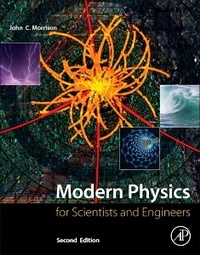
Modern Physics
for Scientists and Engineers
2nd Edition
Published on 4. February 2015
Book
Hardback
448 pages
978-0-12-800734-1 (ISBN)
Description
The second edition of Modern Physics for Scientists and Engineers is intended for a first course in modern physics. Beginning with a brief and focused account of the historical events leading to the formulation of modern quantum theory, later chapters delve into the underlying physics. Streamlined content, chapters on semiconductors, Dirac equation and quantum field theory, as well as a robust pedagogy and ancillary package, including an accompanying website with computer applets, assist students in learning the essential material. The applets provide a realistic description of the energy levels and wave functions of electrons in atoms and crystals. The Hartree-Fock and ABINIT applets are valuable tools for studying the properties of atoms and semiconductors.
More details
Edition
2nd edition
Language
English
Place of publication
San Diego
United States
Publishing group
Elsevier Science Publishing Co Inc
Target group
College/higher education
Physics, Phys Sci & Engineering students
Dimensions
Height: 276 mm
Width: 216 mm
Weight
1450 gr
ISBN-13
978-0-12-800734-1 (9780128007341)
Copyright in bibliographic data and cover images is held by Nielsen Book Services Limited or by the publishers or by their respective licensors: all rights reserved.
Schweitzer Classification
Other editions
New editions
Book
12/2020
3rd Edition
Academic Press
€131.50
Shipment within 10-15 days
Additional editions
E-Book
02/2015
2nd Edition
Academic Press
€78.99
Available for download
Previous edition
Book
12/2009
Academic Press
€85.41
Article exhausted; check for reprint
Person
John Morrison received a BS degree in Physics from University of Santa Clara in California. During his undergraduate years, he majored in English, Philosophy, and Physics and served as the editor of the campus literary magazine, the Owl. Enrolling at Johns Hopkins University in Baltimore, Maryland, he received a PhD degree in theoretical Physics and moved on to postdoctoral research at Argonne National Laboratory where he was a member of the Heavy Atom Group. He then went to Sweden where he received a grant from the Swedish Research Council to build up a research group in theoretical atomic physics at Chalmers Technical University in Goteborg, Sweden. Working together with Ingvar Lindgren, he taught a graduate level-course in theoretical atomic physics for a number of years. Their teaching lead to the publication of the monograph, Atomic Many-Body Theory, which first appeared as Volume 13 of the Springer Series on Chemical Physics. The second edition of this book has become a Springer classic. Returning to the United States, John Morrison obtained a position in the Department of Physics and Astronomy at University of Louisville where he has taught courses in elementary physics, astronomy, modern physics, and quantum mechanics. In recent years, he has traveled extensively in Latin America and the Middle East maintaining contacts with scientists and mathematicians at the Hebrew University in Jerusalem and the Technion University in Haifa. During the Fall semester of 2009, he taught a course on computational physics at Birzeit University near Ramallah on the West Bank, and he has recruited Palestinian students for the graduate program in physics at University of Louisville. He speaks English, Swedish, and Spanish, and he is currently studying Arabic and Hebrew.
Content
1. The Wave-Particle Duality2. The Schrodinger Wave Equation3. Operators and Waves4. Hydrogen Atom5. Many-Electron Atoms6. The Emergence of Masers and Lasers7. Statistical Physics8. Electronic Structure of Solids9. Charge Carriers in Semiconductors10. Semiconductor Lasers11. Relativity I12. Relativity II13. Particles Physics14. Nuclear PhysicsAppendix A: Natural Constants and Conversion ConstantsAppendix B: Table of Atomic MassesAppendix C: Solution of the Oscillator EquationAppendix D: The Average Value of the MomentumAppendix E: The Hartree-Fock AppletAppendix F: Integrals That Arise in Statistical Physics