

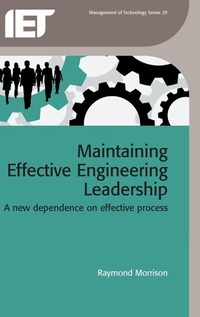
Maintaining Effective Engineering Leadership
A new dependence on effective process
Published on 9. August 2013
Book
Hardback
280 pages
978-1-84919-689-5 (ISBN)
Description
Maintaining Effective Engineering Leadership explores process as a means of maintaining leadership development. The author argues that engineering leadership is the result of the development of four fundamental concepts: personal managerial skills, self-leadership skills, operational leadership skills, and organizational leadership skills. Each is explored in turn, and examples are taken from the space shuttle Columbia disaster to show the importance of these processes and skills, and what can happen when they are ignored. The book introduces the Capability Maturity Model which provides organizations with appropriate processes and knowledge guidelines to ensure effective leadership to avoid such disasters. Topics covered include:
A good process gone bad - setting the stage with the Columbia disaster
The importance of process
Leadership is guiding a process oriented organisation
Maintaining vigilance for product and the need for change
The financial impact on process and operations
How do we change - what do we need to do?
Individual capability
Recommendations for process and capability in today's industries
This book is essential reading for engineers with a management focus (and vice versa) and will find a place on the bookshelves of engineers to use in the continuing development of their personal leadership skills.
A good process gone bad - setting the stage with the Columbia disaster
The importance of process
Leadership is guiding a process oriented organisation
Maintaining vigilance for product and the need for change
The financial impact on process and operations
How do we change - what do we need to do?
Individual capability
Recommendations for process and capability in today's industries
This book is essential reading for engineers with a management focus (and vice versa) and will find a place on the bookshelves of engineers to use in the continuing development of their personal leadership skills.
More details
Series
Language
English
Place of publication
Stevenage
United Kingdom
Target group
College/higher education
Professional and scholarly
Dimensions
Height: 240 mm
Width: 161 mm
Thickness: 19 mm
Weight
592 gr
ISBN-13
978-1-84919-689-5 (9781849196895)
Copyright in bibliographic data and cover images is held by Nielsen Book Services Limited or by the publishers or by their respective licensors: all rights reserved.
Schweitzer Classification
Other editions
Additional editions
E-Book
08/2013
1st Edition
Institution of Engineering and Technology
€115.79
Available for download
Person
Ray Morrison is the President and Principal Consultant of the Marietta, GA. based consulting firm, ACETS. He has a distinguished career working in engineering education, including work for Lockheed Martin Aeronautics Company's Lockheed Technical Institute, Georgia Institute of Technology, Los Alamos National Laboratory, the States of Georgia and Arkansas and University of New Mexico. He is the recipient of the EPDA National Fellowship; awarded by the U.S. Department of Education, the State of New Mexico and the University of Missouri, for excellence and scholarship in Technical Education. He has been an active member of the Society of Automotive Engineers, the Society for Manufacturing Engineers and the American Society for Engineering Education, where he is a Fellow and recipient of the Distinguished Service Award. Dr Morrison's publications include Developing Effective Engineering Leadership published by the IET.
Content
Chapter 1: A good process gone bad: setting the stage with the Columbia disaster
Chapter 2: The importance of processes
Chapter 3: Leadership is guiding a process-oriented organisation
Chapter 4: Maintaining product vigilance and the need for change
Chapter 5: The financial impact on process and operations
Chapter 6: How do we change - what do we need to do?
Chapter 7: Individual capability
Chapter 8: Recommendations for process and capability in today's industries
Appendix
Chapter 2: The importance of processes
Chapter 3: Leadership is guiding a process-oriented organisation
Chapter 4: Maintaining product vigilance and the need for change
Chapter 5: The financial impact on process and operations
Chapter 6: How do we change - what do we need to do?
Chapter 7: Individual capability
Chapter 8: Recommendations for process and capability in today's industries
Appendix