

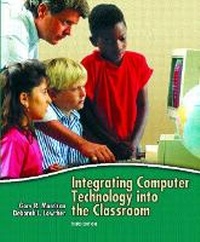
Integrating Computer Technology into the Classroom
3rd Edition
Published on 1. July 2004
Book
Hardback
432 pages
978-0-13-142116-5 (ISBN)
Description
For courses in Computers in Education and Instructional Media and Technology.
This computers in education textbook is constructed around a constructivist lesson-planning model. This text helps prospective teachers understand the potential of using computers in the classroom and develop new methods for using computers. The authors provide a rationale for integrating computers into the classroom curriculum by usign them as tool, rather than just an instructional delivery device. Accessible even for students with minimal computer skills-using a mouse, using menus, and opening/creating/saving documents. Coverage is aligned with ISTE guidelines and structured around the ten-step NTeQ (iNtegrating Technology for inQuiry) model for developing and implementing integrated lesson plans. Word processing, spreadsheets, databases, publishing software, the Internet, and educational software are all explored, with the goal of demonstrating how to determine whether or not computers should be used and how best to use them.
This computers in education textbook is constructed around a constructivist lesson-planning model. This text helps prospective teachers understand the potential of using computers in the classroom and develop new methods for using computers. The authors provide a rationale for integrating computers into the classroom curriculum by usign them as tool, rather than just an instructional delivery device. Accessible even for students with minimal computer skills-using a mouse, using menus, and opening/creating/saving documents. Coverage is aligned with ISTE guidelines and structured around the ten-step NTeQ (iNtegrating Technology for inQuiry) model for developing and implementing integrated lesson plans. Word processing, spreadsheets, databases, publishing software, the Internet, and educational software are all explored, with the goal of demonstrating how to determine whether or not computers should be used and how best to use them.
More details
Edition
3rd edition
Language
English
Place of publication
United States
Publishing group
Pearson Education (US)
Target group
Professional and scholarly
Dimensions
Height: 234 mm
Width: 194 mm
Thickness: 16 mm
Weight
644 gr
ISBN-13
978-0-13-142116-5 (9780131421165)
Copyright in bibliographic data and cover images is held by Nielsen Book Services Limited or by the publishers or by their respective licensors: all rights reserved.
Schweitzer Classification
Other editions
New editions
Gary R. Morrison | Deborah L. Lowther
Integrating Computer Technology into the Classroom
Skills for the 21st Century (with MyEducationLab)
Book
11/2010
4th Edition
Pearson
€120.86
Article is exhausted; no reprint
Gary R. Morrison | Deborah L. Lowther
Integrating Computer Technology into the Classroom
Skills for the 21st Century
Book
01/2010
4th Edition
Pearson
€125.14
Article is exhausted; no reprint
Previous edition
Gary R. Morrison | Deborah L. Lowther
Integrating Computer Technology into the Classroom
Book
06/2001
2nd Edition
Pearson
€44.56
Article exhausted; check for reprint
Persons
Gary R. Morrison received his doctorate in Instructional Systems Technology from Indiana University. Since then, he has worked as instructional designer at the University of Mid-America, Solar Turbines International, General Electric Company's Corporate Consulting Group, and Tenneco Oil Company. As a professor at the University of Memphis, he taught courses in instructional design and served as a faculty associate in the Center of Academic Excellence. Presently, he is a professor in the Instructional Design and Technology Program at Old Dominion University, where he teaches courses in instructional design and distance learning. His credits include print projects, multimedia projects, and more than 30 hours of instructional video programs, including a rive-part series that was aired nationally on PBS-affiliated stations.
Dr. Morrison has written more than 100 papers on topics related to instructional design and computer-based instruction and has contributed to several books and instructional software packages. He is co-author of Designing Effective Instruction with Steven M. Ross and Jerold E. Kemp. He is the associate editor of the research section of Educational Technology Research and Development and past president of AEC:T's Research and Theory Division, and Design and Development Division.
Deborah L. Lowther received her Ph.D. in Educational Technology from Arizona State University. Before completing her doctoral work, she was a seventh-grade science teacher. She is currently an associate professor in the Department of Instruction and Curriculum Leadership at the University of Memphis. Her area of concentration is Instructional Design and Technology. She teaches courses primarily focused toward preparing preservice and inservice teachers to integrate computer technology into their curriculum. She also teaches courses that lead to state certification in instructional computing applications. Her research is centered on factors influencing the integration of technology into various learning environments. Over the past 8 years, Dr. Lowther has been very involved with technology integration from the international to the local level. Her involvement includes conference presentations; co-guest editing Technology in the K-12 Schools, a special edition of a national journal; working with multiple grants focused toward technology integration; providing professional development to K-12 schools across the nation. She is currently the Principal Investigator of Professional Development for the Appalachian Technology in Education Consortium.
Dr. Morrison has written more than 100 papers on topics related to instructional design and computer-based instruction and has contributed to several books and instructional software packages. He is co-author of Designing Effective Instruction with Steven M. Ross and Jerold E. Kemp. He is the associate editor of the research section of Educational Technology Research and Development and past president of AEC:T's Research and Theory Division, and Design and Development Division.
Deborah L. Lowther received her Ph.D. in Educational Technology from Arizona State University. Before completing her doctoral work, she was a seventh-grade science teacher. She is currently an associate professor in the Department of Instruction and Curriculum Leadership at the University of Memphis. Her area of concentration is Instructional Design and Technology. She teaches courses primarily focused toward preparing preservice and inservice teachers to integrate computer technology into their curriculum. She also teaches courses that lead to state certification in instructional computing applications. Her research is centered on factors influencing the integration of technology into various learning environments. Over the past 8 years, Dr. Lowther has been very involved with technology integration from the international to the local level. Her involvement includes conference presentations; co-guest editing Technology in the K-12 Schools, a special edition of a national journal; working with multiple grants focused toward technology integration; providing professional development to K-12 schools across the nation. She is currently the Principal Investigator of Professional Development for the Appalachian Technology in Education Consortium.
Content
Preface.
1. Rethinking Computers and Instruction.
2. NTeQ: A Research-Based Model.
3. Teacher as Designer I: Teacher's Toolbox.
4. Teacher as Designer II: Teacher's Lesson Planning.
5. Word Processing.
6. Spreadsheets.
7. Databases.
8. Publishing and Presentation.
9. The Internet in the Classroom.
10. Educational Software.
11. Implementation: From Plan to Action.
12. Teacher as Facilitator.
13. Managing the Classroom.
14. The Role of Assessment.
Appendix.
1. Rethinking Computers and Instruction.
2. NTeQ: A Research-Based Model.
3. Teacher as Designer I: Teacher's Toolbox.
4. Teacher as Designer II: Teacher's Lesson Planning.
5. Word Processing.
6. Spreadsheets.
7. Databases.
8. Publishing and Presentation.
9. The Internet in the Classroom.
10. Educational Software.
11. Implementation: From Plan to Action.
12. Teacher as Facilitator.
13. Managing the Classroom.
14. The Role of Assessment.
Appendix.