

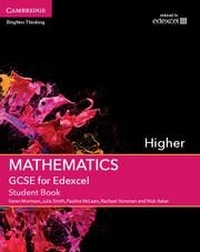
GCSE Mathematics for Edexcel Higher Student Book
Published on 21. May 2015
Book
Paperback/Softback
767 pages
978-1-107-44800-1 (ISBN)
Description
A new series of bespoke, full-coverage resources developed for the 2015 GCSE Mathematics qualifications. Endorsed for the Edexcel GCSE Mathematics Higher tier specification for first teaching from 2015, this Student Book provides full coverage of the new GCSE Mathematics qualification. With a strong focus on developing problem-solving skills, reasoning and fluency, it helps students understand concepts, apply techniques, solve problems, reason, interpret and communicate mathematically. Written by experienced teachers, it also includes a solid breadth and depth of quality questions set in a variety of contexts. GCSE Mathematics Online - an enhanced digital resource incorporating progression tracking - is also available, as well as a free Teacher's Resource, Problem-solving Books and Homework Books.
More details
Series
Language
English
Place of publication
Cambridge
United Kingdom
Target group
Primary & secondary/elementary & high school
Product notice
Paperback (trade)
Illustrations
Worked examples or Exercises
Dimensions
Height: 277 mm
Width: 220 mm
Thickness: 31 mm
Weight
1864 gr
ISBN-13
978-1-107-44800-1 (9781107448001)
Copyright in bibliographic data and cover images is held by Nielsen Book Services Limited or by the publishers or by their respective licensors: all rights reserved.
Schweitzer Classification
Content
Introduction; 1. Calculations; 2. Shapes and solids; 3. 2D representations of 3D shapes; 4. Properties of whole numbers; 5. Introduction to algebra; 6. Fractions; 7. Decimals; 8. Powers and roots; 9. Rounding, estimation and accuracy; 10. Mensuration; 11. Perimeter; 12. Area; 13. Further algebra; 14. Surds; 15. Equations; 16. Functions and sequences; 17. Formulae; 18. Volume and surface area; 19. Percentages; 20. Ratio; 21. Probability basics; 22. Construction and loci; 23. Vectors; 24. Straight-line graphs; 25. Graphs of functions and equations; 26. Angles; 27. Circles; 28. Probability - combined events; 29. Standard form; 30. Similarity; 31. Congruence; 32. Pythagoras' theorem; 33. Trigonometry; 34. Growth and decay; 35. Proportion; 36. Algebraic inequalities; 37. Sampling and representing data; 38. Data analysis; 39. Interpretation of graphs; 40. Transformations; 41. Transforming curves; Glossary; Index; Acknowledgements.