

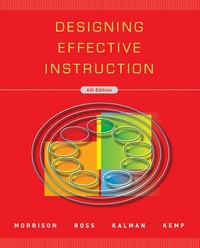
Designing Effective Instruction
6th Edition
Published on 12. March 2010
Book
Paperback/Softback
492 pages
978-0-470-52282-0 (ISBN)
Description
Updated and revised, the sixth edition equips educators with practical skills for successful instructional design. Two new chapters have been added to offer the most current information in the field. One addresses the unique design challenges and opportunities when working with different technologies. It also illustrates how to apply and adapt the design model when working with these technologies. The other presents a combination of information on the ID proposal and project management. A new section also discusses the alternatives to the traditional design process. In addition, educators will find more information about the role of the designer, which they'll be able to apply in the classroom.
More details
Edition
6., Auflage
Language
English
Place of publication
Chichester
United Kingdom
Publishing group
John Wiley and Sons Ltd
Target group
Professional and scholarly
Edition type
Revised edition
Illustrations
Illustrations
Dimensions
Height: 23.8 cm
Width: 19.1 cm
Thickness: 20 mm
Weight
802 gr
ISBN-13
978-0-470-52282-0 (9780470522820)
Schweitzer Classification
Other editions
Previous edition

Gary R. Morrison | Steven M. Ross | Jerrold E. Kemp
Designing Effective Instruction
Book
11/2006
5th Edition
Wiley
€53.22
Article exhausted; check for reprint
Content
Chapter 1: Introduction to the Instructional Design Process.
Chapter 2: Identifying the Need for Instruction.
Chapter 3: Learner and Contextual Analysis.
Chapter 4: Task Analysis.
Chapter 5: Instructional Objectives.
Chapter 6: Designing the Instruction: Sequencing.
Chapter 7: Designing the Instruction: Strategies.
Chapter 8: Designing the Instructional Message.
Chapter 9: Developing Instructional Materials.
Chapter 10: Design Considerations for Technology-Based Instruction.
Chapter 11: The Many Faces of Evaluation.
Chapter 12: Developing Evaluation Instruments.
Chapter 13: Using Evaluation to Enhance Programs: Conducting Formative and Summative Evaluations.
Chapter 14: Learning Theory and Instructional Theory.
Chapter 15: Planning for Instructional Implementation.
Chapter 16: Instructional Design Project Management.
Appendix A: Sample Design Document.
Appendix B: Sample Unit.
Chapter 2: Identifying the Need for Instruction.
Chapter 3: Learner and Contextual Analysis.
Chapter 4: Task Analysis.
Chapter 5: Instructional Objectives.
Chapter 6: Designing the Instruction: Sequencing.
Chapter 7: Designing the Instruction: Strategies.
Chapter 8: Designing the Instructional Message.
Chapter 9: Developing Instructional Materials.
Chapter 10: Design Considerations for Technology-Based Instruction.
Chapter 11: The Many Faces of Evaluation.
Chapter 12: Developing Evaluation Instruments.
Chapter 13: Using Evaluation to Enhance Programs: Conducting Formative and Summative Evaluations.
Chapter 14: Learning Theory and Instructional Theory.
Chapter 15: Planning for Instructional Implementation.
Chapter 16: Instructional Design Project Management.
Appendix A: Sample Design Document.
Appendix B: Sample Unit.