

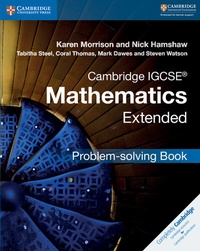
Cambridge IGCSE (R) Mathematics Extended Problem-solving Book
Published on 23. March 2017
Book
Paperback/Softback
264 pages
978-1-316-64352-5 (ISBN)
Description
Revised edition of the IGCSE Mathematics Core and Extended Coursebook for the 0580 syllabus for examination from 2015. The Cambridge IGCSE (R) Mathematics Extended Problem-solving Book delivers a range of problems with fully worked solutions that develop students' mathematical thought. The resource gives students the opportunity to practise the range of mathematics skills covered in the Cambridge IGCSE Mathematics (0580) syllabus. The questions in the book encourage students to think widely about how to apply their knowledge to a broad range of tasks and problems. These help develop mathematical logic and key skills, such as reasoning, interpreting, estimating and communicating mathematically.
More details
Series
Language
English
Place of publication
Cambridge
United Kingdom
Target group
Primary & secondary/elementary & high school
US School Grade: From Sixth Grade to Seventh Grade, Interest Age: From 16 to 17 years
Product notice
Paperback (trade)
Illustrations
Worked examples or Exercises
Dimensions
Height: 276 mm
Width: 219 mm
Thickness: 13 mm
Weight
670 gr
ISBN-13
978-1-316-64352-5 (9781316643525)
Copyright in bibliographic data and cover images is held by Nielsen Book Services Limited or by the publishers or by their respective licensors: all rights reserved.
Schweitzer Classification
Content
Introduction; Problem-solving Strategies: 1. Draw a diagram; 2. Work back from what you know; 3. Change your point of view; 4. Simplify the problem; 5. Consider different cases; 6. Make connections; 7. Use logical reasoning; 8. Use equations, formulae or ratios; 9. Organise data and work systematically; 10. Guess, test and improve; 11. Put it together; Worked Solutions: 1. Draw a diagram; 2. Work back from what you know; 3. Change your point of view; 4. Simplify the problem; 5. Consider different cases; 6. Make connections; 7. Use logical reasoning; 8. Use equations, formulae or ratios; 9. Organise data and work systematically; 10. Guess, test and improve; 11. Put it together