

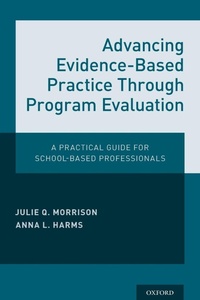
Advancing Evidence-Based Practice Through Program Evaluation
A Practical Guide for School-Based Professionals
Published on 5. April 2018
Book
Paperback/Softback
216 pages
978-0-19-060910-8 (ISBN)
Description
Given the current climate of results-driven accountability, school-based professionals have a significant contribution to make in improving the impact of programs and initiatives through the application of program evaluation methods and tools to inform decision making within a multi-tier system of supports framework. And yet there is currently a dearth of practical resources dedicated to developing school psychologists' competencies in program evaluation.
Advancing Evidence-Based Practice through Program Evaluation will meet the needs of school psychologists and other school-based professionals seeking to use program evaluation approaches to enhance data-based decision making and accountability at a program and systems-level. This practical guide provides the most cutting-edge evaluation frameworks, methods, and tools available, with particular emphasis on the rapidly-developing areas of implementation research, evidence-based professional learning, and innovative approaches to communicating evaluation findings. The book will support school professionals in daily practice by enhancing and extending their knowledge and skills in measurement, assessment, consultation for systems change and the use of evidence-based interventions for academic and social/behavioral concerns, with a focus on evaluating the implementation and outcomes of school-based programs. The book will also facilitate the professional development of those currently engaged in graduate preparation programs in education, educational leadership, school counseling, and school social work, as well as the university faculty who guide their professional preparation. Finally, school professionals may also use Advancing Evidence-Based Practice through Program Evaluation to develop their professional competencies in implementing new initiatives funded by grants with clear expectations for program evaluation.
Advancing Evidence-Based Practice through Program Evaluation will meet the needs of school psychologists and other school-based professionals seeking to use program evaluation approaches to enhance data-based decision making and accountability at a program and systems-level. This practical guide provides the most cutting-edge evaluation frameworks, methods, and tools available, with particular emphasis on the rapidly-developing areas of implementation research, evidence-based professional learning, and innovative approaches to communicating evaluation findings. The book will support school professionals in daily practice by enhancing and extending their knowledge and skills in measurement, assessment, consultation for systems change and the use of evidence-based interventions for academic and social/behavioral concerns, with a focus on evaluating the implementation and outcomes of school-based programs. The book will also facilitate the professional development of those currently engaged in graduate preparation programs in education, educational leadership, school counseling, and school social work, as well as the university faculty who guide their professional preparation. Finally, school professionals may also use Advancing Evidence-Based Practice through Program Evaluation to develop their professional competencies in implementing new initiatives funded by grants with clear expectations for program evaluation.
Reviews / Votes
Timely, practical, and focused, this book is an invaluable resource on program evaluation. I cannot recommend this book highly enough. * David Shriberg, Ph.D., Professor of Education, Loyola University Chicago* Morrison and Harms authoritatively answer the question that plagues many school professionals: How do I know this program is working in my school? Advancing Evidence-Based Practice through Program Evaluation is a definitive source for conducting program evaluation in the schools. Its emphasis on school-based procedures and case studies make this an invaluable resource for all school professionals. * Kara E. McGoey, Ph.D., Professor and Director, School Psychology Program, Duquesne University *
More details
Language
English
Place of publication
New York
United States
Target group
Professional and scholarly
Dimensions
Height: 234 mm
Width: 156 mm
Thickness: 13 mm
Weight
372 gr
ISBN-13
978-0-19-060910-8 (9780190609108)
Copyright in bibliographic data and cover images is held by Nielsen Book Services Limited or by the publishers or by their respective licensors: all rights reserved.
Schweitzer Classification
Other editions
Additional editions
Julie Q. Morrison | Anna L. Harms
Advancing Evidence-Based Practice Through Program Evaluation
A Practical Guide for School-Based Professionals
E-Book
02/2018
1st Edition
OUP eBook
€35.49
Available for download
Julie Q. Morrison | Anna L. Harms
Advancing Evidence-Based Practice Through Program Evaluation
A Practical Guide for School-Based Professionals
E-Book
02/2018
1st Edition
OUP eBook
€35.49
Available for download
Persons
Julie Q. Morrison is an Associate Professor in the School Psychology Program at the University of Cincinnati. Her research interests include evaluating the effectiveness of universal and targeted interventions to address the academic and behavioral needs of school-age children and youth within a multi-tier system of supports framework. She has more than 20 years of experience as an evaluator of educational initiatives implemented at a state-, regional-, and district-level. Currently, she serves on the Joint Committee on Standards in Educational Evaluation (www.jcsee.org) as a liaison member representing the National Association of School Psychologists.
Anna Harms is the Evaluation and Research Coordinator for Michigan's Integrated Behavior and Learning Support Initiative (MIBLSI). MIBLSI is a statewide initiative designed to support regional educational service agencies, districts, and schools in the development and implementation of evidence-based practices within a multi-tiered delivery system. In her current role, she leads the design and implementation of internal evaluation for MIBLSI. This includes work on three federally funded grants. She coordinates a team that provides support to local districts and schools around multi-tier systems of support (MTSS) measurement and evaluation, including research projects on universal screening, data-based decision making, and assessment construction and validation.
Anna Harms is the Evaluation and Research Coordinator for Michigan's Integrated Behavior and Learning Support Initiative (MIBLSI). MIBLSI is a statewide initiative designed to support regional educational service agencies, districts, and schools in the development and implementation of evidence-based practices within a multi-tiered delivery system. In her current role, she leads the design and implementation of internal evaluation for MIBLSI. This includes work on three federally funded grants. She coordinates a team that provides support to local districts and schools around multi-tier systems of support (MTSS) measurement and evaluation, including research projects on universal screening, data-based decision making, and assessment construction and validation.
Content
Acknowledgments
1. Introduction to Program Evaluation
2. Evaluating Implementation
3. Evaluating Professional Learning
4. Developing an Evaluation Plan
5. Communicating Evaluation Findings
6. Case Studies in Using Program Evaluation to Drive Evidence-Based Practices
Appendix
Glossary
References
About the Authors
Index
1. Introduction to Program Evaluation
2. Evaluating Implementation
3. Evaluating Professional Learning
4. Developing an Evaluation Plan
5. Communicating Evaluation Findings
6. Case Studies in Using Program Evaluation to Drive Evidence-Based Practices
Appendix
Glossary
References
About the Authors
Index