

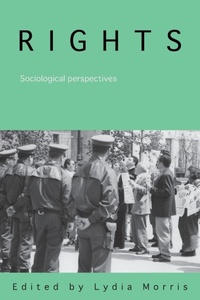
Rights
Sociological Perspectives
1st Edition
Published on 9. March 2006
Book
Paperback/Softback
300 pages
978-0-415-35522-3 (ISBN)
Description
This pioneering book demonstrates how different traditions of sociological thought can contribute to an understanding of the theory and practice of rights. It provides a sociological treatment of a wide range of substantive issues but never loses sight of the key theoretical questions.
It:
considers some varied cases of public intervention, including welfare, caring, mental health provisions, pensions, justice and free speech alongside the rights issues they raise
examines the question of rights from the point of view of distinctive population groups, such as prisoners and victims, women, ethnic minorities, indigenous peoples and lesbians and gays.
A key strength is its detailed presentation and analysis of different aspects of rights and its exploration of a variety of analytical perspectives. Rights are viewed, not in terms of ethical certainty, but as the product of social processes and part of shifting terrain which is open to negotiation.
Including a theoretical critique of existing perspectives, Rights offers a diverse and detailed exploration of the contribution sociological thought can make to this increasingly important aspect of social life and is an invaluable aid to students studying in this area.
It:
considers some varied cases of public intervention, including welfare, caring, mental health provisions, pensions, justice and free speech alongside the rights issues they raise
examines the question of rights from the point of view of distinctive population groups, such as prisoners and victims, women, ethnic minorities, indigenous peoples and lesbians and gays.
A key strength is its detailed presentation and analysis of different aspects of rights and its exploration of a variety of analytical perspectives. Rights are viewed, not in terms of ethical certainty, but as the product of social processes and part of shifting terrain which is open to negotiation.
Including a theoretical critique of existing perspectives, Rights offers a diverse and detailed exploration of the contribution sociological thought can make to this increasingly important aspect of social life and is an invaluable aid to students studying in this area.
More details
Language
English
Place of publication
London
United Kingdom
Publishing group
Taylor & Francis Ltd
Target group
College/higher education
Dimensions
Height: 234 mm
Width: 156 mm
Thickness: 16 mm
Weight
465 gr
ISBN-13
978-0-415-35522-3 (9780415355223)
Copyright in bibliographic data and cover images is held by Nielsen Book Services Limited or by the publishers or by their respective licensors: all rights reserved.
Schweitzer Classification
Other editions
Additional editions
Book
03/2006
1st Edition
Routledge
€206.80
Shipment within 15-20 days
Person
Lydia Morris is a Professor in the Sociology Department at the University of Essex. Her recent research interest has been in the politics of migration in the EU, looking at citizenship, rights and inequality. Her recent publications include Managing Migration: Civic Stratification and Migrants' Rights (2002); Social Divisions (1995); Dangerous Classes (1994) and The Workings of the Household (1990).
Content
Introduction: Sociology and Rights - An Emergent Field Part 1: Political Economy and Rights 1. Do We Need Rights: If So of What Sort? 2. Return of the Proletariat?: Pension Rights and Pension Finance in an Ageing Society 3. Developing an Economic Sociology of Care and Rights Part 2: Status, Norms and Institutions 4. Social Rights, Trans-National Rights and Civic Stratification 5. 'Women's Rights are Human Rights': Campaigns and Concepts 6. Human Rights, Anti-Racism and EU Advocacy Coalitions Part 3: Meaning, Interpretation and Rights 7. Rights, Social Theory and Political Philosophy: A Framework for Case Study Research 8. Rights Work: Constructing Lesbian, Gay and Sexual Rights in Late Modern Times 9. The Sociology of Indigenous People's Rights Part 4: The Clash of Rights 10. Punishment, Rights and Justice 11. Mental Disorder and Human Rights 12. Free to Speak, Free to Hate? Conclusion: A Foundation for Rights or Theories of Practice?