

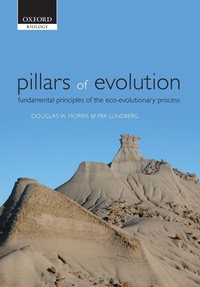
Pillars of Evolution
Fundamental principles of the eco-evolutionary process
Published on 14. July 2011
Book
Paperback/Softback
282 pages
978-0-19-856880-3 (ISBN)
Description
Pillars of Evolution provides a fresh and provocative perspective on adaptive evolution. Readers new to the study of evolution will find a refreshing new insight that establishes evolutionary biology as a rigorous and predictive science, whilst practicing biologists will discover a provocative book that challenges traditional approaches.
The book begins by leading readers through the mechanics of heredity, reproduction, movement, survival, and development. With that framework in place, it then explores the numerous ways that traits emerge from the interactions between genetics, development, and the environment. The key message is that adaptive changes in traits (and their underlying allelic frequencies) evolve through the traits' functions and their connection with fitness. The complex mappings from genes-to-traits-to-fitness are characterized in the structure of evolution. A single "structure matrix" describes why individuals vary in the values of adaptive traits, their ability to perform the function of those traits, and in the fitness they accrue. Fitness depends on how organisms interact with and perceive their environment in time and space. These relationships are made explicit in spatial, temporal, and organizational scale that also sets the stage for the crucially important role that ecology always plays in evolution. The ecological hallmarks of density- and frequency-dependent interactions allow the authors to explore new and exciting insights into evolution's dynamics. The theories and principles are then brought together in a final synthesis on adaptation.
The book's unique approach unites genetic, development, and environmental influences into a single comprehensive treatment of the eco-evolutionary process.
The book begins by leading readers through the mechanics of heredity, reproduction, movement, survival, and development. With that framework in place, it then explores the numerous ways that traits emerge from the interactions between genetics, development, and the environment. The key message is that adaptive changes in traits (and their underlying allelic frequencies) evolve through the traits' functions and their connection with fitness. The complex mappings from genes-to-traits-to-fitness are characterized in the structure of evolution. A single "structure matrix" describes why individuals vary in the values of adaptive traits, their ability to perform the function of those traits, and in the fitness they accrue. Fitness depends on how organisms interact with and perceive their environment in time and space. These relationships are made explicit in spatial, temporal, and organizational scale that also sets the stage for the crucially important role that ecology always plays in evolution. The ecological hallmarks of density- and frequency-dependent interactions allow the authors to explore new and exciting insights into evolution's dynamics. The theories and principles are then brought together in a final synthesis on adaptation.
The book's unique approach unites genetic, development, and environmental influences into a single comprehensive treatment of the eco-evolutionary process.
Reviews / Votes
The strength of this book lies in its simple structure. The pillars of evolutionary knowledge are set out as six principles: mechanics, function, structure, scale, dynamics and adaptation. Familiar enough, yet potentially game changing if the pillars are constructed into a new synthesis that cuts across disciplinary boundaries. * GLENDA M. WARDLE, The Author * The content is persuasive as theory and includes many interesting perspectives on linking genotype with adaptation and maladaptation. * John Hopkins, Bulletin of British Ecological Society *More details
Language
English
Place of publication
Oxford
United Kingdom
Target group
College/higher education
Illustrations
70 illustrations
Dimensions
Height: 244 mm
Width: 170 mm
Thickness: 15 mm
Weight
492 gr
ISBN-13
978-0-19-856880-3 (9780198568803)
Copyright in bibliographic data and cover images is held by Nielsen Book Services Limited or by the publishers or by their respective licensors: all rights reserved.
Schweitzer Classification
Other editions
Additional editions
Douglas W. Morris | Per Lundberg
Pillars of Evolution
Fundamental principles of the eco-evolutionary process
Book
07/2011
Oxford University Press
€164.04
Shipment within 15-20 days
Persons
Douglas Morris is Professor and Lakehead University Research Chair in Northern Studies at Lakehead University, Canada. He obtained his BSc. and MSc. in Biology from the University of Windsor 1974/1976, then a PhD in Biology from the University of Calgary in 1980. He went to on be a NSERC Post-doctoral Fellow at the University of Western Ontario, before being appointed as Associate Professor of Biology at Memorial University of Newfoundland, where he stayed from 1982-1990. As well as his current position at Lakehead University, he is Adjunct Professor of Biology at Laval University. Douglas is former President of the Canadian Society of Zoologists and the Canadian Society for Ecology and Evolution. He has served on the Editorial Boards for several journals, including Ecology, Ecological Monographs, and Ecoscience.
Per Lundberg is Professor of Theoretical Ecology at Lund University, Sweden. He received his BSc./Msc. in Biology from Umea University, Sweden in 1980, and then a PhD in Ecological Zoology . He went on to take up a position as Assistant Professor of Wildlife Ecology and Animal Ecology at the Swedish University of Agricultural Sciences where he worked from 1986 - 1994. He has also held positions as Visiting scientist, Department of Zoology, University of Guelph, Canada (1991), Associate Professor of Theoretical Ecology, Lund University, Sweden, and Center Fellow, National Center for Ecological Analysis and Synthesis (NCEAS), Santa Barbara, USA (2002-2003). Per has served on the Editorial boards of Oikos, Evolutionary Ecology, American Naturalist, and Proceedings of the Royal Society B, and was Editor-in-Chief for Oikos from 2004-2009.
Per Lundberg is Professor of Theoretical Ecology at Lund University, Sweden. He received his BSc./Msc. in Biology from Umea University, Sweden in 1980, and then a PhD in Ecological Zoology . He went on to take up a position as Assistant Professor of Wildlife Ecology and Animal Ecology at the Swedish University of Agricultural Sciences where he worked from 1986 - 1994. He has also held positions as Visiting scientist, Department of Zoology, University of Guelph, Canada (1991), Associate Professor of Theoretical Ecology, Lund University, Sweden, and Center Fellow, National Center for Ecological Analysis and Synthesis (NCEAS), Santa Barbara, USA (2002-2003). Per has served on the Editorial boards of Oikos, Evolutionary Ecology, American Naturalist, and Proceedings of the Royal Society B, and was Editor-in-Chief for Oikos from 2004-2009.
Content
Preface ; 1. Introduction ; 2. Mechanics ; 3. Function ; 4. Structure ; 5. Scale ; 6. Dynamics ; 7. Adaptation ; References ; Index