

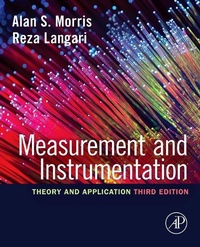
Measurement and Instrumentation
Theory and Application
3rd Edition
Published on 4. December 2020
Book
Paperback/Softback
736 pages
978-0-12-817141-7 (ISBN)
Description
Measurement and Instrumentation: Theory and Application, Third Edition, introduces undergraduate engineering students to measurement principles and the range of sensors and instruments used for measuring physical variables. Providing the most balanced coverage of measurement theory/technologies and instrumentation, this clearly and comprehensively written text arms students and recently graduated engineers with the knowledge and tools to design and build measurement systems for virtually any engineering application.
More details
Edition
3rd edition
Language
English
Place of publication
San Diego
United States
Publishing group
Elsevier Science Publishing Co Inc
Target group
College/higher education
Junior and senior undergraduate engineering students taking measurement and instrumentation courses primarily in mechanical and aerospace engineering departments
Dimensions
Height: 233 mm
Width: 191 mm
Thickness: 32 mm
Weight
1476 gr
ISBN-13
978-0-12-817141-7 (9780128171417)
Copyright in bibliographic data and cover images is held by Nielsen Book Services Limited or by the publishers or by their respective licensors: all rights reserved.
Schweitzer Classification
Other editions
Additional editions
E-Book
09/2020
3rd Edition
Academic Press
€104.00
Available for download
Previous edition
Book
09/2015
2nd Edition
Academic Press
€80.47
Article exhausted; check for reprint
Persons
Dr. Morris Retired senior lecturer in the Department of Automatic Control & Systems Engineering at the University of Sheffield. He has taught the undergraduate course in measurement and instrumentation for nearly 30 years, as well as undergraduate courses in robot technology, engineering design and laboratory skills, and graduate level courses in robot control, modeling and measurement for quality assurance. He is the author of eight books and more than 130 research papers in the fields of measurement and instrumentation and robot control. Dr. Langari is a professor in the Department of Mechanical Engineering at Texas A&M University and head of the Department of Engineering Technology and Industrial Distribution. He earned bachelor's, master's and doctoral degrees from the University of California, Berkeley. He has held research positions at NASA Ames Research Center, Rockwell International Science Center, United Technologies Research Center, as well as the U.S. Air Force Research Laboratory. Langari's expertise is in the area of computational intelligence with application to mechatronic systems and industrial automation. He has played a significant role in the development of theoretical foundations of fuzzy logic control and its applications to problems in mechanical engineering. His work on stability of fuzzy control systems is widely recognized as pioneering the use of nonlinear systems analysis techniques to fuzzy logic.
Content
1. Fundamentals of Measurement Systems
2. Instrument Types and Performance Characteristics
3. Measurement Uncertainty
4. Statistical Analysis of Measurements Subject to Random Errors
5. Calibration of Measuring Sensors and Instruments
6. Data Acquisition and Signal Processing
7. Variable Conversion
8. Measurement Signal Transmission
9. Display, Recording, and Presentation of Measurement Data
10. Intelligent Devices
11. Measurement Reliability and Safety Systems
12. Data Acquisition with LabVIEW
13. Sensor Technologies
14. Temperature Measurement
15. Pressure Measurement
16. Flow Measurement
17. Level Measurement
18. Mass, Force, and Torque Measurement
19. Translational Motion, Vibration, and Shock Measurement
20. Rotational Motion Transducers
21. Summary of Other Measurements
Appendix
1. Imperial-Metric-SI Conversion Tables
2. Thevenin's Theorem
3. Thermocouple Tables
4. Using Mathematical Tables
2. Instrument Types and Performance Characteristics
3. Measurement Uncertainty
4. Statistical Analysis of Measurements Subject to Random Errors
5. Calibration of Measuring Sensors and Instruments
6. Data Acquisition and Signal Processing
7. Variable Conversion
8. Measurement Signal Transmission
9. Display, Recording, and Presentation of Measurement Data
10. Intelligent Devices
11. Measurement Reliability and Safety Systems
12. Data Acquisition with LabVIEW
13. Sensor Technologies
14. Temperature Measurement
15. Pressure Measurement
16. Flow Measurement
17. Level Measurement
18. Mass, Force, and Torque Measurement
19. Translational Motion, Vibration, and Shock Measurement
20. Rotational Motion Transducers
21. Summary of Other Measurements
Appendix
1. Imperial-Metric-SI Conversion Tables
2. Thevenin's Theorem
3. Thermocouple Tables
4. Using Mathematical Tables