

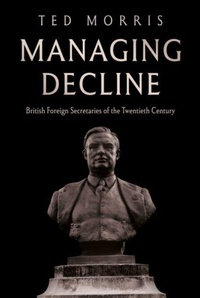
Managing Decline
British Foreign Secretaries of the Twentieth Century
Will be published approx. on 28. January 2026
Book
Hardback
568 pages
978-1-83628-567-0 (ISBN)
Description
Thirty-one men held the position of Foreign Secretary during the twentieth century, usually - though not invariably - being one of the two or three most significant figures in Cabinet. This book provides profiles for each of them, both as standalone essays and as part of the wider story of how the holders of the office have developed from being landed grandees to run-of-the-mill politicians; from largely independent practitioners of foreign policy to playing a supporting role behind their Prime Ministers; and how they oversaw Britain's decline from the preeminent global superpower to a second-tier state with sharply circumscribed freedom of action. The book will examine the journey from Henry Charles Keith Petty-Fitzmaurice, 5th Marquess of Lansdowne, scion of an ancient family, through to Robin Cook, grandson of a miner.
The subjects include some of the best-known politicians of the twentieth century - Grey, Bevin, Callaghan - but also a number who have fallen into comparative obscurity - Rufus Isaacs, Selwyn Lloyd, Franciss Pym. When even Austen Chamberlain - the only serving British Foreign Secretary to win a Nobel Peace Prize for his triumph exactly a century ago at Locarno - has been written off as residing "in virtual oblivion", there is a strong case that none of them is above re-examination
The end of the Victorian era provides the backdrop, with Britain emerging from the twilight of splendid isolation into ambiguous entanglements by 1914; into the inter-war uncertainties of the League of Nations and collective security; then firmly embedded in the post-war alliances of NATO and the EU while struggling to cope with the issues arising from the disentanglement from Empire.
The subjects include some of the best-known politicians of the twentieth century - Grey, Bevin, Callaghan - but also a number who have fallen into comparative obscurity - Rufus Isaacs, Selwyn Lloyd, Franciss Pym. When even Austen Chamberlain - the only serving British Foreign Secretary to win a Nobel Peace Prize for his triumph exactly a century ago at Locarno - has been written off as residing "in virtual oblivion", there is a strong case that none of them is above re-examination
The end of the Victorian era provides the backdrop, with Britain emerging from the twilight of splendid isolation into ambiguous entanglements by 1914; into the inter-war uncertainties of the League of Nations and collective security; then firmly embedded in the post-war alliances of NATO and the EU while struggling to cope with the issues arising from the disentanglement from Empire.
More details
Language
English
Place of publication
Market Harborough
United Kingdom
Dimensions
Height: 240 mm
Width: 160 mm
Thickness: 54 mm
Weight
1018 gr
ISBN-13
978-1-83628-567-0 (9781836285670)
Copyright in bibliographic data and cover images is held by Nielsen Book Services Limited or by the publishers or by their respective licensors: all rights reserved.
Schweitzer Classification
Person
Ted Morris has had a career in banking and financial regulation before his retirement in 2022. Managing Decline is his first book, the fruits of his lifelong interest in British political history. Ted lives in Limehouse, in the East End of London.