

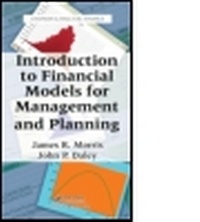
Introduction to Financial Models for Management and Planning
1st Edition
Published on 20. April 2009
Book
Hardback
756 pages
978-1-4200-9054-3 (ISBN)
Description
A properly structured financial model can provide decision makers with a powerful planning tool that helps them identify the consequences of their decisions before they are put into practice. Introduction to Financial Models for Management and Planning enables professionals and students to learn how to develop and use computer-based models for financial planning. Providing critical tools for the financial toolbox, this volume shows how to use these tools to build successful models.
Placing a strong emphasis on the structure of models, the book focuses on developing models that are consistent with the theory of finance and, at the same time, are practical and usable. The authors introduce powerful tools that are imperative to the financial management of the operating business. These include interactive cash budgets and pro forma financial statements that balance even under the most extreme assumptions, valuation techniques, forecasting techniques that range from simple averages to time series methods, Monte Carlo simulation, linear programming, and optimization.
The tools of financial modeling can be used to solve the problems of planning the firm's investment and financing decisions. These include evaluating capital projects, planning the financing mix for new investments, capital budgeting under capital constraints, optimal capital structure, cash budgeting, working capital management, mergers and acquisitions, and constructing efficient security portfolios.
While the primary emphasis is on models related to corporate financial management, the book also introduces readers to a variety of models related to security markets, stock and bond investments, portfolio management, and options.
This authoritative book supplies broad-based coverage and free access to @Risk software for Monte Carlo simulation, making it an indispensible text for professionals and students in financial management. Please contact customer service for access to the software if your copy of the book does not contain this information.
Placing a strong emphasis on the structure of models, the book focuses on developing models that are consistent with the theory of finance and, at the same time, are practical and usable. The authors introduce powerful tools that are imperative to the financial management of the operating business. These include interactive cash budgets and pro forma financial statements that balance even under the most extreme assumptions, valuation techniques, forecasting techniques that range from simple averages to time series methods, Monte Carlo simulation, linear programming, and optimization.
The tools of financial modeling can be used to solve the problems of planning the firm's investment and financing decisions. These include evaluating capital projects, planning the financing mix for new investments, capital budgeting under capital constraints, optimal capital structure, cash budgeting, working capital management, mergers and acquisitions, and constructing efficient security portfolios.
While the primary emphasis is on models related to corporate financial management, the book also introduces readers to a variety of models related to security markets, stock and bond investments, portfolio management, and options.
This authoritative book supplies broad-based coverage and free access to @Risk software for Monte Carlo simulation, making it an indispensible text for professionals and students in financial management. Please contact customer service for access to the software if your copy of the book does not contain this information.
More details
Language
English
Place of publication
United Kingdom
Publishing group
Taylor & Francis Ltd
Target group
College/higher education
Financial managers.
Product notice
Paper over boards
Illustrations
316 s/w Abbildungen, 27 s/w Tabellen
255; 27 Tables, black and white; 316 Illustrations, black and white
Dimensions
Height: 234 mm
Width: 156 mm
Weight
1157 gr
ISBN-13
978-1-4200-9054-3 (9781420090543)
Copyright in bibliographic data and cover images is held by Nielsen Book Services Limited or by the publishers or by their respective licensors: all rights reserved.
Schweitzer Classification
Other editions
New editions
James R. Morris | John P. Daley
Introduction to Financial Models for Management and Planning
Book
05/2017
2nd Edition
Chapman & Hall/CRC
€185.87
Shipment within 15-20 days
Persons
James R. Morris and John P. Daley are faculty members at the University of Colorado, Denver.
Content
An Overview of Financial Planning and Modeling
Part I: Tools for Financial Planning and Modeling: Financial Analysis
The Tools for Financial Planning I: Financial Analysis
Appendix A: Using Names in the Excel Spreadsheet
Appendix B: Constructing a Data Table
The Tools for Financial Planning II: Growth and Cash Flows
Part II: Tools for Financial Planning and Modeling: Simulation
Financial Statement Simulation
Monte Carlo Simulation
Part III: Introduction to Forecasting Methods
Forecasting I: Time Trend Extrapolation
Forecasting II: Econometric Forecasting
Forecasting III: Smoothing Data for Forecasts
Part IV: A Closer Look at the Details of a Financial Model
Modeling Value
Modeling Long-Term Assets
Debt Financing
Modeling Working Capital Accounts
PART V: Modeling Security Prices and Investment Portfolios
Modeling Security Prices
Constructing Optimal Security Portfolios
Options
Part VI: Optimization Models
Optimization Models for Financial Planning
Planning and Managing Working Capital with LP
References
Index
Part I: Tools for Financial Planning and Modeling: Financial Analysis
The Tools for Financial Planning I: Financial Analysis
Appendix A: Using Names in the Excel Spreadsheet
Appendix B: Constructing a Data Table
The Tools for Financial Planning II: Growth and Cash Flows
Part II: Tools for Financial Planning and Modeling: Simulation
Financial Statement Simulation
Monte Carlo Simulation
Part III: Introduction to Forecasting Methods
Forecasting I: Time Trend Extrapolation
Forecasting II: Econometric Forecasting
Forecasting III: Smoothing Data for Forecasts
Part IV: A Closer Look at the Details of a Financial Model
Modeling Value
Modeling Long-Term Assets
Debt Financing
Modeling Working Capital Accounts
PART V: Modeling Security Prices and Investment Portfolios
Modeling Security Prices
Constructing Optimal Security Portfolios
Options
Part VI: Optimization Models
Optimization Models for Financial Planning
Planning and Managing Working Capital with LP
References
Index