

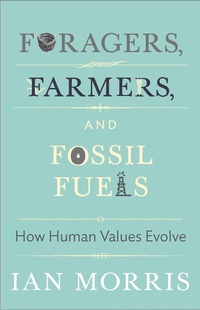
Foragers, Farmers, and Fossil Fuels
How Human Values Evolve
Published on 30. May 2017
Book
Paperback/Softback
400 pages
978-0-691-17589-8 (ISBN)
Description
Most people in the world today think democracy and gender equality are good, and that violence and wealth inequality are bad. But most people who lived during the 10,000 years before the nineteenth century thought just the opposite. Drawing on archaeology, anthropology, biology, and history, Ian Morris explains why. Fundamental long-term changes in values, Morris argues, are driven by the most basic force of all: energy. Humans have found three main ways to get the energy they need--from foraging, farming, and fossil fuels. Each energy source sets strict limits on what kinds of societies can succeed, and each kind of society rewards specific values. But if our fossil-fuel world favors democratic, open societies, the ongoing revolution in energy capture means that our most cherished values are very likely to turn out not to be useful any more. Foragers, Farmers, and Fossil Fuels offers a compelling new argument about the evolution of human values, one that has far-reaching implications for how we understand the past--and for what might happen next.
Originating as the Tanner Lectures delivered at Princeton University, the book includes challenging responses by classicist Richard Seaford, historian of China Jonathan Spence, philosopher Christine Korsgaard, and novelist Margaret Atwood.
Originating as the Tanner Lectures delivered at Princeton University, the book includes challenging responses by classicist Richard Seaford, historian of China Jonathan Spence, philosopher Christine Korsgaard, and novelist Margaret Atwood.
Reviews / Votes
"Excellent and thought-provoking... More important, by putting forth a bold, clearly formulated hypothesis, Morris has done a great service to the budding field of scientific history."--Peter Turchin, Science "A provocative explanation for the evolution and divergence of ethical values... In the hands of this talented writer and thinker, [this] material becomes an engaging intellectual adventure."--Kirkus "A very good and enjoyable read."--Diane Coyle, Enlightened Economist "Stimulating."--Russell Warfield, Resurgence & EcologistMore details
Series
Language
English
Place of publication
New Jersey
United States
Target group
College/higher education
Product notice
Paperback (trade)
Illustrations
6 Maps
Dimensions
Height: 216 mm
Width: 136 mm
Thickness: 30 mm
Weight
479 gr
ISBN-13
978-0-691-17589-8 (9780691175898)
Copyright in bibliographic data and cover images is held by Nielsen Book Services Limited or by the publishers or by their respective licensors: all rights reserved.
Schweitzer Classification
Other editions
Additional editions
E-Book
07/2015
1st Edition
Princeton University Press
from
€86.95
Available for download
Persons
Ian Morris is professor of classics and a fellow of the Stanford Archaeology Center at Stanford University.
Content
List of Figures and Tables ix Acknowledgments xi Introduction by Stephen Macedo xiii Chapter 1 Each Age Gets the Thought It Needs 1 Chapter 2 Foragers 25 Chapter 3 Farmers 44 Chapter 4 Fossil Fuels 93 Chapter 5 The Evolution of Values: Biology, Culture, and the Shape of Things to Come 139 Comments Chapter 6 On the Ideology of Imagining That "Each Age Gets the Thought It Needs," Richard Seaford 172 Chapter 7 But What Was It Really Like? The Limitations of Measuring Historical Values, Jonathan D. Spence 180 Chapter 8 Eternal Values, Evolving Values, and the Value of the Self, Christine M. Korsgaard 184 Chapter 9 When the Lights Go Out: Human Values after the Collapse of Civilization, Margaret Atwood 202 Response Chapter 10 My Correct Views on Everything, Ian Morris 208 Notes 267 References 305 Contributors 341 Index 343