

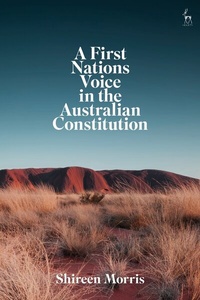
A First Nations Voice in the Australian Constitution
Published on 24. February 2022
Book
Paperback/Softback
338 pages
978-1-5099-4452-1 (ISBN)
Description
This book makes the legal and political case for Indigenous constitutional recognition through a constitutionally guaranteed First Nations voice, as advocated by the historic Uluru Statement from the Heart. It argues that a constitutional amendment to empower Indigenous peoples with a fairer say in laws and policies made about them and their rights, is both constitutionally congruent and politically achievable. A First Nations voice is deeply in keeping with the culture, design and philosophy of Australia's federal Constitution, as well as the long history of Indigenous advocacy for greater empowerment and self-determination in their affairs.
Morris explores the historical, political, theoretical and international contexts underpinning the contemporary debate, before delving into the constitutional detail to craft a compelling case for change.
Morris explores the historical, political, theoretical and international contexts underpinning the contemporary debate, before delving into the constitutional detail to craft a compelling case for change.
Reviews / Votes
Shireen Morris combines her insight from her first hand involvement in the practical struggle for Aboriginal constitutional recognition with a scholarly legal analysis of the possibilities and pitfalls entailed in a range of options. This book provides essential ballast to the debate, explaining why we have got here, which routes have been closed off and what still needs to be done. * Professor Anne Twomey, University of Sydney * Shireen Morris draws on her unique combination of legal scholarship and political advocacy to put forward the case of reason and compromise in order to recognise Indigenous Australians in the Australian Constitution in a way that respects both Indigenous aspirations and the constitutional concerns of people across the political spectrum. In this ongoing conversation about constitutional reform, scholars and statesmen alike should take heed of the compelling voice of moderation that Shireen Morris brings to an otherwise fraught discussion - a discussion that desperately needs the insights of a book like this. * Professor Greg Craven AO GCSG, Vice-Chancellor and President of Australian Catholic University * (Praise for the author's previous writing) Shireen Morris has been one of the most passionate and courageous advocates for Indigenous people and their overdue recognition in the Australian Constitution. Anyone who has followed the debate will know of Shireen's articulate and persuasive advocacy ... [she] shows that reconciliation is not just about black and white. It's the responsibility of all Australians. * Noel Pearson, Founder of the Cape York Institute *More details
Language
English
Place of publication
Oxford
United Kingdom
Publishing group
Bloomsbury Publishing PLC
Target group
College/higher education
Dimensions
Height: 232 mm
Width: 150 mm
Thickness: 20 mm
Weight
520 gr
ISBN-13
978-1-5099-4452-1 (9781509944521)
Copyright in bibliographic data and cover images is held by Nielsen Book Services Limited or by the publishers or by their respective licensors: all rights reserved.
Schweitzer Classification
Other editions
Additional editions
Shireen Morris
A First Nations Voice in the Australian Constitution
E-Book
08/2020
1st Edition
Hart Publishing
€37.49
Available for download
Shireen Morris
A First Nations Voice in the Australian Constitution
E-Book
08/2020
1st Edition
Hart Publishing
€37.49
Available for download
Person
Shireen Morris is Senior Lecturer at Macquarie Law School, Australia.
Content
1. Introduction
I. Background
II. Structure of this Book
2. The Historical, Political and Theoretical Context
I. The Problem of Purpose
II. Historical Context
III. Political Context
IV. Theoretical Context
3. Understanding Objections to a Racial Non-Discrimination Guarantee
I. Introduction
II. The Expert Panel's Racial Non-Discrimination Recommendation
III. Objections to a Racial Non-Discrimination Clause
IV. Responding to the Objections
V. Is a Qualified Power the Answer?
VI. Conclusion
4. International Inspiration
I. UN Declaration on the Rights of Indigenous Peoples
II. New Zealand
III. Canada
IV. Sami Parliaments: Norway, Sweden and Finland
V. Conclusion
5. The Legislative Possibility of Reserved Indigenous Seats in Parliament
I. Introduction
II. Constitutional Constraints
III. How Much Legislative Flexibility Does the Constitution Confer?
IV. What Does this Mean for Reserved Indigenous Seats?
V. Conclusion
6. The Case for a First Nations Voice in the Constitution
I. Introduction
II. Re-Capping the Case for Change
III. Distinguishing the Inter-State Commission and ATSIC
IV. Assessing Options for Constitutional Amendments
V. Legislative Mechanisms to Enhance Impact
VI. Addressing Political Objections
VII. Conclusion
7. Conclusion
I. Background
II. Structure of this Book
2. The Historical, Political and Theoretical Context
I. The Problem of Purpose
II. Historical Context
III. Political Context
IV. Theoretical Context
3. Understanding Objections to a Racial Non-Discrimination Guarantee
I. Introduction
II. The Expert Panel's Racial Non-Discrimination Recommendation
III. Objections to a Racial Non-Discrimination Clause
IV. Responding to the Objections
V. Is a Qualified Power the Answer?
VI. Conclusion
4. International Inspiration
I. UN Declaration on the Rights of Indigenous Peoples
II. New Zealand
III. Canada
IV. Sami Parliaments: Norway, Sweden and Finland
V. Conclusion
5. The Legislative Possibility of Reserved Indigenous Seats in Parliament
I. Introduction
II. Constitutional Constraints
III. How Much Legislative Flexibility Does the Constitution Confer?
IV. What Does this Mean for Reserved Indigenous Seats?
V. Conclusion
6. The Case for a First Nations Voice in the Constitution
I. Introduction
II. Re-Capping the Case for Change
III. Distinguishing the Inter-State Commission and ATSIC
IV. Assessing Options for Constitutional Amendments
V. Legislative Mechanisms to Enhance Impact
VI. Addressing Political Objections
VII. Conclusion
7. Conclusion