

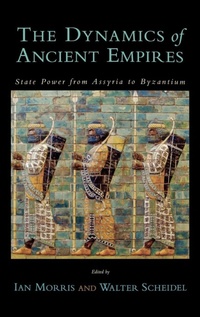
The Dynamics of Ancient Empires
State Power from Assyria to Byzantium
Published on 22. January 2009
Book
Hardback
400 pages
978-0-19-537158-1 (ISBN)
Description
The world's first known empires took shape in Mesopotamia between the eastern shores of the Mediterranean Sea and the Persian Gulf, beginning around 2350 BCE. The next 2,500 years witnessed sustained imperial growth, bringing a growing share of humanity under the control of ever-fewer states. Two thousand years ago, just four major powers--the Roman, Parthian, Kushan, and Han empires--ruled perhaps two-thirds all the people on earth. Yet despite empires' prominence in the early history of civilization, there have been surprisingly few attempts to study the dynamics of ancient empires in the western Old World comparatively. Such grand comparisons were popular in the eighteenth century, but scholars then had only Greek and Latin literature and the Hebrew Bible as evidence, and necessarily framed the problem in different, more limited, terms. Near Eastern texts, and knowledge of their languages, only appeared in large amounts in the later nineteenth century. Neither Karl Marx nor Max Weber could make much use of this material, and not until the 1920s were there enough archaeological data to make syntheses of early European and west Asian history possible. But one consequence of the increase in empirical knowledge was that twentieth-century scholars generally defined the disciplinary and geographical boundaries of their specialties more narrowly than their Enlightenment predecessors had done, shying away from large questions and cross-cultural comparisons. As a result, Greek and Roman empires have largely been studied in isolation from those of the Near East. This volume is designed to address these deficits and encourage dialogue across disciplinary boundaries by examining the fundamental features of the successive and partly overlapping imperial states that dominated much of the Near East and the Mediterranean in the first millennia BCE and CE.
A substantial introductory discussion of recent thought on the mechanisms of imperial state formation prefaces the five newly commissioned case studies of the Neo-Assyrian, Achaemenid Persian, Athenian, Roman, and Byzantine empires. A final chapter draws on the findings of evolutionary psychology to improve our understanding of ultimate causation in imperial predation and exploitation in a wide range of historical systems from all over the globe. Contributors include John Haldon, Jack Goldstein, Peter Bedford, Josef Wiesehoefer, Ian Morris, Walter Scheidel, and Keith Hopkins, whose sparkling essay on Roman political economy was completed just before his death in 2004.
A substantial introductory discussion of recent thought on the mechanisms of imperial state formation prefaces the five newly commissioned case studies of the Neo-Assyrian, Achaemenid Persian, Athenian, Roman, and Byzantine empires. A final chapter draws on the findings of evolutionary psychology to improve our understanding of ultimate causation in imperial predation and exploitation in a wide range of historical systems from all over the globe. Contributors include John Haldon, Jack Goldstein, Peter Bedford, Josef Wiesehoefer, Ian Morris, Walter Scheidel, and Keith Hopkins, whose sparkling essay on Roman political economy was completed just before his death in 2004.
Reviews / Votes
its parts are varied and interesting, the unexceeded sum makes an absorbing (at times provocative) volume. * Christopher J. Tuplin, Bryn Mawr Classical Review *More details
Series
Language
English
Place of publication
New York
United States
Target group
College/higher education
Illustrations
7 maps
Dimensions
Height: 240 mm
Width: 161 mm
Thickness: 26 mm
Weight
763 gr
ISBN-13
978-0-19-537158-1 (9780195371581)
Copyright in bibliographic data and cover images is held by Nielsen Book Services Limited or by the publishers or by their respective licensors: all rights reserved.
Schweitzer Classification
Other editions
Additional editions
Book
12/2010
Oxford University Press Inc
€66.60
Shipment within 15-20 days
E-Book
01/2009
1st Edition
OUP eBook
€24.99
Available for download
E-Book
01/2009
1st Edition
OUP eBook
€31.99
Available for download
Persons
Ian Morris is Professor of Classics and History, Stanford University.
Walter Scheidel is Professor of Classics, Stanford University.
Walter Scheidel is Professor of Classics, Stanford University.
Content
Preface
1.: Jack Goldstone and John Haldon: Ancient States, Empires, and Exploitation: Problems and Perspectives
2.: Peter Bedford: The Neo-Assyrian Empire
3.: Josef Wiesehoefer: The Achaemenid Empire
4.: Ian Morris: The Greater Athenian State
5.: Keith Hopkins: The Political Economy of the Roman Empire
6.: John Haldon: The Byzantine Empire
7.: Walter Scheidel: Sex and Empire: A Darwinian Perspective
Bibliography
Notes on Contributors
1.: Jack Goldstone and John Haldon: Ancient States, Empires, and Exploitation: Problems and Perspectives
2.: Peter Bedford: The Neo-Assyrian Empire
3.: Josef Wiesehoefer: The Achaemenid Empire
4.: Ian Morris: The Greater Athenian State
5.: Keith Hopkins: The Political Economy of the Roman Empire
6.: John Haldon: The Byzantine Empire
7.: Walter Scheidel: Sex and Empire: A Darwinian Perspective
Bibliography
Notes on Contributors