

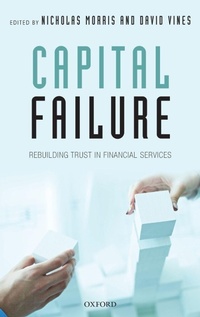
Capital Failure
Rebuilding Trust in Financial Services
Published on 7. August 2014
Book
Hardback
424 pages
978-0-19-871222-0 (ISBN)
Description
Adam Smith's 'invisible hand' relied on the self-interest of individuals to produce good outcomes. Economists' belief in efficient markets took this idea further by assuming that all individuals are selfish. This belief underpinned financial deregulation, and the theories on incentives and performance which supported it. However, although Adam Smith argued that although individuals may be self-interested, he argued that they also have other-regarding motivations, including a desire for the approbation of others. This book argues that the trust-intensive nature of financial services makes it essential to cultivate such other-regarding motivations, and it provides proposals on how this might be done.
Trustworthiness in the financial services industry was eroded by deregulation and by the changes to industry structure which followed. Incentive structures encouraged managers to disguise risky products as yielding high returns, and regulation failed to curb this risk-taking, rent-seeking behaviour. The book makes a number of proposals for reforms of governance, and of legal and regulatory arrangements, to address these issues. The proposals seek to harness values and norms that would reinforce 'other-regarding' behaviour, so that the firms and individuals in the financial services act in a more trustworthy manner.
Four requirements are identified which together might secure more strongly trustworthy behaviour: the definition of obligations, the identification of responsibilities, the creation of mechanisms which encourage trustworthiness, and the holding to account of those involved in an appropriate manner. Financial reforms at present lack sufficient focus on these requirements, and the book proposes a range of further actions for specific parts of the financial industry.
Trustworthiness in the financial services industry was eroded by deregulation and by the changes to industry structure which followed. Incentive structures encouraged managers to disguise risky products as yielding high returns, and regulation failed to curb this risk-taking, rent-seeking behaviour. The book makes a number of proposals for reforms of governance, and of legal and regulatory arrangements, to address these issues. The proposals seek to harness values and norms that would reinforce 'other-regarding' behaviour, so that the firms and individuals in the financial services act in a more trustworthy manner.
Four requirements are identified which together might secure more strongly trustworthy behaviour: the definition of obligations, the identification of responsibilities, the creation of mechanisms which encourage trustworthiness, and the holding to account of those involved in an appropriate manner. Financial reforms at present lack sufficient focus on these requirements, and the book proposes a range of further actions for specific parts of the financial industry.
Reviews / Votes
Trust in the financial services industry is currently at a low ebb. Nicholas Morris and David Vines have gathered together a group of economists, lawyers, philosophers and practitioners to consider what might be done to rebuild trust in this sector. The resulting collection, Capital Failure, provides a wide range of examples of how trust was lost and what might be done to recover it * Mark Hannam, The Times Literary Supplement *More details
Language
English
Place of publication
Oxford
United Kingdom
Target group
College/higher education
Professional and scholarly
Illustrations
5 Figures, 1 Table
Dimensions
Height: 240 mm
Width: 161 mm
Thickness: 27 mm
Weight
798 gr
ISBN-13
978-0-19-871222-0 (9780198712220)
Copyright in bibliographic data and cover images is held by Nielsen Book Services Limited or by the publishers or by their respective licensors: all rights reserved.
Schweitzer Classification
Other editions
Additional editions
Book
09/2016
Oxford University Press
€59.41
Shipment within 15-20 days
E-Book
08/2014
1st Edition
OUP eBook
€37.99
Available for download
Persons
Nicholas Morris is Academic Visitor and Senior Research Associate at Balliol College, Oxford. He is an economist with 35 years of wide-ranging experience: in the finance, water, energy, transport, telecoms, and health sectors; in infrastructure provision; and in the design of regulatory structures. He was a co-founder and then Chief Executive of London Economics, for a period of 14 years, and, prior to that, was Deputy Director of the Institute for Fiscal Studies. Nicholas has an M.A. in Engineering and Economics and an M.Phil. in Economics from Balliol College, Oxford. He has been a visiting Professor of City University, a Governor of the charity 'Research into Ageing', a Fellow of Melbourne University and a Guest Professor at the China Executive Leadership Academy, Pudong. During the last 12 years he has worked extensively in Australia, South East Asia, and China advising governments, regulators, and companies.
David Vines is a Professor of Economics and a Fellow of Balliol College at Oxford University. He obtained a BA in Economics and Mathematics from Melbourne University, and an MA and PhD in Economics from the University of Cambridge. His research has been on international macroeconomics and on global governance and his early work was with James Meade in Cambridge on the construction of inflation-targeting regimes. Between 1994 and 2000 he was the Director of an ESRC Research Programme on Global Economic Institutions, and from 2008 to 2012 he was the Research Director of a European Union Framework Seven Research Program, PEGGED, on the Politics and Economics of Global Governance: the European Dimension. Fifteen years ago he organized an interdisciplinary seminar on integrity with the philosopher Alan Montefiore, the proceedings of which were published as A. Monetefiore and D. Vines, Integrity in the Public and the Private Domains (Routledge, 1999).
David Vines is a Professor of Economics and a Fellow of Balliol College at Oxford University. He obtained a BA in Economics and Mathematics from Melbourne University, and an MA and PhD in Economics from the University of Cambridge. His research has been on international macroeconomics and on global governance and his early work was with James Meade in Cambridge on the construction of inflation-targeting regimes. Between 1994 and 2000 he was the Director of an ESRC Research Programme on Global Economic Institutions, and from 2008 to 2012 he was the Research Director of a European Union Framework Seven Research Program, PEGGED, on the Politics and Economics of Global Governance: the European Dimension. Fifteen years ago he organized an interdisciplinary seminar on integrity with the philosopher Alan Montefiore, the proceedings of which were published as A. Monetefiore and D. Vines, Integrity in the Public and the Private Domains (Routledge, 1999).
Editor
Academic Visitor, Balliol College, University of OxfordAcademic Visitor, Balliol College, University of Oxford
Professor of Economics, and Fellow of Balliol College, University of Oxford; Adjunct Professor of Economics, Australian National UniversityProfessor of Economics, and Fellow of Balliol College, University of Oxford; Adjunct Professor of Economics, Australian National University
Content
WHAT WENT WRONG? ; TRUSTWORTHINESS, MOTIVATIONS, AND ACCOUNTABILITY ; PROBLEMS WITH THE LEGAL AND REGULATORY SYSTEM ; CRAFTING THE REMEDIES