

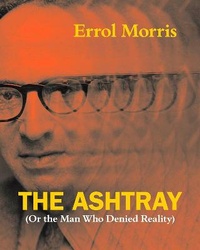
The Ashtray
(Or the Man Who Denied Reality)
Published on 22. May 2018
Book
Hardback
192 pages
978-0-226-92268-3 (ISBN)
Description
In 1972, philosopher of science Thomas Kuhn threw an ashtray at Errol Morris. This book is the result.
At the time, Morris was a graduate student. Now we know him as one of the most celebrated and restlessly probing filmmakers of our time, the creator of such classics of documentary investigation as The Thin Blue Line and The Fog of War. Kuhn, meanwhile, was--and, posthumously, remains--a star in his field, the author of The Structure of Scientific Revolutions, a landmark book that has sold well over a million copies and introduced the concept of "paradigm shifts" to the larger culture. And Morris thought the idea was bunk.
The Ashtray tells why--and in doing so, it makes a powerful case for Morris's way of viewing the world, and the centrality to that view of a fundamental conception of the necessity of truth. "For me," Morris writes, "truth is about the relationship between language and the world: a correspondence idea of truth." He has no patience for philosophical systems that aim for internal coherence and disdain the world itself. Morris is after bigger game: he wants to establish as clearly as possible what we know and can say about the world, reality, history, our actions and interactions. It's the fundamental desire that animates his filmmaking, whether he's probing Robert McNamara about Vietnam or the oddball owner of a pet cemetery. Truth may be slippery, but that doesn't mean we have to grease its path of escape through philosophical evasions. Rather, Morris argues powerfully, it is our duty to do everything we can to establish and support it.
In a time when truth feels ever more embattled, under siege from political lies and virtual lives alike, The Ashtray is a bracing reminder of its value, delivered by a figure who has, over decades, uniquely earned our trust through his commitment to truth. No Morris fan should miss it.
At the time, Morris was a graduate student. Now we know him as one of the most celebrated and restlessly probing filmmakers of our time, the creator of such classics of documentary investigation as The Thin Blue Line and The Fog of War. Kuhn, meanwhile, was--and, posthumously, remains--a star in his field, the author of The Structure of Scientific Revolutions, a landmark book that has sold well over a million copies and introduced the concept of "paradigm shifts" to the larger culture. And Morris thought the idea was bunk.
The Ashtray tells why--and in doing so, it makes a powerful case for Morris's way of viewing the world, and the centrality to that view of a fundamental conception of the necessity of truth. "For me," Morris writes, "truth is about the relationship between language and the world: a correspondence idea of truth." He has no patience for philosophical systems that aim for internal coherence and disdain the world itself. Morris is after bigger game: he wants to establish as clearly as possible what we know and can say about the world, reality, history, our actions and interactions. It's the fundamental desire that animates his filmmaking, whether he's probing Robert McNamara about Vietnam or the oddball owner of a pet cemetery. Truth may be slippery, but that doesn't mean we have to grease its path of escape through philosophical evasions. Rather, Morris argues powerfully, it is our duty to do everything we can to establish and support it.
In a time when truth feels ever more embattled, under siege from political lies and virtual lives alike, The Ashtray is a bracing reminder of its value, delivered by a figure who has, over decades, uniquely earned our trust through his commitment to truth. No Morris fan should miss it.
More details
Language
English
Place of publication
Chicago
United States
Publishing group
The University of Chicago Press
Illustrations
49 color plates, 39 halftones
Dimensions
Height: 254 mm
Width: 203 mm
ISBN-13
978-0-226-92268-3 (9780226922683)
Copyright in bibliographic data and cover images is held by Nielsen Book Services Limited or by the publishers or by their respective licensors: all rights reserved.
Schweitzer Classification
Other editions
Additional editions
E-Book
05/2018
1st Edition
University of Chicago Press
€30.49
Available for download
Person
Errol Morris is a director of films, primarily documentaries, including The Thin Blue Line; Gates of Heaven; Fast, Cheap, and Out of Control; and The Fog of War, which won the Academy Award for Best Documentary Feature for 2003.