

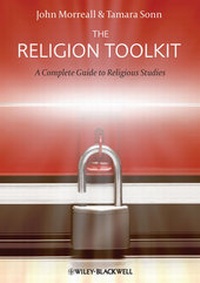
The Religion Toolkit
A Complete Guide to Religious Studies
Published on 28. October 2011
Book
Paperback/Softback
374 pages
978-1-4051-8246-1 (ISBN)
Description
This complete overview of religious studies provides students with the essential knowledge and tools they need to explore and understand the nature of religion.
* Covers the early development of religion, with overviews of major and minor religions from Islam to Scientology
* Considers recent developments including secularization; the relationship between religion and science; and scientific studies on religion, health, and mystical experience
* Uses humor throughout, allowing students to remain open-minded to the subject
* Explains what it means to study religion academically, and considers the impact of the study of religion on religion itself
* Contains numerous student-friendly features including photos, maps, time lines, side bars, historical profiles, and population distribution figures
* Provides classroom users with a lively website,www.wiley.com/go/religiontoolkit, including questions, quizzes, extra material, and helpful primary and secondary sources
More details
Other editions
New editions
Book
07/2024
2nd Edition
Wiley-Blackwell
€32.50
Shipment within 15-20 days
Additional editions
Book
10/2011
1st Edition
Wiley
€105.50
Shipment within 3-4 weeks
E-Book
09/2011
Wiley-Blackwell
€28.99
Available for download
E-Book
09/2011
Wiley-Blackwell
€28.99
Available for download
Persons
John Morreall is Professor of Religious Studies at the College of William and Mary. He has published widely in the philosophy of religion, and on the comic dimensions of world religions. His book Comedy, Tragedy, and Religion (1999) won the Choice Outstanding Academic Book 2000. He is also the author of Comic Relief: A Comprehensive Philosophy of Humor (2009), published by Wiley-Blackwell.
Tamara Sonn is the Wm. R. Kenan Distinguished Professor of Humanities in the Department of Religious Studies at the College of William and Mary. Her books include Comparing Religions through Law: Judaism and Islam (with J. Neusner, 1999) and Islam: A Brief History, 2nd edition (Wiley-Blackwell, 2010). She was senior editor of the Oxford Dictionary of Islam (2003), and associate editor of The Islamic World Past and Present (2004). She is currently an editor of Oxford Islamic Studies Online, and of Encyclopedia of the Islamic World (2009). In addition, Sonn is editor-in-chief of Oxford Bibliographies Online: Islamic Studies, and co-editor-in-chief of Wiley-Blackwell's Religion Compass.
Content
1. Introduction: Prepare To Be Surprised
Part I: The Tools
2. An Overview of Religion: Making Sense of Life
A. Explaining Suffering and Evil
B. Explaining Death
1. Ghosts
2. Resurrection
3. Souls
4. Reincarnation
C. The Importance of Order
1. Order Out of Chaos
2. Order and Predictability: Eschatology, Prophecy, Divination
3. Social Order
a. Group Identity
b.Ethics/Morality and Law
c. Authority and Power
D. The Role of Ritual
E.Conclusion
3. The Early Development of Religious Studies
A. Philosophy, Theology, and Religious Studies
1. The Relationship between Philosophy and Theology
2. Two Kinds of Christian Theology
B. Scriptural (Biblical) Studies and the Impact of the Printing Press
1. Baruch Spinoza
William Robertson Smith: Historical Criticism
C. The Rise of Modernity and New Academic Disciplines:Oriental Studies, Anthropology, Sociology, and Psychology
1. Max Müller: Oriental Studies and Religion
2. Edward Burnett Tylor: Anthropology and Religion
3. James Frazer: Evolution and Religion
D. Negative Views of Religion
1. Karl Marx: Religion and the Opiate of the Masses
2.Sigmund Freud: Religion and Neurosis
E. Sociology of Religion
1. Emile Durkheim: Modernization Theory
2. Max Weber: The Protestant Ethic
F. Conclusion
4. Religious Studies in the Twentieth Century
A. Back to Philosophy
1. Analytic Philosophy: Antony Flew
2. Phenomenology and Religious Studies
a. Rudolf Otto
b. Mircea Eliade
B. Philosophy of Religion
1. John Hick
2. William Lane Craig
C. Anthropology of Religion
1. Clifford Geertz
2. Mary Douglas
D. Sociology of Religion
1. Peter L. Berger
2. Robert N. Bellah
E. Psychology of Religion
1. Wiliam James
2. Carl Jung
F.Conclusion
Part II: Using the Tools: Surveying World Religions
5. Early Traditions
A. Prehistoric Traditions
1. Animism and Anthropomorphism
2. Death Rituals
3.Fertility Goddesses
4. Hunting Rituals
5. Shamans
6. Ancient Religions, Oral Religions
B. The Neolithic Revolution, Patriarchy, and the Rise of Historic Religions
C. Conclusion
6. The Family of Western Monotheisms:
Jewish, Christian, and Islamic Traditions
UNIT I: Judaism
A. The Torah, the Hebrew Bible, the Old Testament
B. The History and Teachings of Judaism
1. The First Five Centuries
2. The Middle Ages(500-1500CE)
3. The Modern Period (1750 to the present)
a. The Enlightenment
b.The Development of Reform Judaism
c.Conservative Judaism
d. Reconstructionist Judaism
C. The Rituals of Judaism
D. Judaism Today
UNIT II: Christianity
A. The History and Teachings of Christianity
1. Origins
2. The Development of Christian Doctrine
a. The Institutionalization and Politicization of Christianity
b. Eastern and Western Christians
i. The Western/Roman Church
ii The Eastern Orthodox Churches
3. The Protestant Reformation
B. Christian Rituals
C. Christianity Today
UNIT III: Islam
A. The History and Teachings of Islam
1. Core Teachings
Early History: The Life of Muhammad and the Rashidun Caliphs
3. The Dynastic Caliphates
The Modern Period: Reform and Recovery
B. Islamic Rituals
C. Major Divisions Today
UNIT IV: The Impact of Religious Studies on the Western Monotheisms
A. Biblical Studies
1. Rudolf Bultmann: "Demythologizing" Scripture
2. John Dominic Crossan: The Historicity of Scripture
B. Theology
1. Liberation Theology
Gustavo Gutierrez
Farid Esack
2. Feminist Theology
a. Judith Plaskow
b. Rosemary Radford Ruether
c. Amina Wadud
C. Conclusion
7. Two Traditions of India: Hinduism and Buddhism
A. Hinduism and Buddhism
B. Hinduism
1. History and Teachings of Hinduism
a. Indus Valley Civilization (3,000-1,500 BCE)
b. The Aryans and the Vedas (1,500-600 BCE)
c. The Mystical Worldview of the Upanishads
d. Classical Hinduism
i. The Ramayana
ii.The Mahabharata
iii. The Puranas
iv. The Laws of Manu
2. Hinduism Today
3. Rituals
C. Buddhism
1. History and Teachings of Buddhism
a. Understanding the Four Noble Truths
b. The Ethics of "Awakening"
c. The Core of All Buddhist Traditions
d. The Development of the Three Main Traditions
i. Theravada (Hinayana)
ii. Mahayana
iii. Vajrayana
2. Buddhism Today
3. Rituals
D. Conclusion: Religious Studies and Indian Traditions
8. Balancing and Blending: Confucianism, Daoism, and Buddhism in China
A. The Tao, Yin and Yang
B. The History of Chinese Religious Thought
1. The Shang Period (18th-12th c. BCE)
The Zhou Period (12th-3rd c. BCE)
C.Confucius
D. Taoism
E. Buddhism in China
1. Pure Land Buddhism
2. Chan (Zen) Buddhism
F. Chinese Folk Traditions
G. Chinese Traditions Today
9. Zoroastrianism, Shinto, Baha'i, Scientology, Wicca, and the Seneca:
What Makes a "World Religion"?
A. What Makes a "World Religion"?
B. Zoroastrianism
1. History and Teachings of Zoroastrianism
2. Zoroastrian Rituals
C. Shinto
1. History and Teachings of Shinto
2. Shinto Rituals
D. Baha'i
1. History and Teachings of Baha'i
2. Baha'i Rituals
E. Scientology
1. History and Teachings of Scientology
2. Scientology Practices
3. Scientology Rituals
F. Wicca
1. History and Teachings of Wicca
2. Wiccan Rituals
G. The Traditions of the Seneca
1. History and Teachings of the Seneca
2. Seneca Traditions
H. Conclusion: To Be or Not To Be a Religion?
10. Closing Question
A. Can We Define Religion?
B.Secularization?
1. Contemporary Atheist Views
2. Contemporary Opposition to Secularization Theory
a. Resurgent Islam
b. Resurgent Religion in the U.S.?
c. Secularization in Europe
3. Religion Revisited
C. Other Issues
1 The Range of Research Areas in the American Academy of Religion
2. Medical Science and Religion
a. Religion and Physical Health
c. Religion and Mental Health
d. Does Prayer Work?
e. Brain Science and Mystical Experience
D. Conclusion: Another Surprise?