

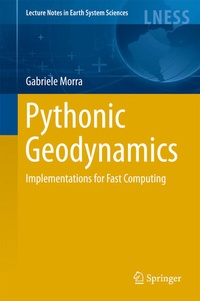
Pythonic Geodynamics
Implementations for Fast Computing
Published on 2. August 2017
Book
Hardback
XVI, 227 pages
978-3-319-55680-2 (ISBN)
Description
This book addresses students and young researchers who want to learn to use numerical modeling to solve problems in geodynamics. Intended as an easy-to-use and self-learning guide, readers only need a basic background in calculus to approach most of the material. The book difficulty increases very gradually, through four distinct parts. The first is an introduction to the Python techniques necessary to visualize and run vectorial calculations. The second is an overview with several examples on classical Mechanics with examples taken from standard introductory physics books. The third part is a detailed description of how to write Lagrangian, Eulerian and Particles in Cell codes for solving linear and non-linear continuum mechanics problems. Finally the last one address advanced techniques like tree-codes, Boundary Elements, and illustrates several applications to Geodynamics. The entire book is organized around numerous examples in Python, aiming at encouraging the reader to learn by experimenting and experiencing, not by theory.
More details
Series
Edition
1st ed. 2018
Language
English
Place of publication
Cham
Switzerland
Publishing group
Springer International Publishing
Target group
Professional and scholarly
Illustrations
40 farbige Abbildungen, 6 s/w Abbildungen
XVI, 227 p. 46 illus., 40 illus. in color.
Dimensions
Height: 241 mm
Width: 160 mm
Thickness: 19 mm
Weight
535 gr
ISBN-13
978-3-319-55680-2 (9783319556802)
DOI
10.1007/978-3-319-55682-6
Schweitzer Classification
Other editions
Additional editions
Book
08/2018
Springer
€96.29
Shipment within 10-15 days
E-Book
08/2017
Springer
€96.29
Available for download
Content
Bird's eye view.- Visualization.- Fast Python: NumPy and Cython.- Mechanics I: Kinematics.- Mechanics II: Newtonian Dynamics.- Insights on the physics of Stokes Flow.- Lagrangian Transport.- Operator Formulation.- Laplacian Operator and Diffusion.- Beyond Linearity.- Trees, Particles and Boundaries.- Applications to Geodynamics.- The future.