

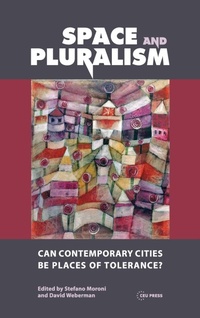
Space and Pluralism
Can Contemporary Cities Be Places of Tolerance?
Published on 20. July 2016
Book
Hardback
272 pages
978-963-386-124-0 (ISBN)
Description
This book addresses the social, functional and symbolic dimensions of urban space in today's world. The twelve essays are grouped in three parts, ranging from a conceptual framework to case descriptions rich with illustrations. They provide a valuable service in exploring the nature and significance of social space and particular aspects of its contemporary distribution and contestation. The book addresses a topic that is intrinsically interdisciplinary. Questions of space are examined from a rich variety of disciplinary perspectives in a welcome range from urban planning to political philosophy, shedding a good deal of light in the process. The issues in focus include the dichotomies of public and private space, discussion of rights and duties with regard to the use of space, or conflicts over its allocation. Well reasoned and presented discussion is offered from the perspective of basic values and rights. The policy issue of institutional recognition of the specifics of (minority community) identity is raised in opposition to abstract distributive accounts of justice.
More details
Language
English
Place of publication
Oxford
Hungary
Target group
Professional and scholarly
Academic
Product notice
sewn/stitched
Cloth over boards
Dimensions
Height: 235 mm
Width: 157 mm
Thickness: 19 mm
Weight
554 gr
ISBN-13
978-963-386-124-0 (9789633861240)
Copyright in bibliographic data and cover images is held by Nielsen Book Services Limited or by the publishers or by their respective licensors: all rights reserved.
Schweitzer Classification
Other editions
Additional editions
E-Book
07/2016
Central European University Press
€79.49
Available for download
Persons
Stefano Moroni is Professor in Planning at Milan Polytechnic, where he teaches "Land use ethics and the law." He is a member of the editorial board of "Planning Theory." He works on planning theory and on ethical and legal issues.
David Weberman is Associate Professor in Philosophy at Central European University, Budapest. He studied at Munich (MA) and Columbia (PhD). He has taught in the US and Hungary. He has published widely on 20th century European philosophy as well as on issues ranging from metaphysics and history to social and political theory.
David Weberman is Associate Professor in Philosophy at Central European University, Budapest. He studied at Munich (MA) and Columbia (PhD). He has taught in the US and Hungary. He has published widely on 20th century European philosophy as well as on issues ranging from metaphysics and history to social and political theory.
Content
List of Figures List of Tables Introduction: Space, Pluralism and Tolerance Stefano Moroni and David Weberman Part I: Overarching Themes 1. Space, Place and Politics Cecilia Lippai and David Weberman 2. Culture and Tolerance in Public Space Ali Madanipour 3. Pluralism and Failures of Recognition: The Need for Dialogue John Forester and David Laws Part II: Emerging Issues 4. Pluralism in Private Spaces: Homeowners Associations, Clubs, Shopping Malls Stefano Moroni and Francesco Chiodelli 5. A Dissenting View of Urban Public Space Andrew Kirby 6. A Right to a Mosque? Access to Public Space, Religious Freedom and Participatory Goods Emanuela Ceva and Federico Zuolo 7. Urban Space and Respect for Persons: Making Sense of Pluralism in Cities Enrico Biale Part III: Case Studies and Policies 8. Contested Identities and Spatial Marginalization: The Case of Roma and Gypsy-Travelers in Wales Francesco Chiesa and Enzo Rossi 9. Negotiating Identity in the Diaspora: Ethnoscapes of Southeast Asian Communities in Los Angeles Tridib Banerjee, Surajit Chakravarty and Felicity Hwee-Hwa Chan 10. What's "Out of Place"? Intolerance in Public Space Laco Tousek and Lenka Strnadova 11. Residential Neighborhoods in an Ethnically Mixed Area: Factors that Shape Coexistence Itzhak Omer List of Contributors Index