

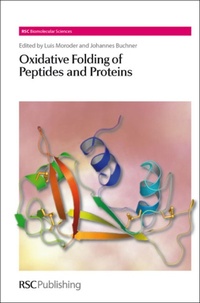
Oxidative Folding of Peptides and Proteins
Published on 10. December 2008
Book
Hardback
448 pages
978-0-85404-148-0 (ISBN)
Description
The formation of disulfide bonds is probably the most influential modification of peptides and proteins. An elaborate set of cellular machinery exists to catalyze and guide this process. In recent years, significant developments have been made in both our understanding of the in vivo situation and the in vitro manipulation of disulfide bonds. This is the first monograph to provide a comprehensive overview of this exciting and rapidly developing area. It offers in-depth insights into the mechanisms of in vivo and in vitro oxidative folding of proteins as well as mono- and multiple-stranded peptides. Procedures applied for laboratory and industrial purposes are also discussed by top experts in the field. The book describes the enzymes involved in the correct oxidative folding of cysteine-containing proteins in prokaryotes and eukaryotes. It then goes on to discuss the mimicking of these enzymes for successful in vitro folding of proteins (including synthetic replicates) and to deal with important issues concerning cysteine-rich peptides. The ability of natural bioactive peptides to fold correctly, and in high yields, to form defined structural motifs using cysteine sequence patterns is still puzzling. With this in mind, synthetic procedures for establishing native cysteine frameworks are discussed using selected examples, such as the potential of selenocysteines. The biotechnological and pharmaceutical relevance of proteins, peptides, their variants and synthetic replicates is continuously increasing. Consequently, this book is invaluable for peptide and protein chemists involved in related research and production.
More details
Series
Language
English
Place of publication
Cambridge
United Kingdom
Target group
College/higher education
Professional and scholarly
Product notice
Unsewn / adhesive bound
Dimensions
Height: 236 mm
Width: 155 mm
Thickness: 23 mm
Weight
816 gr
ISBN-13
978-0-85404-148-0 (9780854041480)
Copyright in bibliographic data and cover images is held by Nielsen Book Services Limited or by the publishers or by their respective licensors: all rights reserved.
Schweitzer Classification
Other editions
Additional editions
Luis Moroder | Johannes Buchner
Oxidative Folding of Peptides and Proteins
E-Book
12/2008
1st Edition
Royal Society of Chemistry
€199.99
Available for download
Persons
Johannes Buchner is based in the Department of Chemistry at the Technical University of Munich. His research interests focus on protein folding in vivo and in vitro, molecular chaperones, folding catalysts, antibody production and engineering. He is author and co-author of 150 publications including the Protein Folding Handbook. Luis Moroder is based at the Max Planck Institute. His research interests focus on biorganic chemistry, peptide chemistry, structure-function studies of bioactive peptides, conformational analysis and protein engineering. He is author and co-author of over 500 publications.
Content
Foreword;
Preface;
Oxidative Folding of Proteins in vivo;
Disulfide-bond Formation and Isomerization in Prokaryotes;
The Periplasm of E. coli - Oxidative Folding of Recombinant Proteins;
Oxidative Protein Folding in Mitochondria;
Oxidative Folding in the Endoplasmic Reticulum;
The Ero1 Sulfhydryl Oxidase and the Oxidizing Potential of the Endoplasmic Reticulum;
Eukaryotic Protein Disulfide-isomerases and their Potential in the Production of Disulfide-bonded Protein Products: What We Need to Know but Do Not!;
Cellular Responses to Oxidative Stress;
Oxidative Folding of Proteins in vitro;
Strategies for the Oxidative in vitro Refolding of Disulfide-bridge-containing Proteins;
Redox Potentials of Cysteine Residues in Peptides and Proteins: Methods for their Determination;
Engineered Disulfide Bonds for Protein Design;
Selenocysteine as a Probe of Oxidative Protein Folding;
Oxidative Folding of Peptides in vitro;
Regioselective Disulfide Formation;
Folding Motifs of Cystine-rich Peptides;
Double-stranded Cystine Peptides;
Multiple-strand Cystine Peptides;
Cystine-based Scaffolds for Functional Miniature Proteins;
Selenocystine Peptides - Synthesis, Folding and Applications;
Subject Index
Preface;
Oxidative Folding of Proteins in vivo;
Disulfide-bond Formation and Isomerization in Prokaryotes;
The Periplasm of E. coli - Oxidative Folding of Recombinant Proteins;
Oxidative Protein Folding in Mitochondria;
Oxidative Folding in the Endoplasmic Reticulum;
The Ero1 Sulfhydryl Oxidase and the Oxidizing Potential of the Endoplasmic Reticulum;
Eukaryotic Protein Disulfide-isomerases and their Potential in the Production of Disulfide-bonded Protein Products: What We Need to Know but Do Not!;
Cellular Responses to Oxidative Stress;
Oxidative Folding of Proteins in vitro;
Strategies for the Oxidative in vitro Refolding of Disulfide-bridge-containing Proteins;
Redox Potentials of Cysteine Residues in Peptides and Proteins: Methods for their Determination;
Engineered Disulfide Bonds for Protein Design;
Selenocysteine as a Probe of Oxidative Protein Folding;
Oxidative Folding of Peptides in vitro;
Regioselective Disulfide Formation;
Folding Motifs of Cystine-rich Peptides;
Double-stranded Cystine Peptides;
Multiple-strand Cystine Peptides;
Cystine-based Scaffolds for Functional Miniature Proteins;
Selenocystine Peptides - Synthesis, Folding and Applications;
Subject Index