

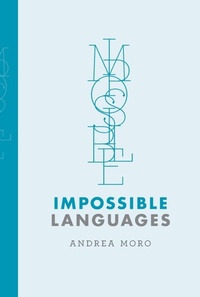
Impossible Languages
Published on 19. September 2023
Book
Paperback/Softback
160 pages
978-0-262-54923-3 (ISBN)
Description
An investigation into the possibility of impossible languages, searching for the indelible “fingerprint” of human language.
Can there be such a thing as an impossible human language? A biologist could describe an impossible animal as one that goes against the physical laws of nature (entropy, for example, or gravity). Are there any such laws that constrain languages? In this book, Andrea Moro—a distinguished linguist and neuroscientist—investigates the possibility of impossible languages, searching, as he does so, for the indelible “fingerprint” of human language.
Moro shows how the very notion of impossible languages has helped shape research on the ultimate aim of linguistics: to define the class of possible human languages. He takes us beyond the boundaries of Babel, to the set of properties that, despite appearances, all languages share, and explores the sources of that order, drawing on scientific experiments he himself helped design. Moro compares syntax to the reverse side of a tapestry revealing a hidden and apparently intricate structure. He describes the brain as a sieve, considers the reality of (linguistic) trees, and listens for the sound of thought by recording electrical activity in the brain. Words and sentences, he tells us, are like symphonies and constellations: they have no content of their own; they exist because we listen to them and look at them. We are part of the data.
Can there be such a thing as an impossible human language? A biologist could describe an impossible animal as one that goes against the physical laws of nature (entropy, for example, or gravity). Are there any such laws that constrain languages? In this book, Andrea Moro—a distinguished linguist and neuroscientist—investigates the possibility of impossible languages, searching, as he does so, for the indelible “fingerprint” of human language.
Moro shows how the very notion of impossible languages has helped shape research on the ultimate aim of linguistics: to define the class of possible human languages. He takes us beyond the boundaries of Babel, to the set of properties that, despite appearances, all languages share, and explores the sources of that order, drawing on scientific experiments he himself helped design. Moro compares syntax to the reverse side of a tapestry revealing a hidden and apparently intricate structure. He describes the brain as a sieve, considers the reality of (linguistic) trees, and listens for the sound of thought by recording electrical activity in the brain. Words and sentences, he tells us, are like symphonies and constellations: they have no content of their own; they exist because we listen to them and look at them. We are part of the data.
More details
Language
English
Place of publication
Cambridge (Massachusetts)
United States
Publishing group
MIT Press Ltd
Target group
Interest Age: From 18 years
Product notice
Paperback (trade)
Illustrations
2 B&W ILLUS.
Dimensions
Height: 203 mm
Width: 137 mm
Thickness: 10 mm
Weight
211 gr
ISBN-13
978-0-262-54923-3 (9780262549233)
Copyright in bibliographic data and cover images is held by Nielsen Book Services Limited or by the publishers or by their respective licensors: all rights reserved.
Schweitzer Classification
Other editions
Additional editions
Person
Andrea Moro is Professor of General Linguistics at the Institute for Advanced Study (IUSS) in Pavia, Italy. He is the author of Impossible Languages, The Boundaries of Babel, and A Brief History of the Verb To Be (all published by the MIT Press), and other books.
Content
Acknowledgments ix
1 Learning from the Impossible 1
2 Capturing the "Stem Mind" 11
3 Sentences as Snowflakes 21
4 The Unreasonable Sieve 33
5 The Boundaries of Babel 45
6 Intermezzo or What Exists When a Tree Exists? 61
7 Toward the Source of Order 71
8 The Sound of Thought 85
9 The Inverse Thunderstorm 99
10 Better Than Possible: Artificial Languages 107
11 A Closer Look at the Turtle's Eyes 117
References 123
Index 137
1 Learning from the Impossible 1
2 Capturing the "Stem Mind" 11
3 Sentences as Snowflakes 21
4 The Unreasonable Sieve 33
5 The Boundaries of Babel 45
6 Intermezzo or What Exists When a Tree Exists? 61
7 Toward the Source of Order 71
8 The Sound of Thought 85
9 The Inverse Thunderstorm 99
10 Better Than Possible: Artificial Languages 107
11 A Closer Look at the Turtle's Eyes 117
References 123
Index 137