

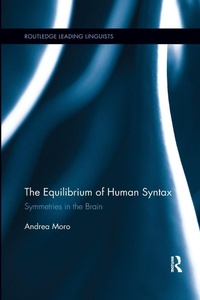
The Equilibrium of Human Syntax
Symmetries in the Brain
1st Edition
Published on 30. June 2020
Book
Paperback/Softback
488 pages
978-0-367-60187-4 (ISBN)
Description
This book assembles a collection of papers in two different domains: formal syntax and neurolinguistics. Here Moro provides evidence that the two fields are becoming more and more interconnected and that the new fascinating empirical questions and results in the latter field cannot be obtained without the theoretical base provided by the former.
The book is organized in two parts: Part 1 focuses on theoretical and empirical issues in a comparative perspective (including the nature of syntactic movement, the theory of locality and a far reaching and influential theory of copular sentences). Part 2 provides the original sources of some innovative and pioneering experiments based on neuroimaging techniques (focusing on the biological nature of recursion and the interpretation of negative sentences).
Moro concludes with an assessment of the impact of these perspectives on the theory of the evolution of language. The leading and pervasive idea unifying all the arguments developed here is the role of symmetry (breaking) in syntax and in the relationship between language and the human brain.
The book is organized in two parts: Part 1 focuses on theoretical and empirical issues in a comparative perspective (including the nature of syntactic movement, the theory of locality and a far reaching and influential theory of copular sentences). Part 2 provides the original sources of some innovative and pioneering experiments based on neuroimaging techniques (focusing on the biological nature of recursion and the interpretation of negative sentences).
Moro concludes with an assessment of the impact of these perspectives on the theory of the evolution of language. The leading and pervasive idea unifying all the arguments developed here is the role of symmetry (breaking) in syntax and in the relationship between language and the human brain.
More details
Series
Language
English
Place of publication
London
United Kingdom
Publishing group
Taylor & Francis Ltd
Target group
College/higher education
Postgraduate and Undergraduate
Dimensions
Height: 229 mm
Width: 152 mm
Thickness: 26 mm
Weight
700 gr
ISBN-13
978-0-367-60187-4 (9780367601874)
Copyright in bibliographic data and cover images is held by Nielsen Book Services Limited or by the publishers or by their respective licensors: all rights reserved.
Schweitzer Classification
Other editions
Additional editions
E-Book
09/2013
1st Edition
Routledge
€60.49
Available for download
E-Book
09/2013
1st Edition
Routledge
€60.49
Available for download
Book
12/2012
1st Edition
Routledge
€233.40
Shipment within 15-20 days
Person
Andrea Moro is Professor of General Linguistics and Director of the Center for Neurolinguistics and Theoretical Syntax (Ne.T.S.) at the Institute for Advanced Study IUSS - Pavia, Italy.
Content
Part 1: Symmetry (Breaking) in Syntax 1. Toward a Unified theory of copular sentences 2. Elements of copular syntax 3. Copular sentences 4. Existential sentences and expletive there 5. A short history of be 6. Heads as Antecedents: A Brief History of The ECP 7. Dynamic Antisymmetry: movement as a symmetry-breaking phenomenon 8. Linear compression as a trigger for movement 9. Rethinking Symmetry: A Note on Labelling and the EPP 10. Clause Structure Folding and the "Wh-in-Situ Effect" 11. Notes on Vocative case: a case study in clause structure Part 2: The Boundaries of Babel: How the Brain Shapes Grammars 12. Syntax and the brain: disentangling grammar by selective anomalies 13. The Neural Cost of the Auditory Perception of Language Switches: An Event-Related Functional Magnetic Resonance Imaging Study in Bilinguals 14. Neural correlates for the acquisition of natural language syntax 15. Broca's area and the language instinct 16. Syntax without language: neurobiological evidence for cross-domain syntactic computations 17. Negation in the brain: modulating action representations 18. Can syntax appear in a mirror (system)? 19. "Kataptation" or the QWERTY-effect in language evolution 20. A closer look at the Turtle's eyes