

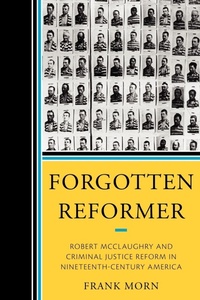
Forgotten Reformer
Robert McClaughry and Criminal Justice Reform in Nineteenth-Century America
Published on 22. December 2010
Book
Paperback/Softback
402 pages
978-0-7618-5300-8 (ISBN)
Description
Forgotten Reformer traces criminal justice practice and reform developments in late nineteenth-century America through the life and career of Robert McClaughry, a leading reformer. As a warden of one of America's toughest prisons, as a chief of police of Chicago, as a superintendent of two different reformatories, and as one of the first wardens of the federal prison system, McClaughry developed and led a reform movement that resonates today.
As a founding member of the reformatory movement that sought to "save" young first offenders, McClaughry advocated new sentencing structures, probation, parole, and rehabilitative regimes within new institutions for young first offenders called reformatories. McClaughry then successfully got these reformatory ideals placed into adult prisons.
In addition, McClaughry became American's main advocate for a criminal identification method called the Bertillon system. He set up the first identification bureaus at the Illinois State Penitentiary, the Chicago police department, and the federal prison at Leavenworth, Kansas and these became models for others across the country.
Finally, as a founding member of the National Association of Chiefs of Police (today the International Association of Chiefs of Police) and the National Prison Assocation (today American Corrections Association), McClaughry sought to professionalize police and prison administrators.
As a founding member of the reformatory movement that sought to "save" young first offenders, McClaughry advocated new sentencing structures, probation, parole, and rehabilitative regimes within new institutions for young first offenders called reformatories. McClaughry then successfully got these reformatory ideals placed into adult prisons.
In addition, McClaughry became American's main advocate for a criminal identification method called the Bertillon system. He set up the first identification bureaus at the Illinois State Penitentiary, the Chicago police department, and the federal prison at Leavenworth, Kansas and these became models for others across the country.
Finally, as a founding member of the National Association of Chiefs of Police (today the International Association of Chiefs of Police) and the National Prison Assocation (today American Corrections Association), McClaughry sought to professionalize police and prison administrators.
More details
Language
English
Place of publication
Lanham, MD
United States
Target group
College/higher education
Dimensions
Height: 229 mm
Width: 152 mm
Thickness: 24 mm
Weight
650 gr
ISBN-13
978-0-7618-5300-8 (9780761853008)
Copyright in bibliographic data and cover images is held by Nielsen Book Services Limited or by the publishers or by their respective licensors: all rights reserved.
Schweitzer Classification
Other editions
Additional editions
Frank Morn
Forgotten Reformer
Robert Mcclaughry and Criminal Justice Reform in Nineteenth-Century America
E-Book
12/2010
1st Edition
University Press of America
€61.99
Available for download
Frank Morn
Forgotten Reformer
Robert Mcclaughry and Criminal Justice Reform in Nineteenth-Century America
E-Book
12/2010
1st Edition
University Press of America
€61.99
Available for download
Person
Frank Morn is a professor of criminal justice sciences at Illinois State University. He is the author of "The Eye That Never Sleeps": A History of the Pinkerton National Detective Agency and Academic Politics and the History of Criminal Justice Education.
Content
Part 1 Preface
Part 2 Introduction
Part 3 Part 1 McClaughry and his Middle Border Beginnings
Part 4 Part 2 Crime and Punishment in Post-Civil War Illinois
Part 5 Part 3 McClaughry and the Reformatory Movement
Part 6 Part 4 Policing Chicago
Part 7 Part 5 State Politics and Penology: McClaughry at Pontiac
Part 8 Part 6 Growing a Prison Profession
Part 9 Part 7 McClaughry at Leavenworth
Part 10 Afterword: Forlorn Hope
Part 11 Bibliography
Part 2 Introduction
Part 3 Part 1 McClaughry and his Middle Border Beginnings
Part 4 Part 2 Crime and Punishment in Post-Civil War Illinois
Part 5 Part 3 McClaughry and the Reformatory Movement
Part 6 Part 4 Policing Chicago
Part 7 Part 5 State Politics and Penology: McClaughry at Pontiac
Part 8 Part 6 Growing a Prison Profession
Part 9 Part 7 McClaughry at Leavenworth
Part 10 Afterword: Forlorn Hope
Part 11 Bibliography