

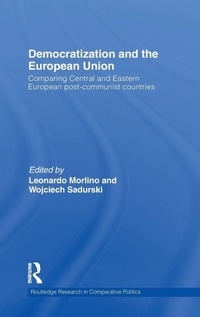
Democratization and the European Union
Comparing Central and Eastern European Post-Communist Countries
1st Edition
Published on 16. April 2010
Book
Hardback
288 pages
978-0-415-56044-3 (ISBN)
Description
This book examines in depth the impact of the EU on aspects of the quality of democracy in eight selected post-communist countries. Considering both the political and legal aspects of the dynamics among institutions and focussing on inter-institutional accountability, the book analyses how constitutional designs have been effectively implemented to achieve this, and to what extent this was the result of EU action.
In order to make a comparative assessment of the EU on democracies, the book features detailed case studies according to their different status vis-a-vis the EU, including older new member states: Poland and Hungary; newer new member states: Romania and Bulgaria; potential candidates: Albania and Serbia; and neighbour and remote neighbour states: Ukraine and Armenia. Each chapter addresses a range of dimensions and most relevant domains of inter-institutional accountability, that is: executive-legislative relationships; constitutional justice; decentralisation and regionalism; and the role of ombudsman or other relevant authorities.
Seeking to assess how important the role of the EU has been in influencing the modes and characteristic of democracies and fundamental rights established in these regions, this book will be of interest to students and scholars of comparative politics, EU politics, Post-communist studies and democratization studies.
In order to make a comparative assessment of the EU on democracies, the book features detailed case studies according to their different status vis-a-vis the EU, including older new member states: Poland and Hungary; newer new member states: Romania and Bulgaria; potential candidates: Albania and Serbia; and neighbour and remote neighbour states: Ukraine and Armenia. Each chapter addresses a range of dimensions and most relevant domains of inter-institutional accountability, that is: executive-legislative relationships; constitutional justice; decentralisation and regionalism; and the role of ombudsman or other relevant authorities.
Seeking to assess how important the role of the EU has been in influencing the modes and characteristic of democracies and fundamental rights established in these regions, this book will be of interest to students and scholars of comparative politics, EU politics, Post-communist studies and democratization studies.
More details
Series
Language
English
Place of publication
London
United Kingdom
Publishing group
Taylor & Francis Ltd
Target group
College/higher education
Product notice
Paper over boards
Illustrations
1 s/w Abbildung, 1 s/w Zeichnung, 18 s/w Tabellen
18 Tables, black and white; 1 Line drawings, black and white; 1 Illustrations, black and white
Dimensions
Height: 240 mm
Width: 161 mm
Thickness: 20 mm
Weight
599 gr
ISBN-13
978-0-415-56044-3 (9780415560443)
Copyright in bibliographic data and cover images is held by Nielsen Book Services Limited or by the publishers or by their respective licensors: all rights reserved.
Schweitzer Classification
Other editions
Additional editions
Leonardo Morlino | Wojciech Sadurski
Democratization and the European Union
Comparing Central and Eastern European Post-Communist Countries
Book
12/2015
1st Edition
Routledge
€71.70
Shipment within 10-20 days
Leonardo Morlino | Wojciech Sadurski
Democratization and the European Union
Comparing Central and Eastern European Post-Communist Countries
E-Book
05/2010
Routledge
€64.49
Available for download
Leonardo Morlino | Wojciech Sadurski
Democratization and the European Union
Comparing Central and Eastern European Post-Communist Countries
E-Book
05/2010
Routledge
€64.49
Available for download
Persons
Leonardo Morlino is Professor of Political Science at the Istituto di Scienze Umane, Florence, Italy and President of the?International Political Science Association (IPSA).
Wojciech Sadurski is Challis professor of Jurisprudence in the University of Sydney, Australia.
Wojciech Sadurski is Challis professor of Jurisprudence in the University of Sydney, Australia.
Content
1. Introduction Leonardo Morlino and Wojciech Sadurski Part 1: "Old-new" Member States 2. Poland: EU Driven Democracy? Adam Bodnar 3. Hungary: High Hopes Revisited Renata Uitz Part 2: "New-new" Member States 4. Romania: A Personalistic Approach to Accountability Alina Stanciulescu 5. Bulgaria: Discontents and Frustrations of a Newly-Consolidated Democracy Daniel Smilov Part 3: Potential Candidate and Neighbour Countries 6. Serbia in Search of Stability and Accountability Cristina Dallara and Irena Marceta 7. Albania and its Struggle to Consolidate Democracy Darinka Piqani 8. Ukraine: A Constitutional Design Between Facade Democracy and Effective Transformation? Oleksandr Serdiuk and Roman Petrov 9. Armenia: Constitutional Design, Accountability and European Integration Armen Mazmanyan 10. Conclusions Leonardo Morlino and Wojciech Sadurski. Bibliography