

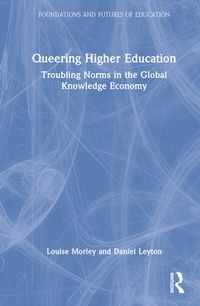
Queering Higher Education
Troubling Norms in the Global Knowledge Economy
1st Edition
Published on 30. December 2022
Book
Hardback
194 pages
978-1-032-19033-4 (ISBN)
Description
This interdisciplinary and international book subjects key areas of inclusion in the global knowledge economy to critical scrutiny from queer perspectivism. Drawing on empirical data from diverse international contexts including Chile, Finland, Japan, Malaysia, India, Afghanistan, Bangladesh, Nepal, Pakistan, Sri Lanka, Ghana, Tanzania, South Africa, and the UK, this book examines sites of affective antagonisms, fragility, and friction, and explores whether queer theory can provide alternative readings of contemporary pathways, pedagogical and research cultures, political economies, and policy priorities with higher education. Main themes covered include:
The Global Knowledge Economy and Epistemic Injustice
Decolonisation
Internationalisation
Feminist Leadership
Affirmative Action
Queering the Political Economy of Neoliberalism
Digitalisation of academic work
Both comparative and illustrative, this key text provides a comparative analysis that recognises epistemic diversity, multiplicity of experiences, and, importantly, the effect of comparative reason in constructing stratified universities' world fields and excluded and marginal academic experiences. It also takes into account the colonial historical entanglements in the ongoing formation and disavowal of the university and academic labour.
Queering Higher Education: Troubling Norms in the Global Knowledge Economy is ideal reading for all those interested in queer theory and how it relates to higher education.
The Global Knowledge Economy and Epistemic Injustice
Decolonisation
Internationalisation
Feminist Leadership
Affirmative Action
Queering the Political Economy of Neoliberalism
Digitalisation of academic work
Both comparative and illustrative, this key text provides a comparative analysis that recognises epistemic diversity, multiplicity of experiences, and, importantly, the effect of comparative reason in constructing stratified universities' world fields and excluded and marginal academic experiences. It also takes into account the colonial historical entanglements in the ongoing formation and disavowal of the university and academic labour.
Queering Higher Education: Troubling Norms in the Global Knowledge Economy is ideal reading for all those interested in queer theory and how it relates to higher education.
Reviews / Votes
'It's great to see queer theory informing research in Higher Education in ways that go beyond adding queers and stirring. Rather, this is a valuable stirring of the academy; a queering that travels beyond the global north to draw insights from research in Higher Education undertaken in East and South Asia, Europe, Latin America, and sub-Saharan Africa.'Professor Mary Lou Rasmussen, School of Sociology, The Australian National University
More details
Series
Language
English
Place of publication
London
United Kingdom
Publishing group
Taylor & Francis Ltd
Target group
College/higher education
Professional and scholarly
Postgraduate and Professional
Dimensions
Height: 234 mm
Width: 156 mm
Weight
360 gr
ISBN-13
978-1-032-19033-4 (9781032190334)
Copyright in bibliographic data and cover images is held by Nielsen Book Services Limited or by the publishers or by their respective licensors: all rights reserved.
Schweitzer Classification
Other editions
Additional editions
Louise Morley | Daniel Leyton
Queering Higher Education
Troubling Norms in the Global Knowledge Economy
E-Book
12/2022
1st Edition
Routledge
€49.99
Available for download
Louise Morley | Daniel Leyton
Queering Higher Education
Troubling Norms in the Global Knowledge Economy
Book
12/2022
1st Edition
Routledge
€54.90
Shipment within 10-20 days
Louise Morley | Daniel Leyton
Queering Higher Education
Troubling Norms in the Global Knowledge Economy
E-Book
12/2022
1st Edition
Routledge
€49.99
Available for download
Persons
Louise Morley, FacSS, is Emeritus Professor of Higher Education and former Director of the Centre for Higher Education and Equity Research (CHEER) (http://www.sussex.ac.uk/education/cheer/) at the University of Sussex, UK. Louise has published and presented widely and she has an international reputation in the field of higher education studies (see http://sro.sussex.ac.uk/view/creators/461.html).
Daniel Leyton is Lecturer of Education at the University at the University of Exeter. His recent publications include Neoliberalising Working-class Subjectification through Affirmative Action Policies: Managerial Leadership and Ontological Coaching in Higher Education (2022) in Journal of Education Policy and The Un/methodology of 'Theoretical Intuitions': Resources of Generations Gone Before, Thinking and Feeling Class in Discourse: Studies in the Cultural Politics of Education, with Valerie Hey and Sarah Leaney.
Daniel Leyton is Lecturer of Education at the University at the University of Exeter. His recent publications include Neoliberalising Working-class Subjectification through Affirmative Action Policies: Managerial Leadership and Ontological Coaching in Higher Education (2022) in Journal of Education Policy and The Un/methodology of 'Theoretical Intuitions': Resources of Generations Gone Before, Thinking and Feeling Class in Discourse: Studies in the Cultural Politics of Education, with Valerie Hey and Sarah Leaney.
Content
Introduction
1. Rainbow Laces and Safe Spaces: Applying Queer Theory to Inclusive Higher Education
2. Covid-19- Pandemic Productivity, Epidemic/ Epistemic Inclusion, and Staying with the Mess
3. Queering the Digital Knowledge Economy: Disruption, Personalisation, and Privatisation
4. Queering Internationalisation: Contesting Policy and Knowledge Imaginaries from Migrants' Embodied Experiences
5. Troubling Affirmative Action's Global Normalisation in Higher Education
6. Queering Women in Higher Education Leadership
Conclusion: You Need to Unmute Yourself
Index
1. Rainbow Laces and Safe Spaces: Applying Queer Theory to Inclusive Higher Education
2. Covid-19- Pandemic Productivity, Epidemic/ Epistemic Inclusion, and Staying with the Mess
3. Queering the Digital Knowledge Economy: Disruption, Personalisation, and Privatisation
4. Queering Internationalisation: Contesting Policy and Knowledge Imaginaries from Migrants' Embodied Experiences
5. Troubling Affirmative Action's Global Normalisation in Higher Education
6. Queering Women in Higher Education Leadership
Conclusion: You Need to Unmute Yourself
Index