

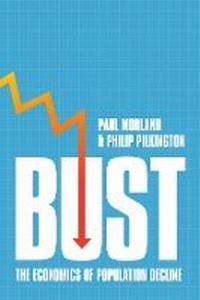
Bust
The Economics of Population Decline
1st Edition
Will be published approx. on 6. November 2026
Book
Hardback
234 pages
978-1-5095-7253-3 (ISBN)
Description
We are entering an era of population decline across the developed world (and beyond). Few have given serious thought to what this might mean economically. Will an ageing society and dwindling population be easily accommodated or strike at the very heart of our prosperity?
Paul Morland and Philip Pilkington argue that the consequences of the coming demographic upheaval will be economically devastating. All of the assumptions of economists - that a world of above-replacement birth rates and gentle annual population growth could be taken for granted - are being upended. Once economics drove population changes, but now demography is the most fundamental force shaping our economic future. Bust addresses everything from labour and capital markets to housing and the welfare state, showing the profoundly worrying consequences of a shrinking working age population and an ageing society. Unless we take radical action to bolster birth-rates, we face a future of falling living standards, high inflation and low growth.
This book shines a penetrating light on one of the most ominous - and least understood - economic and social challenges of the 21st century. No-one who reads it will look upon public policy or the future of our society in the same way again.
Paul Morland and Philip Pilkington argue that the consequences of the coming demographic upheaval will be economically devastating. All of the assumptions of economists - that a world of above-replacement birth rates and gentle annual population growth could be taken for granted - are being upended. Once economics drove population changes, but now demography is the most fundamental force shaping our economic future. Bust addresses everything from labour and capital markets to housing and the welfare state, showing the profoundly worrying consequences of a shrinking working age population and an ageing society. Unless we take radical action to bolster birth-rates, we face a future of falling living standards, high inflation and low growth.
This book shines a penetrating light on one of the most ominous - and least understood - economic and social challenges of the 21st century. No-one who reads it will look upon public policy or the future of our society in the same way again.
Reviews / Votes
"Economics once determined demography, now demography is determining economics. So to properly understand the huge implications of fertility collapse on our economies we need demographers and economists to collaborate. Such a sparkling collaboration is just what this important book provides."David Goodhart, author of The Road to Somewhere and The Care Dilemma
More details
Persons
Paul Morland is one of the world's leading demographers. He has been an Associate Research Fellow at Birkbeck, University of London, and a Senior Member at St Antony's College, University of Oxford. His previous books include The Human Tide and No One Left.
Philip Pilkington is a macroeconomist and investment professional. He regularly writes for Unherd, The Spectator, The New York Post, and American Affairs. He is co-host of the popular geopolitics podcast Multipolarity. His most recent book is The Collapse of Global Liberalism.
Philip Pilkington is a macroeconomist and investment professional. He regularly writes for Unherd, The Spectator, The New York Post, and American Affairs. He is co-host of the popular geopolitics podcast Multipolarity. His most recent book is The Collapse of Global Liberalism.
Content
Chapter One: Economics and Demography - An Introduction
PART ONE: ECONOMICS AND DEMOGRAPHY PAST
Chapter Two: Pre-Modern - Economics Constrains Demography
Chapter Three: Modern - Economics Shapes Demography
Chapter Four: Post-Modern - Demography Shapes Economic
PART TWO: ECONOMICS AND DEMOGRAPHY PRESENT
Chapter Five: Ageing, Stagnation and Inflation
Chapter Six: The Grey Economy
Chapter Seven: The Vampire Economy
Chapter Eight: Housing
PART THREE: ECONOMICS AND DEMOGRAPHY FUTURE
Chapter Nine: Economic Pronatalism
Chapter Ten: The Law as Teacher
PART ONE: ECONOMICS AND DEMOGRAPHY PAST
Chapter Two: Pre-Modern - Economics Constrains Demography
Chapter Three: Modern - Economics Shapes Demography
Chapter Four: Post-Modern - Demography Shapes Economic
PART TWO: ECONOMICS AND DEMOGRAPHY PRESENT
Chapter Five: Ageing, Stagnation and Inflation
Chapter Six: The Grey Economy
Chapter Seven: The Vampire Economy
Chapter Eight: Housing
PART THREE: ECONOMICS AND DEMOGRAPHY FUTURE
Chapter Nine: Economic Pronatalism
Chapter Ten: The Law as Teacher