

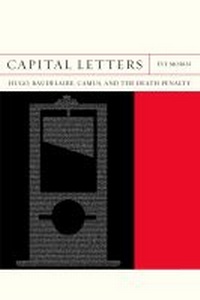
Capital Letters
Hugo, Baudelaire, Camus, and the Death Penalty
Published on 30. March 2020
Book
Hardback
280 pages
978-0-8101-4152-0 (ISBN)
Description
Capital Letters sheds new light on how literature has dealt with society's most violent legal institution, the death penalty. It investigates this question through the works of three major French authors with markedly distinct political convictions and literary styles: Victor Hugo, Charles Baudelaire, and Albert Camus.
Working at the intersection of poetics, ethics, and law, Eve Morisi uncovers an unexpected transhistorical dialogue on both the modern death penalty and the ends and means of literature after the French Revolution. Through close textual analysis, careful contextualization, and the critique of violence forged by Giorgio Agamben, Michel Foucault, and RenE Girard, Morisi reveals that, despite their differences, Hugo, Baudelaire, and Camus converge in questioning France's humanitarian redefinition of capital punishment dating from the late eighteenth century.
Conversely, capital justice leads all three writers to interrogate the functions, tools, and limits of their art. Capital Letters shows that the key modern debate on the political and moral responsibility, or autonomy, of literature crystallizes around the death penalty. Inflecting traditional modes of representation and writing self-reflexively or self-critically, Hugo, Baudelaire, and Camus unsettle the commonly accepted divide between strictly aesthetic and politically committed writing. Form, rather than overtly political argument, at once conveys an ethical critique of justice and reflects on the possibilities, and duties, of literature.
Working at the intersection of poetics, ethics, and law, Eve Morisi uncovers an unexpected transhistorical dialogue on both the modern death penalty and the ends and means of literature after the French Revolution. Through close textual analysis, careful contextualization, and the critique of violence forged by Giorgio Agamben, Michel Foucault, and RenE Girard, Morisi reveals that, despite their differences, Hugo, Baudelaire, and Camus converge in questioning France's humanitarian redefinition of capital punishment dating from the late eighteenth century.
Conversely, capital justice leads all three writers to interrogate the functions, tools, and limits of their art. Capital Letters shows that the key modern debate on the political and moral responsibility, or autonomy, of literature crystallizes around the death penalty. Inflecting traditional modes of representation and writing self-reflexively or self-critically, Hugo, Baudelaire, and Camus unsettle the commonly accepted divide between strictly aesthetic and politically committed writing. Form, rather than overtly political argument, at once conveys an ethical critique of justice and reflects on the possibilities, and duties, of literature.
More details
Series
Language
English
Place of publication
Evanston
United States
Target group
Professional and scholarly
Illustrations
5 black & white images running in text
Dimensions
Height: 229 mm
Width: 152 mm
Thickness: 17 mm
Weight
633 gr
ISBN-13
978-0-8101-4152-0 (9780810141520)
Copyright in bibliographic data and cover images is held by Nielsen Book Services Limited or by the publishers or by their respective licensors: all rights reserved.
Schweitzer Classification
Other editions
Additional editions
E-Book
03/2020
1st Edition
Northwestern University Press
€102.99
Available for download
Person
Eve Morisi is an associate professor of French and Francophone literature at the University of Oxford.