

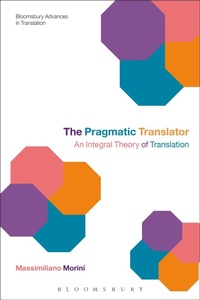
The Pragmatic Translator
An Integral Theory of Translation
Published on 26. June 2014
Book
Paperback/Softback
240 pages
978-1-4725-7585-2 (ISBN)
Description
This book is concerned with translation theory. It proposes an all-round view of translation in the terms of modern pragmatics, as articulated in three pragmatic functions (performative, interpersonal and locative) which describe how translated texts function in the world, involve readers and are rooted in their spatio-temporal contexts. It presents a full and up to date view of translation that takes into account thirty years of research in the field of Descriptive Translation Studies. Unlike DTS, the theory provides an account of products and processes. This publication exhibits the need for and usefulness of such a theory, and will be essential reading for scholars involved in translation and interpreting studies.
More details
Series
Language
English
Place of publication
London
United Kingdom
Publishing group
Bloomsbury Publishing PLC
Target group
College/higher education
Professional and scholarly
Dimensions
Height: 234 mm
Width: 156 mm
Thickness: 12 mm
Weight
327 gr
ISBN-13
978-1-4725-7585-2 (9781472575852)
Copyright in bibliographic data and cover images is held by Nielsen Book Services Limited or by the publishers or by their respective licensors: all rights reserved.
Schweitzer Classification
Other editions
Additional editions
E-Book
12/2012
1st Edition
Bloomsbury Academic USA
€42.99
Available for download
Persons
Massimiliano Morini is Associate Professor of English Linguistics and Translation at the University of Udine, Italy.
Content
1. Introduction: A linguistic theory of translation \ 2. The Pragmatic Translator \ 3. The Performative Function 1: from text-type to text act \ 4. The Performative Function 2: how to do things with poems \ 5. The Interpersonal Function 1: the translator's personality \ 6. The Interpersonal Function 2: The death of the source author \ 7. The Locative Function 1: Translating space, translating time \ 8. The Locative Function 2: Repositioning Humour in Film and Comics \ 9. Conclusion \ Bibliography \ Index