

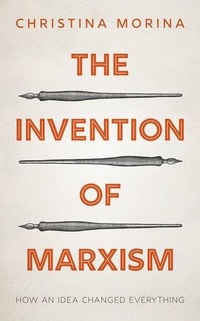
The Invention of Marxism
How an Idea Changed Everything
Published on 12. January 2023
Book
Hardback
558 pages
978-0-19-885208-7 (ISBN)
Description
How did one man's critique of capitalism guide the course of modern history?
When he died in 1883, Karl Marx left behind an intellectual legacy of formidable proportions and revolutionary potential, yet one that exerted limited actual political, social, or economic influence. The full force of his ideas did not come into play for another generation, and only after they had been appropriated and applied by some of Marxism's earliest proponents. The history of Marxism, in other words, is the story of those who brought Marx's ideas into play, transforming a sweeping but fractious and occasionally abstruse view of historical and social forces into a coherent plan of action. Christina Morina's illuminating book focuses on the first generation of Marxists who turned the work and ideas of one social theorist, one among many, into one of the most powerful transnational political movements in modern history.
The Invention Of Marxism is therefore a group portrait, featuring such figures as Rosa Luxemburg, Max Adler, Jean Jaures, Eduard Bernstein, Karl Kautsky, and Vladimir Lenin - German, French, Russian, Czech - whose lives became dedicated to interpreting and applying Marxist thought. They were the vehicles by which his ideas were read, debated, and gradually adopted in socialist movements across Europe. Morina's fascinating book therefore reconstructs the beginnings of Marxism through the individual politicization of a group of intellectuals who made it their purpose in life to solve the 'social question', exploring the nexus between their intellectual constructs and social and political reality. The Invention of Marxism shows how what started as a theory of capitalism grew into a fully-fledged political philosophy and platform, one that shaped the century that followed Marx's death. In short, it reveals how an idea first conquered these individuals and then the world.
When he died in 1883, Karl Marx left behind an intellectual legacy of formidable proportions and revolutionary potential, yet one that exerted limited actual political, social, or economic influence. The full force of his ideas did not come into play for another generation, and only after they had been appropriated and applied by some of Marxism's earliest proponents. The history of Marxism, in other words, is the story of those who brought Marx's ideas into play, transforming a sweeping but fractious and occasionally abstruse view of historical and social forces into a coherent plan of action. Christina Morina's illuminating book focuses on the first generation of Marxists who turned the work and ideas of one social theorist, one among many, into one of the most powerful transnational political movements in modern history.
The Invention Of Marxism is therefore a group portrait, featuring such figures as Rosa Luxemburg, Max Adler, Jean Jaures, Eduard Bernstein, Karl Kautsky, and Vladimir Lenin - German, French, Russian, Czech - whose lives became dedicated to interpreting and applying Marxist thought. They were the vehicles by which his ideas were read, debated, and gradually adopted in socialist movements across Europe. Morina's fascinating book therefore reconstructs the beginnings of Marxism through the individual politicization of a group of intellectuals who made it their purpose in life to solve the 'social question', exploring the nexus between their intellectual constructs and social and political reality. The Invention of Marxism shows how what started as a theory of capitalism grew into a fully-fledged political philosophy and platform, one that shaped the century that followed Marx's death. In short, it reveals how an idea first conquered these individuals and then the world.
Reviews / Votes
Morinas pen-portraits - fine-grained, deftly interlinked - are superb. Forgotten figures, such as Adler and Struve, are coaxed back into the sunlight, famous ones - Lenin, Kautsky, Luxemburg - reimagined * Madoc Cairns, Times Literary Supplement * Morina's pen-portraits - fine-grained, deftly interlinked are superb. * Madoc Cairns, Editor at Plough Quarterly , TLS * The Invention of Marxism provides rich biographical portraits of the first generation of Marx's most ardent followers. * Choice *More details
Language
English
Place of publication
Oxford
United Kingdom
Target group
Professional and scholarly
Dimensions
Height: 219 mm
Width: 139 mm
Thickness: 43 mm
Weight
824 gr
ISBN-13
978-0-19-885208-7 (9780198852087)
Copyright in bibliographic data and cover images is held by Nielsen Book Services Limited or by the publishers or by their respective licensors: all rights reserved.
Schweitzer Classification
Other editions
Additional editions
E-Book
05/2023
1st Edition
OUP eBook
€35.49
Available for download
E-Book
12/2022
1st Edition
OUP eBook
€35.49
Available for download
Person
Christina Morina is Professor of Modern and Contemporary History at the University of Bielefeld. Her research focuses on major themes in nineteenth and twentieth century German and European history, especially World War II, the Holocaust and bystander history, political and memory cultures in Germany since 1945, the history of Marxism, and the history of historiography. In 2017, she published her second monograph Die Erfindung des Marxismus: Wie eine Idee die Welt eroberte. She is also co-author of Zur rechten Zeit: Wider die Rueckkehr das Nationalismus (with Norbert Frei, Franka Maubach und Maik Taendler, 2019) and co-editor of Das 20. Jahrhundert erzaehlen: Zeiterfahrung und Zeiterforschung im geteilten Deutschland (with Franka Maubach, 2016) as well as Probing the Limits of Categorization: The Bystander in Holocaust History (with Krijn Thijs, 2018).
Content
PROLOGUE: Marxism as a Generational Project
I SOCIALIZATION
Born in the Nineteenth Century: Family Influences
Adolescence and Its Discontents: Emerging Worldviews
Beating the Drum: Literary Influences
II POLITICIZATION
Paths to Marxism I: London, Paris, Zurich, Vienna (1878-1888)
Translating Marxism: Guesde and Jaures
Star Students: Bernstein and Kautsky
Theory and Practice: Adler's Belated Marxism
Paths to Marxism II: Geneva, Warsaw, St. Petersburg (1885-1903)
The Social Question as a Political Question: Plekhanov's Turn toward Marx
The Social Question as a Question of Power: Struve and Lenin
Engagement as Science: Luxemburg
III ENGAGEMENT
On Misery, or the First Commandment: The Radical Study of Reality
Miserable Living: Depicting Proletarians and Peasants
Miserable Labor: The Proletarian World of Work
On Revolution, or the Second Commandment: Philosophy as Practice
Revolutionary Expectations
Revolution at Last? Dress Rehearsal in St. Petersburg, 1905/06
CONCLUSION: From Marx to Marxism: Fieldworkers, Bookworms, and Adventurers
I SOCIALIZATION
Born in the Nineteenth Century: Family Influences
Adolescence and Its Discontents: Emerging Worldviews
Beating the Drum: Literary Influences
II POLITICIZATION
Paths to Marxism I: London, Paris, Zurich, Vienna (1878-1888)
Translating Marxism: Guesde and Jaures
Star Students: Bernstein and Kautsky
Theory and Practice: Adler's Belated Marxism
Paths to Marxism II: Geneva, Warsaw, St. Petersburg (1885-1903)
The Social Question as a Political Question: Plekhanov's Turn toward Marx
The Social Question as a Question of Power: Struve and Lenin
Engagement as Science: Luxemburg
III ENGAGEMENT
On Misery, or the First Commandment: The Radical Study of Reality
Miserable Living: Depicting Proletarians and Peasants
Miserable Labor: The Proletarian World of Work
On Revolution, or the Second Commandment: Philosophy as Practice
Revolutionary Expectations
Revolution at Last? Dress Rehearsal in St. Petersburg, 1905/06
CONCLUSION: From Marx to Marxism: Fieldworkers, Bookworms, and Adventurers