

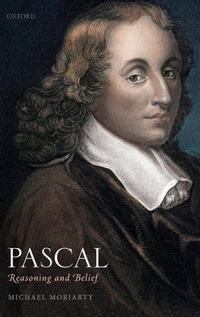
Pascal: Reasoning and Belief
Reasoning and Belief
Published on 27. February 2020
Book
Hardback
426 pages
978-0-19-884911-7 (ISBN)
Description
This book is a study of Blaise Pascal's defence of Christian belief in the Pensees. Michael Moriarty aims to expound--and in places to criticize--what he argues is a coherent and original apologetic strategy. Setting out the basic philosophical and theological presuppositions of Pascal's project, the present volume draws the distinction between convictions attained by reason and those inspired by God-given faith. It also presents Pascal's view of the contradictions within human nature, between the 'wretchedness' (our inability to live the life of reason, to attain secure and durable happiness) and the 'greatness' (the power of thought, manifested in the very awareness of our wretchedness). His mind-body dualism and his mechanistic conception of non-human animals are discussed. Pascal invokes the biblical story of the Fall and the doctrine of original sin as the only credible explanation of these contradictions. His analysis of human occupations as powered by the twin desire to escape from painful thoughts and to gratify one's vanity is subjected to critical examination, as is his conception of the self and self-love. Pascal argues that just as Christianity propounds the only explanation for the human condition, so it offers the only kind of happiness that would satisfy our deepest longings. He thus reasons that we have an interest in investigating its truth-claims as rooted in the Bible and in history. The closing chapters of this book discuss Pascal's view of Christian morality and the famous 'wager' argument for opting in favour of Christian belief.
Reviews / Votes
In exploring the validity of Pascal's claims, Moriarty appeals to a wide variety of sources, ancient and modern, analytic and contemporary European. * Daniel Garber, Princeton University, Journal of the History of Philosophy * Moriarty's contribution here breaks boundaries in the extraordinary depth of its intellectual quality and in its sheer philosophical scope. * Henry Phillips, The Seventeenth Century * It is common practice to avoid writing extremely laudatory reviews of academic books. In this case, however, it is appropriate to make an exception, because Michael Moriarty's recent monograph on Pascal is nothing short of a masterpiece ... Thanks to its originality, accuracy and convincing argument, Moriarty's monograph on Pascal is likely to become the standard book on this author's religious thought. Therefore, this book definitely deserves to be read by all those interested in early modern thought. * Diego Lucci, Journal of Ecclesiastical History * This book is an excellent contribution to the immense body of literature on Blaise Pascal (1623-62). Highly recommended. Graduate students, researchers, faculty. * B. T. Harding, Texas Woman's University, CHOICE * Especially strong are the careful arguments about Pascal's theological structures and his imaginative force, certainly one of the most powerful elements in the Pensees, together with the way in which it facilitates the making of connections. * Mary Ann Caws, Graduate School, City University of New York *More details
Language
English
Place of publication
Oxford
United Kingdom
Target group
College/higher education
Dimensions
Height: 240 mm
Width: 161 mm
Thickness: 27 mm
Weight
801 gr
ISBN-13
978-0-19-884911-7 (9780198849117)
Copyright in bibliographic data and cover images is held by Nielsen Book Services Limited or by the publishers or by their respective licensors: all rights reserved.
Schweitzer Classification
Other editions
Additional editions
Michael Moriarty
Pascal: Reasoning and Belief
E-Book
02/2020
1st Edition
OUP eBook
€57.99
Available for download
Michael Moriarty
Pascal: Reasoning and Belief
E-Book
02/2020
1st Edition
OUP eBook
€63.49
Available for download
Person
Michael Moriarty is Drapers Professor of French at the University of Cambridge, and a Fellow of Peterhouse. He works chiefly on the literature and thought of the early modern period. His publications include Early Modern French Thought (Oxford 2003), Fallen Nature, Fallen Selves (Oxford 2006), and Disguised Vices (Oxford 2011). He is co-editor of The Camswinbridge History of French Thought (2019), and he has translated Rene Descartes's Meditations on First Philosophy and The Passions on the Soul for the Oxford World's Classics series. Moriarty is a Fellow of the British Academy and a Chevalier dans l'Ordre des Palmes Academiques.
Content
Part One
1: Introduction
2: Contexts
3: The Uses of Philosophy
4: Belief, Reason, Persuasion, Faith
5: Order and Disorder
6: Futility and Wretchedness
7: Reasons for the Irrational
8: Human Greatness
9: Contradictions
10: The Fall
11: Self
Part Two
12: Diversion
13: Happiness
14: 'The Plan of his Whole Work'
Part Three
15: The Need to Seek for God
16: The Claims and Limits of Reason
17: Transition
18: True and False Religions: the Singularity of Christianity
19: The Order of Charity
20: The Wager
21: Conclusion
1: Introduction
2: Contexts
3: The Uses of Philosophy
4: Belief, Reason, Persuasion, Faith
5: Order and Disorder
6: Futility and Wretchedness
7: Reasons for the Irrational
8: Human Greatness
9: Contradictions
10: The Fall
11: Self
Part Two
12: Diversion
13: Happiness
14: 'The Plan of his Whole Work'
Part Three
15: The Need to Seek for God
16: The Claims and Limits of Reason
17: Transition
18: True and False Religions: the Singularity of Christianity
19: The Order of Charity
20: The Wager
21: Conclusion