

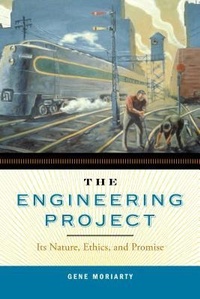
The Engineering Project
Its Nature, Ethics, and Promise
Will be published approx. on 31. March 2008
Book
Hardback
224 pages
978-0-271-03254-2 (ISBN)
Description
We all live our daily lives surrounded by the products of technology that make what we do simpler, faster, and more efficient. These are benefits we often just take for granted. But at the same time, as these products disburden us of unwanted tasks that consumed much time and effort in earlier eras, many of them also leave us more disengaged from our natural and even human surroundings. It is the task of what Gene Moriarty calls focal engineering to create products that will achieve a balance between disburdenment and engagement: "How much disburdenment will be appropriate while still permitting an engagement that enriches one's life, elevates the spirit, and calls forth a good life in a convivial society?"
One of his examples of a focally engineered structure is the Golden Gate Bridge, which "draws people to it, enlivens and elevates the human spirit, and resonates with the world of its congenial setting. Humans, bridge, and world are in tune." These values of engagement, enlivenment, and resonance are key to the normative approach Moriarty brings to the profession of engineering, which traditionally has focused mainly on technical measures of evaluation such as efficiency, productivity, objectivity, and precision. These measures, while important, look at the engineered product in a local and limited sense. But "from a broader perspective, what is locally benign may present serious moral problems," undermining "social justice, environmental sustainability, and health and safety of affected parties." It is this broader perspective that is championed by focal engineering, the subject of Part III of the book, which Moriarty contrasts with "modern" engineering in Part I and "pre-modern" engineering in Part II.
One of his examples of a focally engineered structure is the Golden Gate Bridge, which "draws people to it, enlivens and elevates the human spirit, and resonates with the world of its congenial setting. Humans, bridge, and world are in tune." These values of engagement, enlivenment, and resonance are key to the normative approach Moriarty brings to the profession of engineering, which traditionally has focused mainly on technical measures of evaluation such as efficiency, productivity, objectivity, and precision. These measures, while important, look at the engineered product in a local and limited sense. But "from a broader perspective, what is locally benign may present serious moral problems," undermining "social justice, environmental sustainability, and health and safety of affected parties." It is this broader perspective that is championed by focal engineering, the subject of Part III of the book, which Moriarty contrasts with "modern" engineering in Part I and "pre-modern" engineering in Part II.
Reviews / Votes
"This genuinely original book contributes significantly to contemporary efforts to rethink the human-made world through an extended engagement with the philosophical examinations of technology found in the work of Albert Borgmann, Hubert Dreyfus, Andrew Feenberg, Juergen Habermas, and others. It constitutes a thoughtful, reflective engineer's effort to deepen engineering and engineering education discussion in ways that go beyond apology or promotion. It will be of value not only to those in engineering, engineering studies, and the philosophy of technology, but also to historians of technology, to science and technology studies scholars, and to any informed citizen concerned about the future shape and character of our technoscientific world. I recommend it for all of us."-Carl Mitcham, Colorado School of Mines "I think this will make a major contribution to the sub-field of philosophy of technology that devotes itself to the philosophy of engineering-which I think ought to be the heart of philosophy of technology. Up to now there has been almost nothing available in that field. And it is a unique and original interpretation from within the engineering profession."
-Paul Durbin, University of Delaware "He does an admirable job in considering the contributions of engineering within a philosophical and ethical perspective. The book has a good index."
-N. Sadanand Choice
More details
Language
English
Place of publication
Pennsylvania
United States
Target group
Professional and scholarly
Product notice
sewn/stitched
Illustrations
10 Charts
Dimensions
Height: 235 mm
Width: 157 mm
Thickness: 18 mm
Weight
524 gr
ISBN-13
978-0-271-03254-2 (9780271032542)
Copyright in bibliographic data and cover images is held by Nielsen Book Services Limited or by the publishers or by their respective licensors: all rights reserved.
Schweitzer Classification
Person
Gene Moriarty is Professor of Electrical Engineering at San Jose State University.
Content
Contents
Preface and Acknowledgments
Introduction
Part I: The Modern Engineering Enterprise
1. Process
2. Process Ethics
3. Colonization
Part II: The Premodern Engineering Endeavor
4 Person
5. Virtue Ethics
6. Contextualization
Part III: The Focal Engineering Venture
7. Product
8. Material Ethics
9. Balance
Index
Preface and Acknowledgments
Introduction
Part I: The Modern Engineering Enterprise
1. Process
2. Process Ethics
3. Colonization
Part II: The Premodern Engineering Endeavor
4 Person
5. Virtue Ethics
6. Contextualization
Part III: The Focal Engineering Venture
7. Product
8. Material Ethics
9. Balance
Index