

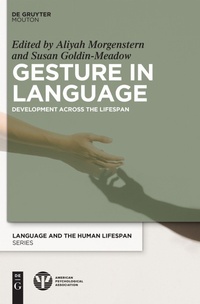
Gesture in Language
Development Across the Lifespan
Published on 30. November 2021
Book
Hardback
383 pages
978-1-4338-3629-9 (ISBN)
Description
When do human beings begin producing gestures, and how do they evolve throughout our cognitive and social development?
This book investigates the rich and complex ways in which gesture precedes language development and then is used in conjunction with language across the lifespan.
Some experts argue that gesture is a part of language, while others argue it is a partner to language. But all agree that gesture plays a major role in language development and practices, and therefore must be captured by scientific analyses.
This volume explores gesture's many functions--communicative, restorative, cognitive--across cultures and ages, in monolingual and multilingual populations, in students and in teachers.
Gestures, verbal productions, signs, gazes, facial expressions, and postures are all part of our socially learned, intersubjective communicative systems that we combine for the purpose of sharing meaning, referring to present and absent entities and events, expressing projects, desires, and feelings, and so much more. Collectively, the chapters demonstrate how gestures contribute to the cognitive and social development of humans within their lifespan, and may also indicate the efficacy of interactional practices and cognitive processes.
This book is thought-provoking reading for psycholinguists, cognitive scientists, and all who study language development.
This book investigates the rich and complex ways in which gesture precedes language development and then is used in conjunction with language across the lifespan.
Some experts argue that gesture is a part of language, while others argue it is a partner to language. But all agree that gesture plays a major role in language development and practices, and therefore must be captured by scientific analyses.
This volume explores gesture's many functions--communicative, restorative, cognitive--across cultures and ages, in monolingual and multilingual populations, in students and in teachers.
Gestures, verbal productions, signs, gazes, facial expressions, and postures are all part of our socially learned, intersubjective communicative systems that we combine for the purpose of sharing meaning, referring to present and absent entities and events, expressing projects, desires, and feelings, and so much more. Collectively, the chapters demonstrate how gestures contribute to the cognitive and social development of humans within their lifespan, and may also indicate the efficacy of interactional practices and cognitive processes.
This book is thought-provoking reading for psycholinguists, cognitive scientists, and all who study language development.
Reviews / Votes
"No more handwaving at gesture! The authors of this comprehensive volume examine moving and interacting bodies and minds across ages and languages, across theories and methods. Gesture in Language is an invaluable resource for anyone who wonders how we manage to understand each other-or, for that matter, to think our own thoughts." - Dan I. Slobin, PhD, Professor Emeritus of Psychology and Linguistics, University of California, Berkeley, CA, United States"This volume presents the latest thinking by leading scholars in the field. It is essential reading for researchers interested in the development of language and communication. This is also a great resource for teaching advanced undergraduates and graduate students." - Sotaro Kita, PhD, Department of Psychology, University of Warwick, Coventry, United Kingdom
"Morgenstern and Goldin-Meadow open a fascinating new chapter on what our hands and visible body reveal about language development, learning, bilingualism, and aging. A must-read game-changer volume for linguists and cognitive scientists who are interested in human capacity for language and cognition in general." - Asli Ozyurek, PhD, Donders Institute for Brain, Cognition and Behaviour, Radboud University, and Max Planck Institute for Psycholinguistics, Nijmegen, the Netherlands
More details
Series
Language
English
Place of publication
Washington DC
United States
Target group
Professional and scholarly
Product notice
sewn/stitched
Cloth over boards
Dimensions
Height: 244 mm
Width: 180 mm
Thickness: 25 mm
Weight
751 gr
ISBN-13
978-1-4338-3629-9 (9781433836299)
Copyright in bibliographic data and cover images is held by Nielsen Book Services Limited or by the publishers or by their respective licensors: all rights reserved.
Schweitzer Classification
Persons
Aliyah Morgenstern, PhD, is Professor of English linguistics and language acquisition at Sorbonne Nouvelle University. Her research is focused on multimodal interaction and language development, using ethnographic methods to capture ecological data. Dr. Morgenstern's current research projects intend to retrace children's pathways into multimodal language acquisition in a scaffolding interactional environment. She also works on typological and cultural differences in multimodal adult-child and adult-adult interactions in French, English, Russian, German, and French Sign Language. Dr. Morgenstern uses a plurisemiotic, multi-linguistic level approach, and a combination of quantitative and qualitative analyses.
Susan Goldin-Meadow, PhD, is the Beardsley Ruml Distinguished Service Professor in the Department of Psychology and Committee on Human Development at the University of Chicago. Her research interests include language development and creation as well as gesture's role in communicating, thinking, and learning. Dr. Goldin-Meadow's research has been funded by the National Science Foundation, the Spencer Foundation, the March of Dimes, the National Institute of Child Health and Human Development, and the National Institute of Neurological and Communicative Disorders and Stroke. She has served as a member of the language review panel for NIH, has been a Member-at-Large to the Section on Linguistics and Language Science in AAAS, and was part of the Committee on Integrating the Science of Early Childhood Development sponsored by the National Research Council and the Institute of Medicine and leading to the book Neurons to Neighborhoods. She is a Fellow of AAAS, APS, and APA (Divisions 3 and 7). in 2001, Dr. Goldin-Meadow was awarded a Guggenheim Fellowship and a James McKeen Cattell Fellowship which led to her two recently published books, Resilience of Language and Hearing Gesture. She is currently the President of the Cognitive Developmental Society and the editor of the new journal sponsored by the Society for Language Development, Language Learning and Development. Dr. Goldin-Meadow also serves as chair of the developmental area program.
Susan Goldin-Meadow, PhD, is the Beardsley Ruml Distinguished Service Professor in the Department of Psychology and Committee on Human Development at the University of Chicago. Her research interests include language development and creation as well as gesture's role in communicating, thinking, and learning. Dr. Goldin-Meadow's research has been funded by the National Science Foundation, the Spencer Foundation, the March of Dimes, the National Institute of Child Health and Human Development, and the National Institute of Neurological and Communicative Disorders and Stroke. She has served as a member of the language review panel for NIH, has been a Member-at-Large to the Section on Linguistics and Language Science in AAAS, and was part of the Committee on Integrating the Science of Early Childhood Development sponsored by the National Research Council and the Institute of Medicine and leading to the book Neurons to Neighborhoods. She is a Fellow of AAAS, APS, and APA (Divisions 3 and 7). in 2001, Dr. Goldin-Meadow was awarded a Guggenheim Fellowship and a James McKeen Cattell Fellowship which led to her two recently published books, Resilience of Language and Hearing Gesture. She is currently the President of the Cognitive Developmental Society and the editor of the new journal sponsored by the Society for Language Development, Language Learning and Development. Dr. Goldin-Meadow also serves as chair of the developmental area program.
Content
Contributors
Chapter . Introduction to Gesture in Language Aliyah Morgenstern and Susan Goldin-Meadow
Part I: An Emblematic Gesture: Pointing
Chapter 2. Pointing in Gesture and Sign Kensy Cooperrider and Kate Mesh
Chapter 3. Early Pointing Gestures Aliyah Morgenstern
Part II: Gesture Before Speech
Chapter 4. Early Gesture Predicts Later Language Development Meredith L. Rowe, Ran Wei, and Virginia C. Salo
Chapter 5. Interaction Between Modalities and Within Development Olga Capirci, Maria Cristina Caselli, and Virginia Volterra
Part III: Gesture With Speech During Language Learning
Chapter 6. Constructing a System of Communication with Gestures and Words Eve V. Clark and Barbara F. Kelly
Chapter 7. Embodying Language Complexity: Co-Speech Gestures Between Age 3 and 4 Pauline Beaupoil-Hourdel
Chapter 8. Gesture Can Facilitate Children's Learning and Generalization of Verbs Casey Hall, Elizabeth Wakefield, and Susan Goldin-Meadow
Part IV: Gesture After Speech is Mastered
Chapter 9. On the Codevelopment of Gesture and Monologic Discourse in Children Jean-Marc Colletta
Chapter 10. Understanding How Gestures are Produced and Perceived Susan Wagner Cook
Chapter 11. Gesture in the Aging Brain Tilbe GOEksun, Demet OEzer, and Seda Akbiyik
Part V: Gesture With More Than One Language
Chapter 12. Gesture in Bilingual Language Acquisition Elena Nicoladis and Lisa Smithson
Chapter 13. Bimodal Convergence: How Languages Interact in Multicompetent Language Users' Speech and Gestures Marianne Gullberg
Chapter 14. Gesture Helps Second and Foreign Language Learning and Teaching Gale Stam and Marion Tellier
Afterword: Gesture as Part of Language or Partner to Language Across the Lifespan
Aliyah Morgenstern and Susan Goldin-Meadow
Index
About the Editors
Chapter . Introduction to Gesture in Language Aliyah Morgenstern and Susan Goldin-Meadow
Part I: An Emblematic Gesture: Pointing
Chapter 2. Pointing in Gesture and Sign Kensy Cooperrider and Kate Mesh
Chapter 3. Early Pointing Gestures Aliyah Morgenstern
Part II: Gesture Before Speech
Chapter 4. Early Gesture Predicts Later Language Development Meredith L. Rowe, Ran Wei, and Virginia C. Salo
Chapter 5. Interaction Between Modalities and Within Development Olga Capirci, Maria Cristina Caselli, and Virginia Volterra
Part III: Gesture With Speech During Language Learning
Chapter 6. Constructing a System of Communication with Gestures and Words Eve V. Clark and Barbara F. Kelly
Chapter 7. Embodying Language Complexity: Co-Speech Gestures Between Age 3 and 4 Pauline Beaupoil-Hourdel
Chapter 8. Gesture Can Facilitate Children's Learning and Generalization of Verbs Casey Hall, Elizabeth Wakefield, and Susan Goldin-Meadow
Part IV: Gesture After Speech is Mastered
Chapter 9. On the Codevelopment of Gesture and Monologic Discourse in Children Jean-Marc Colletta
Chapter 10. Understanding How Gestures are Produced and Perceived Susan Wagner Cook
Chapter 11. Gesture in the Aging Brain Tilbe GOEksun, Demet OEzer, and Seda Akbiyik
Part V: Gesture With More Than One Language
Chapter 12. Gesture in Bilingual Language Acquisition Elena Nicoladis and Lisa Smithson
Chapter 13. Bimodal Convergence: How Languages Interact in Multicompetent Language Users' Speech and Gestures Marianne Gullberg
Chapter 14. Gesture Helps Second and Foreign Language Learning and Teaching Gale Stam and Marion Tellier
Afterword: Gesture as Part of Language or Partner to Language Across the Lifespan
Aliyah Morgenstern and Susan Goldin-Meadow
Index
About the Editors