

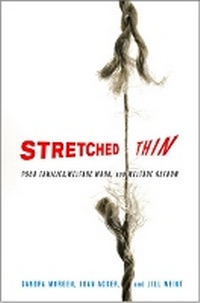
Stretched Thin
Poor Families, Welfare Work, and Welfare Reform
Published on 15. January 2010
Book
Paperback/Softback
256 pages
978-0-8014-7510-8 (ISBN)
Description
When the Personal Responsibility and Work Opportunity Reconciliation Act became law in 1996, the architects of welfare reform celebrated what they called the new "consensus" on welfare: that cash assistance should be temporary and contingent on recipients' seeking and finding employment. However, assessments about the assumptions and consequences of this radical change to the nation's social safety net were actually far more varied and disputed than the label "consensus" suggests. By examining the varied realities and accountings of welfare restructuring, Stretched Thin looks back at a critical moment of policy change and suggests how welfare policy in the United States can be changed to better address the needs of poor families and the nation.
Using ethnographic observations, in-depth interviews with poor families and welfare workers, survey data tracking more than 750 families over two years, and documentary evidence, Sandra Morgen, Joan Acker, and Jill Weigt question the validity of claims that welfare reform has been a success. They show how poor families, welfare workers, and welfare administrators experienced and assessed welfare reform differently based on gender, race, class, and their varying positions of power and control within the welfare state. The authors document the ways that, despite the dramatic drop in welfare rolls, low-wage jobs and inadequate social supports left many families struggling in poverty. Revealing how the neoliberal principles of a drastically downsized welfare state and individual responsibility for economic survival were implemented through policies and practices of welfare provision and nonprovision, the authors conclude with new recommendations for reforming welfare policy to reduce poverty, promote economic security, and foster shared prosperity.
Using ethnographic observations, in-depth interviews with poor families and welfare workers, survey data tracking more than 750 families over two years, and documentary evidence, Sandra Morgen, Joan Acker, and Jill Weigt question the validity of claims that welfare reform has been a success. They show how poor families, welfare workers, and welfare administrators experienced and assessed welfare reform differently based on gender, race, class, and their varying positions of power and control within the welfare state. The authors document the ways that, despite the dramatic drop in welfare rolls, low-wage jobs and inadequate social supports left many families struggling in poverty. Revealing how the neoliberal principles of a drastically downsized welfare state and individual responsibility for economic survival were implemented through policies and practices of welfare provision and nonprovision, the authors conclude with new recommendations for reforming welfare policy to reduce poverty, promote economic security, and foster shared prosperity.
Reviews / Votes
"This is a wonderfully thoughtful and illuminating book. For more than a decade, Sandra Morgen, Joan Acker, and Jill Weigt peered into the workings of the Oregon welfare system after the implementation of the draconian reform of 1996. The result is a closely observant picture of just what went on. We learn about the real human costs to mothers and children of the much-heralded shift to 'work first' and 'personal responsibility.' We also learn about the pressures on the staff of the local agencies as they tried to adapt a neoliberal policy designed in Washington to the exigencies of the lives of the poor and troubled people they were mandated to help."-Frances Fox Piven, Graduate Center of the City University of New York, coauthor (with Richard Cloward) of Regulating the Poor and Poor People's Movements "Stretched Thin is a tour de force. It proves that the best scholarship makes for good politics. The story is sobering, but presented in highly accessible prose and based on stunning empirical research. It tells us all we need to know about neoliberal social welfare policy today: it fails to deliver for the poor. Here is engaged scholarship at its best. Read it and weep!"-Sanford Schram, author of Welfare Discipline: Discourse, Governance, and Globalization "A stunning dialogue between ethnography and poverty policy, Stretched Thin takes risks to chronicle the messy moral incongruities that lay at the basis of welfare reform. Sandra Morgen, Joan Acker, and Jill Weigt urge us to face the myths we so readily accept about work, family, and poverty. They have written a classic that will stand the test of time."-Carol Stack, author of All Our Kin and Call To HomeMore details
Language
English
Place of publication
Ithaca
United States
Product notice
Paperback (trade)
Dimensions
Height: 235 mm
Width: 155 mm
Thickness: 16 mm
Weight
454 gr
ISBN-13
978-0-8014-7510-8 (9780801475108)
Copyright in bibliographic data and cover images is held by Nielsen Book Services Limited or by the publishers or by their respective licensors: all rights reserved.
Schweitzer Classification
Other editions
Additional editions
Sandra L. Morgen | Joan Acker | Jill Weigt
Stretched Thin
Poor Families, Welfare Work, and Welfare Reform
E-Book
01/2011
Cornell University Press
€22.49
Available for download
Persons
Sandra Morgen is Professor of Anthropology and Associate Dean of the Graduate School at the University of Oregon. She is author of books including Into Our Own Hands: The Women's Health Movement in the United States, 1969-1990 and coeditor most recently of Security Disarmed: Critical Perspectives on Gender, Race, and Militarization. Joan Acker is Professor Emerita of Sociology at the University of Oregon and author of Class Questions: Feminist Answers and Doing Comparable Worth: Gender, Class, and Pay Equity. Jill Weigt is Associate Professor of Sociology at California State University-San Marcos.
Content
PrologueIntroduction: Questioning the Success of Welfare Reform1. History and Political Economy of Welfare in the United States and Oregon2. Velvet Gloves, Iron Fists, and Rose-Colored Glasses: Welfare Administrators and the Official Story of Welfare Restructuring3. Doing the Work of Welfare: Enforcing "Self-Sufficiency" on the Front Lines4. Negotiating Neoliberal Ideology and "On the Ground" Reality in Welfare Work5. The Other Side of the Desk: Client Experiences and Perspectives on Welfare Restructuring6. Life after Welfare: The Costs of Low-Wage Employment
Conclusion: Reforming Welfare "Reform"Appendix: Situating Ourselves
Notes
Bibliography
Index
Conclusion: Reforming Welfare "Reform"Appendix: Situating Ourselves
Notes
Bibliography
Index