

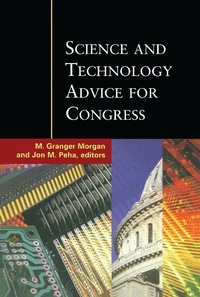
Science and Technology Advice for Congress
1st Edition
Published on 8. September 2003
Book
Paperback/Softback
228 pages
978-1-891853-74-6 (ISBN)
Description
The elimination of the Office of Technology Assessment (OTA) in 1995 came during a storm of budget cutting and partisan conflict. Operationally, it left Congress without an institutional arrangement to bring expert scientific and technological advice into the process of legislative decisionmaking. This deficiency has become increasingly critical, as more and more of the decisions faced by Congress and society require judgments based on highly specialized technical information. Offering perspectives from scholars and scientists with diverse academic backgrounds and extensive experience within the policy process, Science and Technology Advice for Congress breaks from the politics of the OTA and its contentious aftermath. Granger Morgan and Jon Peha begin with an overview of the use of technical information in framing policy issues, crafting legislation, and the overall process of governing. They note how, as nonexperts, legislators must make decisions in the face of scientific uncertainty and competing scientific claims from stakeholders. The contributors continue with a discussion of why OTA was created. They draw lessons from OTA's demise, and compare the use of science and technological information in Europe with the United States. The second part of the book responds to requests from congressional leaders for practical solutions. Among the options discussed are expanded functions within existing agencies such as the General Accounting or Congressional Budget Offices; an independent, NGO- administrated analysis group; and a dedicated successor to OTA within Congress. The models emphasize flexibility--and the need to make political feasibility a core component of design.
Reviews / Votes
'Deserves to be read by every person concerned with the quality of technical input that Congress needs to absorb.'Amory Houghton, Jr., Former U.S. Representative
'In a climate where the objectivity and relevance of science seems nearly everywhere subjected to political scrutiny, [this book] is refreshing, if not poignant. . . . This little volume is positioned to help Congress think carefully about their own knowledge gaps and appropriate ways to close them.'
Step Ahead, APSA
More details
Language
English
Place of publication
Washington
United States
Publishing group
Taylor & Francis Inc
Target group
College/higher education
Professional and scholarly
Academic and Professional Practice & Development
Dimensions
Height: 227 mm
Width: 153 mm
Thickness: 17 mm
Weight
358 gr
ISBN-13
978-1-891853-74-6 (9781891853746)
Copyright in bibliographic data and cover images is held by Nielsen Book Services Limited or by the publishers or by their respective licensors: all rights reserved.
Schweitzer Classification
Other editions
Additional editions
M. Granger Morgan | Jon M. Peha
Science and Technology Advice for Congress
Book
09/2003
1st Edition
Resources for the Future Press (RFF Press)
€207.98
Article exhausted; check different version
M. Granger Morgan | Jon M. Peha
Science and Technology Advice for Congress
E-Book
09/2003
Routledge
€47.49
Available for download
M. Granger Morgan | Jon M. Peha
Science and Technology Advice for Congress
E-Book
09/2003
Routledge
€47.49
Available for download
Persons
M. Granger Morgan is professor and head of the Department of Engineering and Public Policy, Lord Chair Professor in Engineering, professor in the Department of Electrical and Computer Engineering, and professor in the H. John Heinz III School of Public Policy and Management at Carnegie Mellon University.
Content
Preface
Contributors Part I: The Issue
1. Analysis, Governance, and the Need for Better Institutional Arrangements
M. Granger Morgan and Jon M. Peha
Part II: Background
2. Technical Advice for Congress: Past Trends and Present Obstacles
Bruce L.R. Smith and Jeffrey K. Stine
3. The Origins, Accomplishments, and Demise of the Office of Technology Assessment
Robert M. Margolis and David H. Guston
4. Insights from the Office of Technology Assessment and Other Assessment Experiences David H. Guston
5. The European Experience
Norman J. Vig
Contents
Part III: Possible Institutional Models
6. Thinking about Alternative Models
M. Granger Morgan and Jon M. Peha
7. An Expanded Analytical Capability in the Congressional Research Service, the General Accounting Office, or the Congressional Budget Office
Christopher T. Hill
8. Expanded Use of the National Academies
John Ahearne and Peter Blair
9. Expanding the Role of the Congressional Science and Engineering Fellowship Program
Albert H. Teich and Stephen J. Lita
10. A Lean, Distributed Organization To Serve Congress
M. Granger Morgan, Jon M. Peha, and Daniel E. Hastings
11. A Dedicated Organization in Congress
Gerald L. Epstein and Ashton B. Carter
12. An Independent Analysis Group That Works Exclusively for Congress, Operated by a Nongovernmental Organization
Caroline S. Wagner and William A. Stiles Jr.
Part IV: Moving toward Solution
13. Where Do We Go from Here?
M. Granger Morgan and Jon M. Peha
Appendix 1: The Technology Assessment Act of 1972
Appendix 2: Details on the National Academies Complex
Appendix 3: An External Evaluation of the GAO's First Pilot
Technology Assessment
Index
About the Editors
Contributors Part I: The Issue
1. Analysis, Governance, and the Need for Better Institutional Arrangements
M. Granger Morgan and Jon M. Peha
Part II: Background
2. Technical Advice for Congress: Past Trends and Present Obstacles
Bruce L.R. Smith and Jeffrey K. Stine
3. The Origins, Accomplishments, and Demise of the Office of Technology Assessment
Robert M. Margolis and David H. Guston
4. Insights from the Office of Technology Assessment and Other Assessment Experiences David H. Guston
5. The European Experience
Norman J. Vig
Contents
Part III: Possible Institutional Models
6. Thinking about Alternative Models
M. Granger Morgan and Jon M. Peha
7. An Expanded Analytical Capability in the Congressional Research Service, the General Accounting Office, or the Congressional Budget Office
Christopher T. Hill
8. Expanded Use of the National Academies
John Ahearne and Peter Blair
9. Expanding the Role of the Congressional Science and Engineering Fellowship Program
Albert H. Teich and Stephen J. Lita
10. A Lean, Distributed Organization To Serve Congress
M. Granger Morgan, Jon M. Peha, and Daniel E. Hastings
11. A Dedicated Organization in Congress
Gerald L. Epstein and Ashton B. Carter
12. An Independent Analysis Group That Works Exclusively for Congress, Operated by a Nongovernmental Organization
Caroline S. Wagner and William A. Stiles Jr.
Part IV: Moving toward Solution
13. Where Do We Go from Here?
M. Granger Morgan and Jon M. Peha
Appendix 1: The Technology Assessment Act of 1972
Appendix 2: Details on the National Academies Complex
Appendix 3: An External Evaluation of the GAO's First Pilot
Technology Assessment
Index
About the Editors