

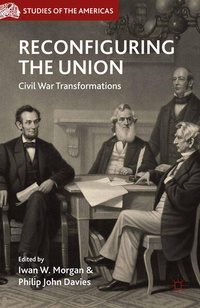
Reconfiguring the Union
Civil War Transformations
Published on 16. August 2013
Book
Paperback/Softback
XII, 228 pages
978-1-349-46350-3 (ISBN)
Description
From the perspective of the North, the Civil War began as a war to restore the Union and ended as a war to make a more perfect Union. The Civil War not only changed the moral meaning of the Union, it changed what the Union stood for in political, economic, and transnational terms. This volume examines the transformations the Civil War brought to the American Union as a politico-constitutional, social, and economic system. It explores how the war changed the meaning of the Union with regard to the supremacy of the federal government over the states, the right of secession, the rights of citizenship, and the political balance between the union's various sections. It further considers the effect of the war on international and transnational perceptions of the United States. Finally, it considers how historical memory has shaped the legacy of the Civil War in the last 150 years.
Reviews / Votes
To come
More details
Series
Edition
1st ed. 2013
Language
English
Place of publication
New York
United States
Target group
Professional and scholarly
Product notice
Paperback (trade)
Unsewn / adhesive bound
Illustrations
XII, 228 p.
Dimensions
Height: 216 mm
Width: 140 mm
Thickness: 13 mm
Weight
286 gr
ISBN-13
978-1-349-46350-3 (9781349463503)
DOI
10.1057/9781137336484
Schweitzer Classification
Other editions
Additional editions
Book
08/2013
Palgrave MacMillan
€53.49
Shipment within 10-20 days
Persons
Iwan W. Morgan, University College London, UK
Philip John Davies, British Library, UK
Adam Smith, University College London, UK
Richard Carwardine, University of Oxford, UK
Erik Mathisen, University of Portsmouth, UK
Brian Holden Reid, Kings College London., UK
Andrew Heath, University of Sheffield, UK
Matthew Shaw, British Library, UK
David Gleason, Northumbria University, UK
Amanda Foreman, historian, writer, and broadcaster
Robert Cook, University of Sussex, UK
Jenny Barrett, Edge Hill University, UK
Content
1. The Civil War, Democracy and the Union; Adam Smith 2. Lincoln and Emancipation: The Lessons of the Letter to Horace Greeley; Richard Carwardine 3. Freedpeople, Politics and the State in Civil War America; Erik Mathisen 4. The Military Significance of the 1864 Presidential Election; Brian Holden Reid 5. In Union There is Strength:' City-Building and Nation-Building in Civil-War Era Philadelphia, 1844-1865; Andrew Heath 6. 'There Will be Blood:' The Civil War and the Birth of the Oil Industry; Matthew Shaw 7. Faugh a Ballagh! (Clear the Way): The Irish and the American Civil War; David Gleason 8. Lincoln's Emancipation Proclamation and British Views of the Civil War; Amanda Foreman 9. Ordeal of the Union: Alan Nevins, the Civil War Centennial, and the Civil Rights Struggles of the 1960s; Robert Cook 10. Glory, Glory: Hollywood's Consensus Memory of the Civil War; Jenny Barrett