

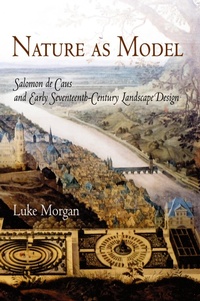
Nature As Model
Salomon De Caus and Early Seventeenth-Century Landscape Design
Published on 29. November 2006
Book
Hardback
312 pages
978-0-8122-3963-8 (ISBN)
Description
Salomon de Caus has been viewed as, variously, a Protestant martyr, the unsung inventor of the steam engine, one of the most important early hydraulic engineers, and a garden designer whose work was influenced by astrology and hermeticism. The first comprehensive book on this protean figure, Nature as Model sifts through historical material, Caus's own writings, and his extant landscape designs to determine what is fact and what is fiction in the life of this polymathic and prolific figure. In doing so, it clarifies numerous hitherto unresolved problems in his biography and historiography.
As Luke Morgan shows, Caus made important contributions to some of the most significant landscape projects of his period, including the gardens of Coudenberg Palace in Brussels, Richmond Palace, Hatfield House, Somerset House, Greenwich Palace in London, as well as, most famously, the Hortus Palatinus in Heidelberg, which he designed for the Elector Palatine, Frederick V, and his wife, Elisabeth Stuart, daughter of James I of England. In his work, Caus drew on his intimate knowledge of the late sixteenth-century Italian garden, and through his commissions the design principles and motifs of the late Renaissance garden were transmitted across Europe.
The book is a masterful exercise in historical reconstruction, showing how Caus has been read by subsequent generations intent on nationalism, romance, or magic. Morgan investigates the ways in which the early modern garden actually generated meaning through conventional motifs rather than through esoteric narrative programs.
As Luke Morgan shows, Caus made important contributions to some of the most significant landscape projects of his period, including the gardens of Coudenberg Palace in Brussels, Richmond Palace, Hatfield House, Somerset House, Greenwich Palace in London, as well as, most famously, the Hortus Palatinus in Heidelberg, which he designed for the Elector Palatine, Frederick V, and his wife, Elisabeth Stuart, daughter of James I of England. In his work, Caus drew on his intimate knowledge of the late sixteenth-century Italian garden, and through his commissions the design principles and motifs of the late Renaissance garden were transmitted across Europe.
The book is a masterful exercise in historical reconstruction, showing how Caus has been read by subsequent generations intent on nationalism, romance, or magic. Morgan investigates the ways in which the early modern garden actually generated meaning through conventional motifs rather than through esoteric narrative programs.
Reviews / Votes
"Luke Morgan bracingly tests conjecture and assertion against evidence and a shrewdly developed chronology; he turns a coolly evaluative eye to the kinds of interpretive assumptions underlying previous accounts; and he develops a fresh picture of Caus, his career, and the intellectual culture of garden-making in the period." (Michael Leslie, Rhodes College) "A volume of interest not only to specialists in landscape history but also to all those concerned with the cultural history of the period." (Renaissance Quarterly)More details
Series
Language
English
Place of publication
Pennsylvania
United States
Target group
Adult education
Product notice
Paper over boards
Illustrations
54 illus.
Dimensions
Height: 235 mm
Width: 157 mm
Thickness: 23 mm
Weight
659 gr
ISBN-13
978-0-8122-3963-8 (9780812239638)
Copyright in bibliographic data and cover images is held by Nielsen Book Services Limited or by the publishers or by their respective licensors: all rights reserved.
Schweitzer Classification
Person
Luke Morgan is Lecturer in the Department of Theory of Art and Design, Monash University, Melbourne, Australia.