

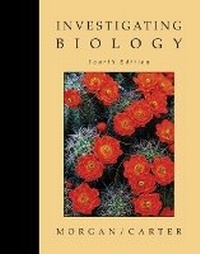
Investigating Biology
4th Edition
Published on 23. May 2002
Book
Spiral bound
750 pages
978-0-8053-7365-3 (ISBN)
Description
With its distinctive investigative approach to learning, this effective laboratory manual encourages students to become detectives of science. While teaching the basic materials and procedures important for all biology majors to learn, the authors also invite students to pose hypotheses, make predictions, conduct open-ended experiments, collect data, and then apply the results to new problems. The result of this "process of science" approach is that students learn to think creatively, just as scientists do. Laboratory exercises are divided into 3 categories-directed investigations, thematic investigations, and open-ended investigations.
More details
Edition
4th edition
Language
English
Place of publication
Upper Saddle River
United States
Target group
Primary & secondary/elementary & high school
Dimensions
Height: 277 mm
Width: 242 mm
Thickness: 32 mm
Weight
1669 gr
ISBN-13
978-0-8053-7365-3 (9780805373653)
Copyright in bibliographic data and cover images is held by Nielsen Book Services Limited or by the publishers or by their respective licensors: all rights reserved.
Schweitzer Classification
Other editions
New editions
Judith Giles Morgan | M. Eloise Brown Carter
Investigating Biology Lab Manual
Book
03/2005
5th Edition
Pearson Education (US)
€59.60
Article exhausted; check for reprint
Previous edition

Judith Giles Morgan | M. Eloise Brown Carter
Investigating Biology
Book
02/1999
3rd Edition
Benjamin Cummings
€80.65
Article exhausted; check for reprint
Persons
Judith Giles Morgan received her M.A. degree from the University of Texas, Austin. She teaches in the coastal biology program and the introductory biology program at Emory University. She has revised the general biology laboratory curriculum for majors to incorporate an investigative approach and has developed a TA training program for multi-section investigative laboratories. She has long emphasized the importance of writing and computer simulations in the lab.
M. Eloise Brown Carter earned her Ph.D. from Emory University and is currently Associate Professor of Biology at Oxford College of Emory University. With expertise in plant ecology, she has incorporated independent and team research into lecture and laboratory courses in introductory and advanced biology. Dr. Carter also teaches in the Oxford Institute for Environmental Education, a summer program of Oxford College for precollege teachers.
M. Eloise Brown Carter earned her Ph.D. from Emory University and is currently Associate Professor of Biology at Oxford College of Emory University. With expertise in plant ecology, she has incorporated independent and team research into lecture and laboratory courses in introductory and advanced biology. Dr. Carter also teaches in the Oxford Institute for Environmental Education, a summer program of Oxford College for precollege teachers.
Content
LABS.
1. Scientific Investigation.
2. Enzymes.
3. Microscopes and Cells.
4. Diffusion and Osmosis.
5. Photosynthesis.
6. Cellular Respiration.
7. Mitosis and Meiosis.
8. Mendelian Genetics.
9. Mendelian Genetics: Drosophila.
10. Molecular Biology.
11. Population Genetics/Hardy-Weinberg Theorem.
12. Population Genetics/Genetic Variation.
13. Bacteriology.
14. Protista and Fungi.
15. Plant Diversity I/Bryophytes/Seedless Plants.
16. Plant Diversity II/Seed Plants.
17. Animal Diversity I.
18. Animal Diversity II.
19. Plant Anatomy.
20. Plant Growth.
21. Vertebrate Anatomy I/Skin and Digestive System.
22. Vertebrate Anatomy II/Circulatory and Respiratory Systems.
23. Vertebrate Anatomy III/Excretory, Reproductive, and Nervous Systems.
24. Animal Development.
25. Ecology I/Terrestrial Ecology.
26. Ecology II/Computer Simulation of Pond Ecosystem.
27. Animal Behavior.
1. Scientific Investigation.
2. Enzymes.
3. Microscopes and Cells.
4. Diffusion and Osmosis.
5. Photosynthesis.
6. Cellular Respiration.
7. Mitosis and Meiosis.
8. Mendelian Genetics.
9. Mendelian Genetics: Drosophila.
10. Molecular Biology.
11. Population Genetics/Hardy-Weinberg Theorem.
12. Population Genetics/Genetic Variation.
13. Bacteriology.
14. Protista and Fungi.
15. Plant Diversity I/Bryophytes/Seedless Plants.
16. Plant Diversity II/Seed Plants.
17. Animal Diversity I.
18. Animal Diversity II.
19. Plant Anatomy.
20. Plant Growth.
21. Vertebrate Anatomy I/Skin and Digestive System.
22. Vertebrate Anatomy II/Circulatory and Respiratory Systems.
23. Vertebrate Anatomy III/Excretory, Reproductive, and Nervous Systems.
24. Animal Development.
25. Ecology I/Terrestrial Ecology.
26. Ecology II/Computer Simulation of Pond Ecosystem.
27. Animal Behavior.