

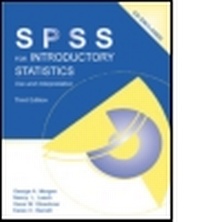
IBM SPSS for Introductory Statistics
Use and Interpretation, Third Edition
3rd Edition
Published on 18. October 2006
Book
Paperback/Softback
232 pages
978-0-8058-6027-6 (ISBN)
Description
This book distinguishes itself from other SPSS resources through its unique integration of the research process (including design) and the use and interpretation of the statistics. Designed to help students analyze and interpret research data, the authors demonstrate how to: choose the appropriate statistic based on the research design, interpret SPSS output, and write about the output in a research paper. The authors describe the use and interpretation of these statistics in a user-friendly, non-technical language. The book prepares students for all of the steps in the research process, from design and data collection, to writing about the results.
The new edition features SPSS 14.0 for Windows, but can also be used with older and newer versions. There are also new problems, expanded discussions of effect sizes, and an expanded appendix on getting started with SPSS. The book features discussions of writing about outputs, data entry and checking, reliability assessment, testing assumptions, and descriptive, inferential, and nonparametric statistics. Several related statistics are included in each chapter. SPSS syntax, along with the output, is included for those who prefer this format. Two realistic data sets are available on the book's CD and are used to solve the end of chapter problems.
SPSS for Introductory Statistics, Third Edition provides helpful teaching tools:
all of the key SPSS windows needed to perform the analyses
complete outputs with call-out boxes to highlight key points
interpretation sections and questions to help students better understand the output
lab assignments organized the way students proceed when they conduct a research project
extra SPSS problems for practice in running and interpreting SPSS
helpful appendices on how to: get started with SPSS, write research questions, and create tables and figures.
This book is an ideal supplement for courses in either statistics or research methods taught in departments of psychology, education, and other social and health sciences. The Instructor's Resource CD features PowerPoint slides and answers to and additional information on the questions and problems.
The new edition features SPSS 14.0 for Windows, but can also be used with older and newer versions. There are also new problems, expanded discussions of effect sizes, and an expanded appendix on getting started with SPSS. The book features discussions of writing about outputs, data entry and checking, reliability assessment, testing assumptions, and descriptive, inferential, and nonparametric statistics. Several related statistics are included in each chapter. SPSS syntax, along with the output, is included for those who prefer this format. Two realistic data sets are available on the book's CD and are used to solve the end of chapter problems.
SPSS for Introductory Statistics, Third Edition provides helpful teaching tools:
all of the key SPSS windows needed to perform the analyses
complete outputs with call-out boxes to highlight key points
interpretation sections and questions to help students better understand the output
lab assignments organized the way students proceed when they conduct a research project
extra SPSS problems for practice in running and interpreting SPSS
helpful appendices on how to: get started with SPSS, write research questions, and create tables and figures.
This book is an ideal supplement for courses in either statistics or research methods taught in departments of psychology, education, and other social and health sciences. The Instructor's Resource CD features PowerPoint slides and answers to and additional information on the questions and problems.
Reviews / Votes
"This introductory book for statistics and SPSS is a wonderful guide for anyone wanting to learn how to use SPSS for statistical analyses...On the whole, I would recommend this book to anyone who wants to further their knowledge of SPSS analyses. The examples and extra problems at the end of the chapters encourage readers to explore on their own. The problems within the chapters allow the reader to verify that they are following the examples." -Amy Herrin, Medical University of South Carolina, The American StatisticianMore details
Edition
3rd New edition
Language
English
Place of publication
Mahwah
United States
Publishing group
Taylor & Francis Inc
Target group
College/higher education
Edition type
New edition
Dimensions
Height: 279 mm
Width: 216 mm
Weight
680 gr
ISBN-13
978-0-8058-6027-6 (9780805860276)
Copyright in bibliographic data and cover images is held by Nielsen Book Services Limited or by the publishers or by their respective licensors: all rights reserved.
Schweitzer Classification
Other editions
New editions
George A. Morgan | Nancy L. Leech | Gene W. Gloeckner
IBM SPSS for Introductory Statistics
Use and Interpretation, Fourth Edition
Book
09/2010
4th Edition
Routledge Academic
€57.13
Article exhausted; check for reprint
Additional editions

Karen C. Barrett | Gene W. Gloeckner | Nancy L. Leech
Instructor's Manual to Accompany SPSS for Introductory Statistics, 3/e.
Use and Interpretation
Software
01/2008
3rd Edition
Taylor & Francis
Unfortunately, price unknown
Available (delivery time upon request)
Previous edition
George A. Morgan | Nancy L. Leech | Gene W. Gloeckner
SPSS for Introductory Statistics
Use and Interpretation, Second Edition
Book
04/2004
2nd Edition
Lawrence Erlbaum Associates Inc
€40.99
Article exhausted; check for reprint
Content
Preface. Variables, Research Problems, and Questions. Data Coding, Entry, and Checking. Measurement and Descriptive Statistics. Understanding Your Data and Checking Assumptions. Data File Management. Selecting and Interpreting Inferential Statistics. Cross Tabulation, Chi-Square, and Nonparametric Measures of Association. Correlation and Regression. Comparing Two Groups with t Tests and Similar Nonparametric Tests. Analysis of Variance (ANOVA). Appendix A: P.G. Cress, Getting Started and Other Useful SPSS Procedures. Appendix B: Writing Research Problems and Questions. Appendix C: D. Quick, Making Tables and Figures. Appendix D: Answers to Odd Numbered Interpretation Questions.