

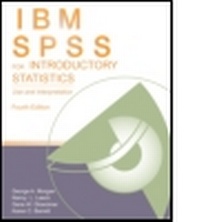
IBM SPSS for Introductory Statistics
Use and Interpretation, Fourth Edition
4th Edition
Published on 2. September 2010
Book
Paperback/Softback
248 pages
978-0-415-88229-3 (ISBN)
Description
Designed to help students analyze and interpret research data using IBM SPSS, this book describes the use of statistics in user-friendly, non-technical language to show readers how to choose the appropriate statistic based on the design, interpret output, and write about the results. The authors prepare readers for all of the steps in the research process, from design and data collection, to writing about the results. Discussions of writing about outputs, data entry and checking, reliability assessment, testing assumptions, and computing descriptive and inferential parametric and nonparametric statistics are included. SPSS syntax, along with the output, is provided for those who prefer this format.
The new edition features:
IBM SPSS version 18 but the book can also be used with older and newer versions
New section on describing demographics and key variables
Expanded discussion of assumptions and effect size measures in several chapters
Expansion of other useful SPSS functions in Appendix A
Examples that meet the new formatting guidelines outlined in the 6th edition of the APA Publication Manual (2010)
Flowcharts and tables to help select the appropriate statistic and interpret statistical significance and effect sizes
Two realistic data sets at www.psypress.com used to solve the chapter problems
Password protected Instructor's Resource materials with PowerPoint slides, answers to interpretation questions, extra SPSS problems, and more found at http://www.psypress.com/ibm-spss-intro-stats .
IBM SPSS for Introductory Statistics, Fourth Edition provides helpful teaching tools:
All of the key IBM SPSS windows needed to perform the analyses
Complete outputs with call-out boxes to highlight key points
Interpretation sections and questions to help students better understand and interpret the output
Lab assignments organized the way students proceed when they conduct a research project
Extra problems for practice in running and interpreting SPSS
Helpful appendices on how to: get started with SPSS; write research questions; and create tables and figures.
An ideal supplement for courses in either statistics, research methods, or any course in which SPSS is used, taught in departments of psychology, education, and other social and health sciences, this book is also appreciated by researchers interested in using SPSS for their data analysis.
The new edition features:
IBM SPSS version 18 but the book can also be used with older and newer versions
New section on describing demographics and key variables
Expanded discussion of assumptions and effect size measures in several chapters
Expansion of other useful SPSS functions in Appendix A
Examples that meet the new formatting guidelines outlined in the 6th edition of the APA Publication Manual (2010)
Flowcharts and tables to help select the appropriate statistic and interpret statistical significance and effect sizes
Two realistic data sets at www.psypress.com used to solve the chapter problems
Password protected Instructor's Resource materials with PowerPoint slides, answers to interpretation questions, extra SPSS problems, and more found at http://www.psypress.com/ibm-spss-intro-stats .
IBM SPSS for Introductory Statistics, Fourth Edition provides helpful teaching tools:
All of the key IBM SPSS windows needed to perform the analyses
Complete outputs with call-out boxes to highlight key points
Interpretation sections and questions to help students better understand and interpret the output
Lab assignments organized the way students proceed when they conduct a research project
Extra problems for practice in running and interpreting SPSS
Helpful appendices on how to: get started with SPSS; write research questions; and create tables and figures.
An ideal supplement for courses in either statistics, research methods, or any course in which SPSS is used, taught in departments of psychology, education, and other social and health sciences, this book is also appreciated by researchers interested in using SPSS for their data analysis.
Reviews / Votes
"[This] is my "go to" book ... for concise and comprehensive information on how to run basic statistical analysis, interpret the output and accurately present the findings in written work." - Joan L. Ellis, Washington State University, USA"This is not your usual SPSS guidebook! The text guides the reader through the research process from research question, to choice of appropriate statistics, to running SPSS, to interpretation of the SPSS output, and finally to writing up results.? It should be very useful to applied researchers." - Richard Lomax, The Ohio State University, USA
"[This book] is appropriate for all levels of SPSS users in its transparency of the "how-to" process. At the same time, a comprehensive conceptual foundation is incorporated-such that it could be used nearly as a standalone statistics textbook." - Debbie Hahs-Vaughn, University of Central Florida, USA
"This textbook provides a step-by-step approach to using IBM SPSS to conduct various parametric and nonparametric analyses, from descriptive statistics to analysis of variance. The numerous visual displays, including screenshots and write-ups, make this textbook exceptional." - Tony Onwuegbuzie, Sam Houston State University, USA
"The authors present illustrative examples and screen shots to clarify the process of ?analyzing and interpreting data, thereby making this book an excellent resource for ?graduate students conducting research and professors teaching methods courses and ?statistics." - Kathleen M.T. Collins, University of Arkansas, USA
"Using SPSS for Introductory Statistics as a guide through statistical analysis since 2003 has been a real lifesaver. Since I do not do statistical analysis every week, having a "cookbook" to help remind me of how to use SPSS quantitative data analysis software is extremely helpful." - David E. Gunderson, Washington State University, USA
More details
Edition
4th New edition
Language
English
Place of publication
London
United Kingdom
Publishing group
Taylor & Francis Ltd
Target group
College/higher education
Edition type
New edition
Dimensions
Height: 279 mm
Width: 216 mm
Weight
694 gr
ISBN-13
978-0-415-88229-3 (9780415882293)
Copyright in bibliographic data and cover images is held by Nielsen Book Services Limited or by the publishers or by their respective licensors: all rights reserved.
Schweitzer Classification
Other editions
New editions
George A. Morgan | Nancy L. Leech | Gene W. Gloeckner
IBM SPSS for Introductory Statistics
Use and Interpretation, Fifth Edition
Book
07/2012
5th Edition
Routledge
€75.70
Article exhausted; check different version
Previous edition
George A. Morgan | Nancy L. Leech | Gene W. Gloeckner
IBM SPSS for Introductory Statistics
Use and Interpretation, Third Edition
Book
10/2006
3rd Edition
Lawrence Erlbaum Associates Inc
€50.89
Article exhausted; check for reprint
Persons
George A. Morgan is an Emeritus Professor of Education and Human Development at Colorado State University. He received his Ph.D. in child development and psychology from Cornell University. In addition to writing text books on SPSS and research methods, he has advised many PhD students in education and related fields. Over the past 35 years, he has conducted a program of research on children's motivation to master challenging tasks.
Nancy L. Leech is an Associate Professor of Education and Human Development at University of Colorado Denver. She received her Ph.D. in Education with an emphasis on research and statistics from Colorado State University. She currently teaches master's and PhD level courses in research, statistics and measurement. Her area of research is promoting new developments and better understanding in applied qualitative, quantitative, and mixed methodologies.
Gene W. Gloeckner is an Associate Professor of Education at Colorado State University. He received his Ph.D. in education from The Ohio State University. Much of his writing has focused on research methods issues in both qualitative and quantitative research areas. He has been teaching research design and statistics for more than 25 years. He has advised many doctoral students (over 20) and has served as the research methodologist on many doctoral committees.
Karen C. Barrett is a Professor of Human Development and Family Studies with a joint appointment in Psychology at Colorado State University. She received her Ph.D. in psychology from the University of Denver. She is Assistant Department head of HDFS and teaches graduate level research methods and statistics courses. Her research regards emotion regulation and its influence on development; social emotions such as guilt and shame; and family and cultural influences on emotions.?
Nancy L. Leech is an Associate Professor of Education and Human Development at University of Colorado Denver. She received her Ph.D. in Education with an emphasis on research and statistics from Colorado State University. She currently teaches master's and PhD level courses in research, statistics and measurement. Her area of research is promoting new developments and better understanding in applied qualitative, quantitative, and mixed methodologies.
Gene W. Gloeckner is an Associate Professor of Education at Colorado State University. He received his Ph.D. in education from The Ohio State University. Much of his writing has focused on research methods issues in both qualitative and quantitative research areas. He has been teaching research design and statistics for more than 25 years. He has advised many doctoral students (over 20) and has served as the research methodologist on many doctoral committees.
Karen C. Barrett is a Professor of Human Development and Family Studies with a joint appointment in Psychology at Colorado State University. She received her Ph.D. in psychology from the University of Denver. She is Assistant Department head of HDFS and teaches graduate level research methods and statistics courses. Her research regards emotion regulation and its influence on development; social emotions such as guilt and shame; and family and cultural influences on emotions.?
Content
1. Variables, Research Problems and Questions. 2. Data Coding, Entry, and Checking. 3. Measurement and Descriptive Statistics. 4. Understanding Your Data and Checking Assumptions. 5. Data File Management and Descriptive Statistics. 6. Selecting and Interpreting Inferential Statistics. 7. Cross-Tabulation, Chi-Square, and Nonparametric Measures of Association. 8. Correlation and Regression. 9. Comparing Two Groups with t Tests and Similar Nonparametric Tests. 10. Analysis of Variance (ANOVA). Appendix A: Getting Started and Other Useful SPSS Procedures. Appendix B: Writing Research Problems and Questions. Appendix C: Making Tables and Figures. Appendix D: Answers to Odd Numbered Interpretation Questions.