

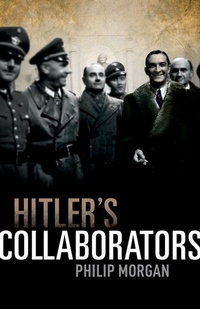
Hitler's Collaborators
Choosing between bad and worse in Nazi-occupied Western Europe
Published on 14. June 2018
Book
Hardback
386 pages
978-0-19-923973-3 (ISBN)
Description
Hitler's Collaborators focuses the spotlight on one of the most controversial and uncomfortable aspects of the Nazi wartime occupation of Europe: the citizens of those countries who helped Hitler. Although a widespread phenomenon, this was long ignored in the years after the war, when peoples and governments understandably emphasized popular resistance to Nazi occupation as they sought to reconstruct their devastated economies and societies along anti-fascist and democratic lines.
Philip Morgan moves away from the usual suspects, the Quislings who backed Nazi occupation because they were fascists, and focuses instead on the businessmen and civil servants who felt obliged to cooperate with the Nazis. These were the people who faced the most difficult choices and dilemmas by dealing with the various Nazi uthorities and agencies, and who were ultimately responsible for gearing the economies of the occupied territories to the Nazi war effort. It was their choices which had the greatest impact on the lives and livelihoods of their fellow countrymen in the occupied territories, including the deportation of slave-workers to the Reich and hundreds of thousands of European Jews to the death camps in the East.
In time, as the fortunes of war shifted so decisively against Germany between 1941 and 1944, these collaborators found themselves trapped by the logic of their initial cooperation with their Nazi overlords -- caught up between the demands of an increasingly desperate and extremist occupying power, growing internal resistance to Nazi rule, and the relentlessly advancing Allied armies.
Philip Morgan moves away from the usual suspects, the Quislings who backed Nazi occupation because they were fascists, and focuses instead on the businessmen and civil servants who felt obliged to cooperate with the Nazis. These were the people who faced the most difficult choices and dilemmas by dealing with the various Nazi uthorities and agencies, and who were ultimately responsible for gearing the economies of the occupied territories to the Nazi war effort. It was their choices which had the greatest impact on the lives and livelihoods of their fellow countrymen in the occupied territories, including the deportation of slave-workers to the Reich and hundreds of thousands of European Jews to the death camps in the East.
In time, as the fortunes of war shifted so decisively against Germany between 1941 and 1944, these collaborators found themselves trapped by the logic of their initial cooperation with their Nazi overlords -- caught up between the demands of an increasingly desperate and extremist occupying power, growing internal resistance to Nazi rule, and the relentlessly advancing Allied armies.
Reviews / Votes
meticulously researched ... Hitler's Collaborators takes a much-needed fresh look at the complexities of collaboration during the Nazi era. * Zoe Waxman, Times Higher Education * Collaborating with an occupying power is a tangled skein of complex motives: opportunism, survival, fear, a sense of professional responsibility. That is Morgan's subject in this solid and accessible account of Germany's occupation of western Europe from 1940 to 1944 and the occupation's reverberations in the various countries of Europe. Morgan (Univ. of Hull, UK) moves carefully and thoroughly, country by country. He examines not only governmental officials in powerful positions but also bureaucrats, businessmen, educators, and others who played a critical role in supplying the Nazi war machine. * CHOICE * The reader is left wanting to know more about how the changing course of the war influenced the calculations of state officials and industrialists. More might also have been said about the relationship between resistance and collaboration. Morgan sometimes presents the relationship in binary terms: collaboration or resistance. Yet considerable space conceivably existed between the two, and one way to probe this space is to examine not only the constraints operating on officials and industrialists, but also their room for maneuver. * Talbot C. Imlay, Journal of Modern History * A subject as contentious and divisive as the Nazi occupation of wartime Europe deserves a historian of Philip Morgan's stature... Hitler's Collaborators is meticulously researched. There is a wealth of empirical detail, much of which demonstrates the complexities of the interaction between business and politics in a fraught wartime situation. * Andrew Moore, Labour History * In Hitler's Collaborators: Choosing between Bad and Worse in Nazi-Occupied Western Europe, Philip Morgan provides an essential synthesis of wide-ranging Nazi occupation policy across Western Europe from a base of secondary sources in several languages. * Jadwiga Biskupska, H-War *More details
Language
English
Place of publication
Oxford
United Kingdom
Product notice
sewn/stitched
Cloth over boards
Illustrations
11 black and white illustrations
Dimensions
Height: 243 mm
Width: 164 mm
Thickness: 37 mm
Weight
632 gr
ISBN-13
978-0-19-923973-3 (9780199239733)
Copyright in bibliographic data and cover images is held by Nielsen Book Services Limited or by the publishers or by their respective licensors: all rights reserved.
Schweitzer Classification
Other editions
Additional editions
E-Book
06/2018
1st Edition
OUP eBook
€9.99
Available for download
E-Book
05/2018
1st Edition
OUP eBook
€9.99
Available for download
Person
Philip Morgan is now Senior Fellow at the University of Hull, after a career lecturing in contemporary European history in the Departments of European Studies and History at the University of Hull. His previous publications include Italian Fascism, 1919-1945 (Palgrave Macmillan, 2003), Fascism in Europe, 1919-1945 (Routledge, 2002), and The Fall of Mussolini: Italy, the Italians, and the Second World War (2007), which was also published by Oxford University Press.
Content
Preface
Introduction: Dealing with the Past
1: Starting at the End: Liberation and the Post-war Purges of Collaborators
2: The Nature of the Beast: the Nazi New Order, and the Nazi Occupation of Northern and Western Europe
3: Collaboration with the Grain of Occupation, 1940-42
4: Economic Collaboration,1940-42
5: The Collaboration of Officials, 1940-42
6: Collaboration against the Grain of Occupation, 1942-44: the Deportation of Jews
7: Collaboration against the Grain of Occupation, 1942-5: the Deportation of Workers
Conclusion: Officials will be Officials
Notes
Bibliography
Acknowledgements
Index
Introduction: Dealing with the Past
1: Starting at the End: Liberation and the Post-war Purges of Collaborators
2: The Nature of the Beast: the Nazi New Order, and the Nazi Occupation of Northern and Western Europe
3: Collaboration with the Grain of Occupation, 1940-42
4: Economic Collaboration,1940-42
5: The Collaboration of Officials, 1940-42
6: Collaboration against the Grain of Occupation, 1942-44: the Deportation of Jews
7: Collaboration against the Grain of Occupation, 1942-5: the Deportation of Workers
Conclusion: Officials will be Officials
Notes
Bibliography
Acknowledgements
Index