

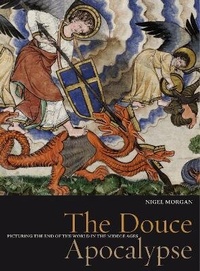
The Douce Apocalypse
Picturing the End of the World in the Middle Ages
Published on 15. November 2005
Book
Hardback
120 pages
978-1-85124-360-0 (ISBN)
Description
The Douce Apocalypse is one of the finest of a series of illustrated copies of the Apocalypse, the Revelation of St. John, made in England between 1250 and 1275. It was made for the prince Edward, later Edward I, and his wife Eleanor of Castile, probably c. 1270. The Apocalypse text, provided with a commentary, is illustrated by exquisite pictures on every page. The pictures illustrate the dramatic events and conflicts narrated in the series of visions of St. John. The dragon and the beast, symbolising the Devil and the Antichrist, are shown in their attempt to dominate the world, eventually to be overcome by Christ and the angels.
This lavishly illustrated book, the second in the series Treasures from the Bodleian Library introduces and explores the royal patronage, Douce Apocalypse, its imagery, its artistic creation and its contemporary significance in the context of prophecies concerning the coming of the Antichrist.
A special aspect of the book, evident in a few of its pictures, is that the artist had only partially completed his drawing, gilding and painting. This gives a fascinating insight into the techniques of medieval illumination. The style of drawing and painting is an English interpretation of contemporary Parisian art, also seen in a closely related work of English panel painting, the Westminster Abbey Retable. The Douce Apocalypse also seems to come from that same milieu of royal patronage at Westminster.
Though no modern book can match the beauty of this great illuminated manuscript, this volume conveys both the beauty of the original and the enduring fascination of its contents.
This lavishly illustrated book, the second in the series Treasures from the Bodleian Library introduces and explores the royal patronage, Douce Apocalypse, its imagery, its artistic creation and its contemporary significance in the context of prophecies concerning the coming of the Antichrist.
A special aspect of the book, evident in a few of its pictures, is that the artist had only partially completed his drawing, gilding and painting. This gives a fascinating insight into the techniques of medieval illumination. The style of drawing and painting is an English interpretation of contemporary Parisian art, also seen in a closely related work of English panel painting, the Westminster Abbey Retable. The Douce Apocalypse also seems to come from that same milieu of royal patronage at Westminster.
Though no modern book can match the beauty of this great illuminated manuscript, this volume conveys both the beauty of the original and the enduring fascination of its contents.
Reviews / Votes
"The volume is beautifully put together, a fine introduction to a Gothic masterpiece and the circumstances of its creation. Highly recommended."-ChoiceMore details
Series
Language
English
Place of publication
United Kingdom
Product notice
sewn/stitched
With printed dust jacket
Illustrations
73 Illustrations, color
Dimensions
Height: 267 mm
Width: 194 mm
Thickness: 18 mm
Weight
778 gr
ISBN-13
978-1-85124-360-0 (9781851243600)
Copyright in bibliographic data and cover images is held by Nielsen Book Services Limited or by the publishers or by their respective licensors: all rights reserved.
Schweitzer Classification
Person
Nigel Morgan was, until his recent retirement, Professor of Medieval Art History at the University of Oslo. He is author of the two volumes Early Gothic Manuscripts 1190-1285 for the Survey of Manuscripts Illuminated in the British Isles, and contributing author of the monographs on the Lambeth, Gulbenkian and Trinity Apocalypses