

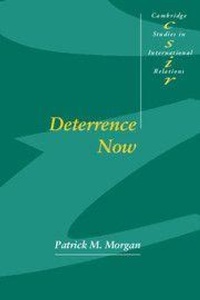
Deterrence Now
Published on 17. April 2003
Book
Hardback
358 pages
978-0-521-82257-2 (ISBN)
Description
Patrick Morgan's authoritative study revisits the place of deterrence after the Cold War. By assessing and questioning the state of modern deterrence theory, particularly under conditions of nuclear proliferation, Morgan argues that there are basic flaws in the design of the theory that ultimately limits its utility. Given the probable patterns of future international politics, he suggests that greater attention be paid to 'general' deterrence as opposed to 'immediate' deterrence and to examining the deterrent capabilities of collective actors such as NATO and the UN Security Council. Finally he contends that the revolution in military affairs can promote less reliance on deterrence by retaliatory threats, support better collective management of peace and security and permit us to outgrow nuclear and other weapons of mass destruction. This new major work builds upon Patrick Morgan's landmark book, Deterrence (1983).
Reviews / Votes
'By helping us to think about deterrence in new ways, Morgan guides us to a better understanding of this crucial part of international relations.' The Journal of European AffairsMore details
Series
Language
English
Place of publication
Cambridge
United Kingdom
Target group
Professional and scholarly
Dimensions
Height: 235 mm
Width: 157 mm
Thickness: 26 mm
Weight
732 gr
ISBN-13
978-0-521-82257-2 (9780521822572)
Copyright in bibliographic data and cover images is held by Nielsen Book Services Limited or by the publishers or by their respective licensors: all rights reserved.
Schweitzer Classification
Other editions
Additional editions
Patrick M. Morgan
Deterrence Now
E-Book
12/2004
1st Edition
Cambridge University Press
€44.49
Available for download
Person
Content
1. History: deterrence in the Cold War; 2. Deterrence and rationality; 3. General deterrence; 4. Testing, testing, one ... two ... three; 5. Collective actor deterrence; 6. The revolution in military affairs and deterrence; 7. Deterrence in the post-Cold War world; 8. Some conclusions.