

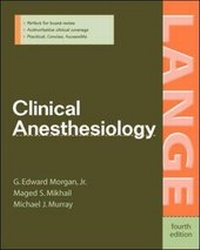
Clinical Anesthesiology
4th Edition
Published on 16. October 2005
Book
Paperback/Softback
1120 pages
978-0-07-142358-8 (ISBN)
Description
Clinical Anesthesiology integrates succinct coverage of basic principles and clinical considerations in the anesthetic management of patients. It features up-to-date discussion of all relevant areas within anesthesiology, including equipment, pharmacology, regional anesthesia, pathophysiology, pain management, anesthetic management, and critical care. Extensive use of case discussions, figures, and tables in each chapter promotes application of the concepts to practice.
More details
Edition
4th edition
Language
English
Place of publication
New York
United States
Publishing group
McGraw-Hill Education - Europe
Target group
College/higher education
Dimensions
Height: 236 mm
Width: 185 mm
Thickness: 39 mm
Weight
1594 gr
ISBN-13
978-0-07-142358-8 (9780071423588)
Copyright in bibliographic data and cover images is held by Nielsen Book Services Limited or by the publishers or by their respective licensors: all rights reserved.
Schweitzer Classification
Persons
G. Edward Morgan, Jr., MD President and Chief Executive Officer Excellence in Medicine, LLC OrthoSource Medical Clinics, Inc. Pasadena, CA
Maged S. Mikhail, MD Attending Anesthesiologist San Fernanco Valley Heart Institute Encino-Tarzana Regional Medical Center Los Angeles, CA
Michael J. Murray, MD, PhD Dean, Mayo School of Health Sciences Professor of Anesthesiology, Mayo Medical School Chair, Department of Anesthesiology Mayo Clinic Jacksonville Jacksonville, FL
Maged S. Mikhail, MD Attending Anesthesiologist San Fernanco Valley Heart Institute Encino-Tarzana Regional Medical Center Los Angeles, CA
Michael J. Murray, MD, PhD Dean, Mayo School of Health Sciences Professor of Anesthesiology, Mayo Medical School Chair, Department of Anesthesiology Mayo Clinic Jacksonville Jacksonville, FL
Content
Clinical Anesthesiology1. The Practice of Anesthesiology I. Anesthesia Equipment & Monitors 2. The Operating Room: Medical Gas Systems, Environmental Factors, & Electrical Safety 3. Breathing Systems 4. The Anesthesia Machine 5. Airway Management 6. Patient Monitors II. Clinical Pharmacology 7. Inhalational Anesthetics 8. Nonvolatile Anesthetic Agents 9. Neuromuscular Blocking Agents 10. Cholinesterase Inhibitors 11. Anticholinergic Drugs 12. Adrenergic Agonists & Antagonists 13. Hypotensive Agents 14. Local Anesthetics 15. Adjuncts to Anesthesia III. Regional Anesthesia & Pain Management 16. Spinal, Epidural, & Caudal Blocks 17. Peripheral Nerve Blocks 18. Pain Management IV. Physiology, Pathophysiology, & Anesthetic Management 19. Cardiovascular Physiology & Anesthesia 20. Anesthesia for Patients with Cardiovascular Disease 21. Anesthesia for Cardiovascular Surgery 22. Respiratory Physiology: The Effects of Anesthesia 23. Anesthesia for Patients with Respiratory Disease 24. Anesthesia for Thoracic Surgery 25. Neurophysiology & Anesthesia 26. Anesthesia for Neurosurgery 27. Anesthesia for Patients with Neurological & Psychiatric Diseases 28. Management of Patients with Fluid & Electrolyte Disturbances 29. Fluid Management & Transfusion 30. Acid--Base Balance 31. Renal Physiology & Anesthesia 32. Anesthesia for Patients with Renal Disease 33. Anesthesia for Genitourinary Surgery 34. Hepatic Physiology & Anesthesia 35. Anesthesia for Patients with Liver Disease 36. Anesthesia for Patients with Endocrine Disease 37. Anesthesia for Patients with Neuromuscular Disease 38. Anesthesia for Ophthalmic Surgery 39. Anesthesia for Otorhinolaryngological Surgery 40. Anesthesia for Orthopedic Surgery 41. Anesthesia for the Trauma Patient 42. Maternal & Fetal Physiology & Anesthesia 43. Obstetric Anesthesia 44. Pediatric Anesthesia 45. Geriatric Anesthesia V. Special Problems 46. Anesthetic Complications 48. Postanesthesia Care 49. Critical Care