

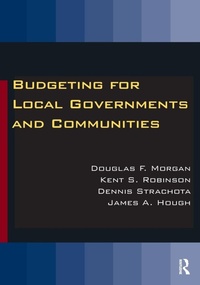
Budgeting for Local Governments and Communities
1st Edition
Published on 30. September 2014
Book
Paperback/Softback
608 pages
978-0-7656-2780-3 (ISBN)
Description
Budgeting for Local Governments and Communities is designed as the primary textbook for a quarter or semester-long course in public budgeting and finance in an MPA programme.
Many currently available texts for this course suffer from a combination of defects that include a focus on federal and state budgeting, a lack of a theoretical governance framework, an omission of important topics, and typically a lack of exercises and datasets for student use. Budgeting for Local Governments and Communities solves all of these problems.
The book is exceptionally comprehensive and well written, and represents the efforts of veteran authors with both teaching and real-world experience.
Key Features:
Special Focus on Local Government Budgeting: focuses exclusively on budgeting at the local levels of American government, which are responsible for spending 40 percent of the taxes collected from citizens.
Integration of Theory and Practice: teaching cases and chapters capture the "lessons learned" by professional practitioners who have extensive experience in making local public budgeting work on the ground.< /li>
Polity Approach to Local Budgeting: presents an introduction to local budgeting as the central political activity that integrates the resources of the community into a unified whole. Budgeting is presented as governance work, rather than as a unique set of skills possessed by analysts and financial specialists.
Legal, Historical, Economic and Moral Foundations of Local Government Budgeting: provides readers with an understanding of how the structures and processes of local budgeting systems are firmly tethered to the underlying core values, legal principles and historical development of the larger American federal, state and local political systems.
Electronic Datasets and Budgeting Exercises: the text includes access to extensive electronic datasets and practice exercises that provide abundant opportunities for students to "learn through doing."
Extensive Glossary and Bibliography: covers terms on the history and practice of local public budgeting.
Many currently available texts for this course suffer from a combination of defects that include a focus on federal and state budgeting, a lack of a theoretical governance framework, an omission of important topics, and typically a lack of exercises and datasets for student use. Budgeting for Local Governments and Communities solves all of these problems.
The book is exceptionally comprehensive and well written, and represents the efforts of veteran authors with both teaching and real-world experience.
Key Features:
Special Focus on Local Government Budgeting: focuses exclusively on budgeting at the local levels of American government, which are responsible for spending 40 percent of the taxes collected from citizens.
Integration of Theory and Practice: teaching cases and chapters capture the "lessons learned" by professional practitioners who have extensive experience in making local public budgeting work on the ground.< /li>
Polity Approach to Local Budgeting: presents an introduction to local budgeting as the central political activity that integrates the resources of the community into a unified whole. Budgeting is presented as governance work, rather than as a unique set of skills possessed by analysts and financial specialists.
Legal, Historical, Economic and Moral Foundations of Local Government Budgeting: provides readers with an understanding of how the structures and processes of local budgeting systems are firmly tethered to the underlying core values, legal principles and historical development of the larger American federal, state and local political systems.
Electronic Datasets and Budgeting Exercises: the text includes access to extensive electronic datasets and practice exercises that provide abundant opportunities for students to "learn through doing."
Extensive Glossary and Bibliography: covers terms on the history and practice of local public budgeting.
Reviews / Votes
"Budgeting for Local Governments and Communities is the textbook for students of local government, public finance, and democratic governance. It is long overdue in the field of public administration, and brings a refreshing and insightful 'polity' perspective, which accounts for the role of governments, nonprofits, and for-profits in the local budgeting process. The text is comprehensive in scope, and rich with illustrative cases and scenarios." -- Richard Green, University of UtahMore details
Language
English
Place of publication
London
United Kingdom
Publishing group
Taylor & Francis Ltd
Target group
College/higher education
Dimensions
Height: 254 mm
Width: 178 mm
Thickness: 33 mm
Weight
1130 gr
ISBN-13
978-0-7656-2780-3 (9780765627803)
Copyright in bibliographic data and cover images is held by Nielsen Book Services Limited or by the publishers or by their respective licensors: all rights reserved.
Schweitzer Classification
Other editions
Additional editions
Douglas Morgan | Kent S. Robinson | Dennis Strachota
Budgeting for Local Governments and Communities
E-Book
09/2017
1st Edition
Routledge
€77.99
Available for download
Douglas Morgan | Kent S. Robinson | Dennis Strachota
Budgeting for Local Governments and Communities
E-Book
09/2017
1st Edition
Routledge
€77.99
Available for download
Douglas Morgan | Kent S. Robinson | Dennis Strachota
Budgeting for Local Governments and Communities
Book
08/2014
1st Edition
Routledge
€230.80
Article not available at the moment
Persons
Douglas F. Morgan, Kent S. Robinson, Dennis Strachota, James A. Hough
Content
Preface and Acknowledgments PART I. GENERAL CONCEPTS OF LOCAL PUBLIC BUDGETING Teaching Case: A Case of Drastically Falling Nonprofit Revenues 1. Local Public Budgeting and the Challenges of Decentralized Governance 2. Local Public Budgeting and Democratic Theory 3. The Multiple Purposes of Public Budgeting 4. Budget Actors: Conflicting Perspectives 5. The Budget Cycle: Characteristics and Consequences PART II. REVENUES AND BUDGETING Teaching Case: Commissioners Request Recommendations on a Public Safety Services Levy 6. Obtaining Governmental Revenues 7. Forecasting Governmental Revenues: Techniques and Limitations 8. Polity Revenues and Governance Decisions 9. Budget Funds Organize the Public Budget 10. Budget Planning: Preparing the Organization and Community to Budget PART III. EXPENDITURE FORMATS FOR DECISION AND CONTROL Teaching Case: A New Mayor Mandates Performance-Based Budgeting 11. Line-Item (Object Code) Budgeting 12. Planning, Programming, Budgeting System (PPBS) Format 13. Performance Budgeting 14. Public-Sector Innovation and Zero-Base Budgeting PART IV. EXECUTIVE PRIORITIES, BUDGET ADOPTION, AND IMPLEMENTATION Teaching Case: Negotiations with City Unions Threaten to Disrupt the Budget Process Teaching Case: County Board Consideration of a Capital Project That Could Jeopardize the County Credit Rating 15. Executive Budget Preparation and Legislative Body Approval 16. Capital Budgeting and Financing 17. Budget Execution 18. Audit and Performance Evaluation 19. Local Budgeting for the Common Good Glossary Bibliography Index About the Authors