

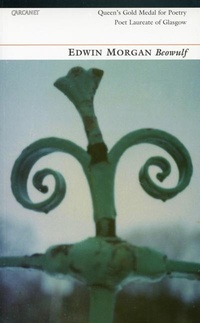
Beowulf
Published on 21. November 2002
Book
Paperback/Softback
128 pages
978-1-85754-588-3 (ISBN)
Description
Edwin Morgan's Beowulf has been a popular standard translation for half a century. His version is a vigorous, spoken English and conveys the heroism, violence and pathos of the first English epic. The poem marks a key moment in Edwin Morgan's development, as he recalls: 'This translation of Beowulf was made in the last years of the 1940s and was published in hardback by the Hand and Flower Press in 1952. In the present Carcanet edition, poem and introduction have been kept the same despite temptations to tinker here and there. The translation which was begun shortly after I came out of the army at the end of the Second World War, was in a sense my unwritten war poem, and I would not want to alter the expression I gave to its themes of conflict and danger, voyaging and displacement, loyalty and loss. Inter arma musae tacent ("In the time of conflict the Muses are silent"), but they are not sleeping.'
Edwin Morgan was a major translator. In 2011 he was awarded the Weidenfeld Translation Prize for his version of Racine, Phaedra. His Carcanet titles include his Collected Translations (1996).
Edwin Morgan was a major translator. In 2011 he was awarded the Weidenfeld Translation Prize for his version of Racine, Phaedra. His Carcanet titles include his Collected Translations (1996).
Reviews / Votes
William Wooten in the London Review of BooksNow in his eighties, Morgan is the most influential Scottish poet since Hugh MacDiarmid.Partly because his prose statements and his poetic praxis lay more stress on what poetry can be than on what it should be, that influence has occasioned remarkably little anxiety in younger poets, such as Robert Crawford, Liz Lochead, WN Herbert, Kathleen Jamie and Jackie Kay, who have learned from him.
...
Reading Morgan's most recent collection, Cathures (the old name for Glasgow), alongside the reissue of his early Beowulf make it clear that he is as much a poet of la mmme chose as the poet of changes.He began his translation of Beowulf in the late 1940s; it was first published in 1952.Recent versions by Seamus Heaney and Michael Alexander might have made the need for the republication of Morgan's less urgent for anyone who just wants to get hold of a good modern Beowulf, but as an early and defining Morgan poem it remains indispensable.First of all, the poem is translation: Morgan has also translated from Russian, German, Spanish, French, Italian, Portuguese, Dutch and ancient Greek, as well as (with a crib) from Khmer, Armenian and Hungarian.He has turned English into Scots and, in his version of Marlowe's Dr. Faustus, turned English into English.In his original work, too, Morgan likes his language foreign.His talent for imitation and pastiche has given rise to passable impersonations of Shelley, Byron, Joyce and MacDiarmid; it has also allowed him to transcribe the sentiments of animals, aliens, walking mummies, monsters and computers.
The attempt to make a strange time and tongue communicate is supremely Morganish behaviour.But Beowulf has a rather more personal significance.In his new preface, Morgan writes: 'The translation, which was begun shortly after I came out of the army at the end of the Second World War, was in a sense my unwritten war poem, and I would not want to alter the expression I gave to its themes of conflict and danger, voyaging and displacement, loyalty and loss.'
Not one of them thought he would ever again
Leave there to find his beloved land,
His folk or his fortress, where he once was bred;
For they knew how sudden death had already
Swept from the wine-hall more than too many
Morgan's later reflections on the war also come at an angle.The poem that most explicitly addresses his wartime experience, the 1970s sequence 'The New Divan', intersperse personal reminiscences with fictions and meditations on the 14th-century Persian poet Hafiz. 'The Demon Goes to Kill Death', in Cathures, describes battlefields where
the sand was fused to glass,
And oil burned screaming along the waves,
And shelled villages were smoking shells
Or hells, though the shellers crowed to heaven.
Morgan has strong feelings of solidarity with the war band, but he's also rather taken with one of its enemies.Grendel is a 'demon', a 'monster' and 'mankind's enemy'; but a 'terrible solitary', he is also almost human: he is an outcast of the race of Cain, which has somehow strayed form the land of nod into the fen.There are moments when it is clear how terribly solitary a terrible solitary can feel.Grendel
Began to suffer bitter sorrow
When day after day he heard the happiness
Of the hall resounding: the harp ringing,
Sweet minstrelsinging
Barred from the officer's mess, it's unsurprising that Grendel doesn't care for its party music, or that he decides to ruin the fun of those inside.
More details
Language
English
Place of publication
Manchester
United Kingdom
Dimensions
Height: 219 mm
Width: 135 mm
Thickness: 10 mm
Weight
186 gr
ISBN-13
978-1-85754-588-3 (9781857545883)
Copyright in bibliographic data and cover images is held by Nielsen Book Services Limited or by the publishers or by their respective licensors: all rights reserved.
Schweitzer Classification
Other editions
Additional editions
Person
Edwin Morgan (1920-2010) was born in Glasgow. He served with the RAMC in the Middle East during World War II. He became lecturer in English at the University of Glasgow, where he had studied, and retired as titular Professor in 1980. He was Glasgow's first Poet Laureate and from 2004 until 2010 served as Scotland's first Makar, or National Poet. He was made an OBE in 1982 and received the Queen's Gold Medal for Poetry in 2000. A Book of Lives (2007) won the Scottish Arts Council Sundial Book of the Year. Carcanet has published most of his work, including his Collected Poems, Collected Translations, plays such as A.D.: A Trilogy of Plays on the Life of Jesus Christ and The Play of Gilgamesh and his translations of Rostand's Cyrano de Bergerac and Racine's Phaedra.
The Edwin Morgan Trust and partners will be celebrating Edwin Morgan's 100th year in 2020 - 2021.Commencing on Edwin Morgan's birthday, April 27, 2020 and continuing until April 2021. For more information on #edwinmorgan100, of their biannual Edwin Morgan Poetry Award and Translation Exchanges please visit their website.
The Edwin Morgan Trust and partners will be celebrating Edwin Morgan's 100th year in 2020 - 2021.Commencing on Edwin Morgan's birthday, April 27, 2020 and continuing until April 2021. For more information on #edwinmorgan100, of their biannual Edwin Morgan Poetry Award and Translation Exchanges please visit their website.