

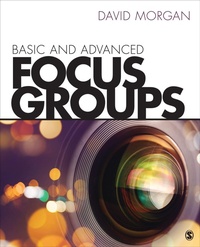
Basic and Advanced Focus Groups
1st Edition
Published on 13. September 2018
Book
Paperback/Softback
216 pages
978-1-5063-2711-2 (ISBN)
Description
Basic and Advanced Focus Groups illustrates both the different types of focus groups and how to decide among those options in order to produce the most effective focus groups possible. A variety of approaches to doing research with focus groups gives readers the tools to develop and examine their research designs, starting with the basics. Advanced coverage in each chapter takes an in-depth look at topics such as moderating focus groups, using mixed methods, and working with different sizes of groups. By taking a practical, applied approach, the author gives even novice students the knowledge and confidence to design and conduct effective focus group research, while simultaneously providing more advanced researchers with the tools and knowledge to refine their current practices.
Reviews / Votes
"This is great tool for their students or themselves if they want to use focus groups as a research approach. There is a lot of value for the price of this text." -- Kyle M. Woosnam "This introductory text provides students with a solid understanding of principles, methods, and contributions of focus group methodology. It provides good coverage of the topic and essential components for consideration in using focus groups. Morgan is among the most well-known experts on focus group research; this current volume reflects how his insight and own research have evolved over the years to show how the field has changed." -- Christina Harnett "This book provides accessible, practical information that is targeted toward an audience unfamiliar with the logistics of conducting focus groups." -- Sally O. Hastings "The chapters contain enough depth for the text to serve as a one-stop shop for designing and using a focus group methodology." -- Michael A. Guerra "Overall, the book is written in a language that is easy to understand (despite the topics the book is covering) for undergraduate students who may not be interested in research methods and have taken it as a required course in their curriculum." -- Kenneth C. Yang "I was pleasantly surprised at how useful the appendices are. Each of them provides information that will help a researcher. Including transcribed text is good because new researchers may not have been exposed to this type of data. In addition, the interview guides are useful tools and can be used in other forms of research as well." -- Patricia A. PoteatMore details
Language
English
Place of publication
Thousand Oaks
United States
Target group
College/higher education
Dimensions
Height: 231 mm
Width: 189 mm
Thickness: 12 mm
Weight
406 gr
ISBN-13
978-1-5063-2711-2 (9781506327112)
Copyright in bibliographic data and cover images is held by Nielsen Book Services Limited or by the publishers or by their respective licensors: all rights reserved.
Schweitzer Classification
Person
David L. Morgan received his PhD in sociology from the University of Michigan, and is currently an emeritus professor in the Department of Sociology at Portland State University. He is an inter-disciplinary research methodologist, working in both qualitative research and mixed methods research. In addition to artificial intelligence, his research interests include focus groups and mixed methods research. He is the author of more than fifty peer-reviewed articles and author or editor of nine books on research methods; he is currently the series editor for the Qualitative Research Methods Series from Sage (the "little blue books").
Content
Preface
About the Author
PART I. BASIC ISSUES
Chapter 1. Introducing Focus Groups
Basic Issues
Advanced Topics
Chapter 2. Uses for Focus Groups
Basic Issues
Advanced Topics
Chapter 3. The Importance of Interaction
Basic Issues
Advanced Topics
PART II. DESIGNING FOCUS GROUPS
Chapter 4. Research Design for Focus Groups
Basic Issues
Advanced Topics
Chapter 5. Group Composition, Group Size, and Number of Groups
Basic Issues
Advanced Topics
Chapter 6. Asking Questions in Focus Groups
Basic Issues
Advanced Topics
Chapter 7. Moderating the Discussion
Basic Issues
Advanced Topics
Chapter 8. Analyzing Focus Groups
Basic Issues
Advanced Topics
PART III. ADVANCED TOPICS AND CONCLUSIONS
Chapter 9. Working Cross-Culturally
Basic Issues
Chapter 10. Specialized Age Groups
Basic Issues
Chapter 11. Online Focus Groups
Basic Issues
Chapter 12. Conclusions: Future Directions for Focus Groups
Basic Issues
APPENDICES
Appendix 1
Statement of Informed Consent
Appendix 2
Generic Focus Group Introduction
Appendix 3
Three Examples of Interview Guides
Appendix 4
Experiences as Graduate Students
Glossary
References
Index
About the Author
PART I. BASIC ISSUES
Chapter 1. Introducing Focus Groups
Basic Issues
Advanced Topics
Chapter 2. Uses for Focus Groups
Basic Issues
Advanced Topics
Chapter 3. The Importance of Interaction
Basic Issues
Advanced Topics
PART II. DESIGNING FOCUS GROUPS
Chapter 4. Research Design for Focus Groups
Basic Issues
Advanced Topics
Chapter 5. Group Composition, Group Size, and Number of Groups
Basic Issues
Advanced Topics
Chapter 6. Asking Questions in Focus Groups
Basic Issues
Advanced Topics
Chapter 7. Moderating the Discussion
Basic Issues
Advanced Topics
Chapter 8. Analyzing Focus Groups
Basic Issues
Advanced Topics
PART III. ADVANCED TOPICS AND CONCLUSIONS
Chapter 9. Working Cross-Culturally
Basic Issues
Chapter 10. Specialized Age Groups
Basic Issues
Chapter 11. Online Focus Groups
Basic Issues
Chapter 12. Conclusions: Future Directions for Focus Groups
Basic Issues
APPENDICES
Appendix 1
Statement of Informed Consent
Appendix 2
Generic Focus Group Introduction
Appendix 3
Three Examples of Interview Guides
Appendix 4
Experiences as Graduate Students
Glossary
References
Index