

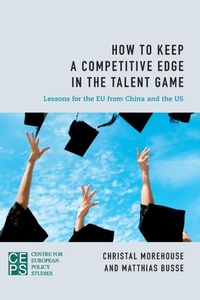
How to Keep a Competitive Edge in the Talent Game
Lessons for the EU from China and the US
Published on 30. October 2014
Book
Paperback/Softback
104 pages
978-1-78348-298-6 (ISBN)
Description
BY 2020, the global map of higher education will be completely redrawn, and by 2030, China is expected to emerge as the world's largest source of brainpower. The European Union should not necessarily view this development as a threat, but rather it can be seen as an opportunity for the EU to become more competitive in attracting foreign human capital. The quality of human capital in the form of university graduates is well-developed in the EU, although there remain stark differences between the member states. EU universities have not managed to penetrate the premium university rankings, with the exception of those in the UK, but their overall performance is comparatively high.
This book compares tertiary education in the European Union, the United States and China with the aim of evaluating how the EU as a region fares with respect to the US and China, how to improve higher education in the EU and how to secure its stock of human capital. In the process, we identify a number of game-changing factors that affect higher education. These notably include how digital technology is integrated into education, how education relates to employment and how university institutions are governed. Viewed intra-regionally, Europe is making progress in developing its talent pipeline. But if we take a step back and compare the performance of higher education in the EU with that of the US and China -- and how it is likely to perform in the future -- there are important lessons to be learned that will allow Europe to sustain prosperity and growth and secure its long-term well-being and quality of life.
This book compares tertiary education in the European Union, the United States and China with the aim of evaluating how the EU as a region fares with respect to the US and China, how to improve higher education in the EU and how to secure its stock of human capital. In the process, we identify a number of game-changing factors that affect higher education. These notably include how digital technology is integrated into education, how education relates to employment and how university institutions are governed. Viewed intra-regionally, Europe is making progress in developing its talent pipeline. But if we take a step back and compare the performance of higher education in the EU with that of the US and China -- and how it is likely to perform in the future -- there are important lessons to be learned that will allow Europe to sustain prosperity and growth and secure its long-term well-being and quality of life.
More details
Language
English
Place of publication
United States
Publishing group
Bloomsbury Publishing Plc
Target group
Professional and scholarly
US School Grade: From College Senior to College Graduate Student
Illustrations
2 tables; 16 graphs
Dimensions
Height: 229 mm
Width: 152 mm
Thickness: 6 mm
Weight
167 gr
ISBN-13
978-1-78348-298-6 (9781783482986)
Copyright in bibliographic data and cover images is held by Nielsen Book Services Limited or by the publishers or by their respective licensors: all rights reserved.
Schweitzer Classification
Other editions
Additional editions
Christal Morehouse | Matthias Busse
How to Keep a Competitive Edge in the Talent Game
Lessons for the Eu from China and the Us
E-Book
10/2014
1st Edition
Center for European Policy Studies
€26.99
Available for download
Christal Morehouse | Matthias Busse
How to Keep a Competitive Edge in the Talent Game
Lessons for the Eu from China and the Us
E-Book
10/2014
1st Edition
Center for European Policy Studies
€26.99
Available for download
Persons
Christal Morehouse is a Senior Project Manager in the Centre for International Affairs of the Bertelsmann Stiftung, where she was previously responsible for managing its migration and international programmes at the European and transatlantic level.
Matthias Busse is a researcher in Economic Policy at the Centre for European Policy Studies in Brussels.
Matthias Busse is a researcher in Economic Policy at the Centre for European Policy Studies in Brussels.
Content
Foreword by Daniel Gros, Director of CEPS
Preface
Executive Summary
1. Introduction
2. Comparative performance of the EU, the US and China in higher education
3. Private and public funding of higher education in the EU, the US and China
4. Game-changing factors in innovating higher education
5. Policy recommendations for the EU: Learning from China and the US
References
Annex. Members of the CEPS Task Force and invited Speakers
Index
Preface
Executive Summary
1. Introduction
2. Comparative performance of the EU, the US and China in higher education
3. Private and public funding of higher education in the EU, the US and China
4. Game-changing factors in innovating higher education
5. Policy recommendations for the EU: Learning from China and the US
References
Annex. Members of the CEPS Task Force and invited Speakers
Index